

Halo, semuanya? Apa kabar? This time, we are going to talk about the meaning of [aku] in Indonesian. As always, we are also going to be watching examples from movies, YouTube videos, and whatnot, where Indonesians use this word.
Aku In Bahasa Indonesia
[Aku] is informal for [saya] = I. You will hear [aku] used in informal settings, like in daily conversations. You use [aku] with [kamu], whereas [kamu] is informal for [Anda] = you.
When Do You Use Aku?
If you’re close enough to someone, you can use this word. But if you’re new with that person, I think it’s safer if you use [saya] instead of [aku]. If you feel that you’re close enough to that person, you can switch from [saya] to [aku], as simple as that.
In Jakarta, another informal word that is used a lot is [gue]. It is more common to use [gue] than to use [aku] in Jakarta. In fact, from what I’ve seen in my daily life in Jakarta, [aku] is used by women a lot more than by men. But only in Jakarta.
Men in Jakarta usually use the word [gue] instead of [aku] for the informal word [saya]. But, once again, it’s only in Jakarta. Outside of Jakarta, [aku] is used by men and women as the informal word [saya] in daily conversation.
Also, you will hear couples using the words [aku] and [kamu] when talking to each other. If they’re not a couple, they usually use [gue] and [loe]. This happens in Jakarta and its surrounding cities like Depok, Tangerang, Bekasi, and Bogor.
How to Pronounce Aku
Here is how you pronounce [aku] in bahasa Indonesia.
Next, let’s watch clips where the word [aku] is spoken by Indonesians.
Examples of Aku In Use
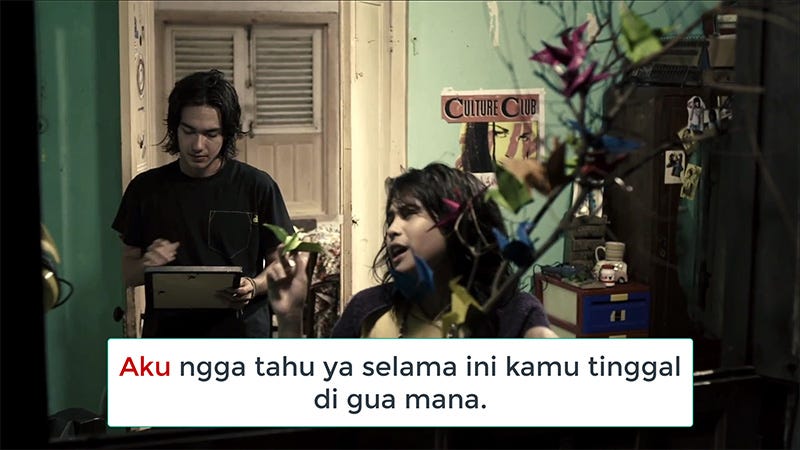
The first clip we are about to watch is taken from Perahu Kertas 1 (2012). Let’s watch the clip.
Keenan: Berarti kamu berubah jadi orang lain dulu baru balik lagi jadi diri kamu lagi. Gitu? (So, it means first, you become another person, and then you come back and become you again. Is that what you are trying to say?)
Kugy: Aku ngga tahu ya selama ini kamu tinggal di goa mana. Tapi cita-cita jadi pendongeng itu ngga realistis. Dikit banget yang bisa survive cuma nulis doang. (I have no idea where you have lived all this time. But becoming a writer is really not a realistic dream. Only a few can survive as writers.)
Keenan and Kugy are friends, so they use [aku] and [kamu] instead of [saya] and [Anda] when speaking. It’s weird to use [saya] and [Anda] when you speak to your friends because [saya] and [Anda] are so formal.
Vocabulary From the Clip
[Berarti] is used when you arrive at a judgment or opinion by reasoning, and then you start to make a point.
[Kamu] = you.
[Berubah] = change.
[Goa] = cave.
[Pendongeng] = a person who tells stories.
[Dikit] is short for [sedikit] = a few, a little.
[Nulis] is short for [menulis] = to write.
[Doang] = just.
The second clip is taken from a movie on BRI's YouTube channel called Pakai Hati, Season 2, Episode 1 (2020). Let's watch the clip.
There are two characters in this clip: a man named Bagas, who is from Jakarta, and a woman named Indah, who is from Jogja. In Jogja, they never use [gue] and [loe]. For the informal version of [saya], they use [aku]. In Jakarta, most men use [gue] instead of [aku] in daily conversation.
Below is the conversation from the clip with English translations.
Indah: Halo, mas. Mas Bagas, ya? (Hello. You are Bagas, right?)
Bagas: Iya. (Yes, I am.)
Indah: Halo, saya Indah. Mantri BRI unit Sewon. Kebetulan saya ditugaskan kantor cabang untuk nemenin mas Bagas di sini. (Hello, I’m Indah. I’m a banking associate of the BRI unit Sewon. I was assigned by the branch office to accompany you in this city.)
Bagas: Iya, panggil Bagas aja. Ngga usah pake mas. (Just call me Bagas. You don’t need to use mas.)
Indah: Oh gitu? Oke. Oke, Bagas. (Is that so? Okay then. Okay, Bagas.)
Bagas: Sekarang? Yuk! (Now? Let’s go!)
Indah: Ke pak Dimas langsung? (Are we’re gonna go to Mr. Dimas right away?)
Bagas: Eh, kita keliling-keliling dulu aja kali ya? Ngelihat pengrajin setempat. (How about if we take a look around first? I want to see the local craftsmen here.)
Indah: Oh. (Okay.)
Bagas: Masih ada waktu, kan? (We still have time for it, right?)
Indah: Masih bisa sih, mas. Tapi naik motor, ngga papa? (Yes, I think so. Is it okay with you if we go by motorcycle?)
Bagas: Ngga papa. (It’s okay.)
Indah: Biar saya aja yang bonceng ya, mas? (Let me ride the motorcycle.)
Bagas: Eh, jangan! Gue aja. (No, no, no! Let me!)
Indah: Hah? Ngga papa? (What? Is it okay with you?)
Bagas: Ngga papa lah. Gue aja yang bawa. Yah? (Yeah, it’s okay with me. Let me ride the motorcycle.)
Indah: Oh gitu? Ini mas helmnya. (Is that so? Here’s your helmet.)
Bagas: Iya. (Okay.)
Indah: Bu, mari ya. (Ma’am, I’m leaving.)
Ibu: Iya. (Okay.)
Indah: Monggo. (I’m off.)
Ibu: Enggih. Makasih. (Okay. Thank you.)
Bagas: Loe udah kaya orang sini, ya? (You’re just like a local.)
Indah: Ngga juga sih, mas. Ibuku yang asli Jogja. Almarhum bapak yang asli Jepara. Makanya aku apal banget lah tentang industri kayu. (Not really, actually. My mom was from this place, Jogja. My late father was from Jepara. That’s why I know a lot about the wood industry.)
As you can see, Indah first used the formal word [saya], and then when Bagas started using [gue], Indah switched from using [saya] to using [aku]. She didn’t use [gue] like Bagas did because she was from Jogja, and in Jogja, as far as I know, they never use [gue] or [loe] in their daily conversation.
Bagas here did not use the word [aku] but [gue] instead because, as I’ve said to you, [aku] is commonly used by women in Jakarta (and only in Jakarta) and not by men. This comes from my observation because I’ve lived in Jakarta for almost 30 years.
From what I’ve seen in Jakarta, [aku] is used mostly by women, men who act like women, or people outside Jakarta. But if a man talks to a woman and then the woman uses [aku] and [kamu], then usually the man will follow using the words [aku] and [kamu].
Also, a couple in love uses [aku] [kamu] when talking to each other. This [aku] thingy, mostly used by women, only happens in Jakarta, not in different cities.
You can also see this in this clip, which I embedded below. Watch at minute 3:00, when the woman starts talking. She uses the word [aku] instead of [gue] or [saya].
Watch minute 4:23. When the host (Desta) asks the guest, who is a man, he uses the words [gue] and [loe] instead of [aku] and [kamu]. The guest (Andika) also uses the word [gue] instead of [aku] in minute 5:05. Once again, this is only applied in Jakarta.
Vocabulary From the Clip
[Mas] is an honorific title; in this context, it is used to address someone whom Indah has just met. Indah uses the honorific title [mas] to Bagas just to be polite. As you can see, Bagas then says she doesn’t have to use the honorific title [mas] when she addresses him.
[Ngga papa] is short for [ngga apa-apa] = it’s okay.
[Ngeliat] is the colloquial way of saying [melihat] = to see.
[Monggo] comes from the Javanese language. [Monggo] in Indonesian means [silakan] = go ahead.
[Enggih] also comes from the Javanese language. It means yes.
[Makasih] is short for [terima kasih].
[Udah] is short for [sudah].
The third clip is taken from a movie on Airwalk Indonesia's YouTube channel - Airwalk Indonesia Web Series, Episode 1 (2019). Let's watch the clip.
In this clip, the two of them don’t know each other’s names. They just met. Actually, the woman who happened to have a cafe watched the man outside her cafe. At that moment, he was drawing something. Then, the woman brought tea to him and gave him tea. And just like that, they knew each other, but they still didn’t know each other’s names.
Below is the conversation from the clip with English translations.
Dira: Ya udah. Aku duluan ya. Aku ke arah sana. (Okay. I’m off. I’m headed this way.)
Adinata: Gua ke sana. (Me, that way.)
Dira: Dah. (Bye.)
Adinata: Aa, eit! Tunggu, tunggu, tunggu, tunggu. (Hey! Wait up.)
Dira: Ini kafe aku? (Is this my cafe?)
Adinata: Gua punya kebiasaan kalo kek ada momen sama tempat yang menarik gua langsung fast sketch. Itu hasilnya. (I have a habit. When I find an interesting moment or a fascinating place, I would make a rough sketch. And here it is.)
Dira: Aku juga gitu sih biasanya. (So do I.)
As you can see from the clip, the woman uses the word [aku], whereas the man uses the word [gua]. About [gua] and [gue], you don’t need to be too precise because sometimes people write [gue] where actually, what you hear is he says [gua] instead of [gue]. So, it’s all the same [gue] and [gua]. I usually prefer to write it down as [gue], but when I speak, I say it [gua].
Vocabulary From the Clip
[Ya udah] is usually used when you are ending a conversation.
[Duluan ya] is used when you are about to part with someone that day.
[Tunggu] = wait.
[Kebiasaan] = habit.
[Ada] = there is. [Ada] in a literal meaning means something that exists.
[Kalo] is the colloquial way of saying [kalau] = if.
[Kek] = [kaya] = like.
If you found this article helpful and would like to support my work, you can buy me a coffee. Thank you for your support!
That’s gonna be it for now. If you have any questions, feel free to leave them in the comments below. Thank you for reading my article, and I’ll see you soon.