

Halo semuanya. Apa kabar? Ketemu lagi sama saya, Iman Prabawa. This time, I want to talk about the meaning of the word [amsyong]. This word is considered a slang term, and as always, we will watch scenes from movies where the word [amsyong] is spoken.
Meaning of Amsyong
[Amsyong] is considered [bahasa gaul] or a slang term. When you say amsyong, it means that you are so unlucky. Something bad has happened to you. Or something that is not good for you.
How to Pronounce Amsyong
Here is how you pronounce [amsyong] in bahasa Indonesia.
Next, let’s watch examples, mostly from movies where the word [amsyong] is used by Indonesians.
Examples of Amsyong In Use
Here are some examples to help you understand how Indonesians use this word.
The first example we are about to watch is from a movie called Filosofi Kopi (2015). Let’s watch the scene below.
Conversation from the clip with English translations.
Cici: Ya tabung kek 200 jutanya. Lu pake jalan-jalan kek. Lu kan ngga harus usaha. Ngga harus dagang. Kerjalah sama orang sekali-sekali. (Just save the 200 million. Use it to travel or something. You don’t have to run a business. You don’t have to sell stuff. Try working for someone for once.)
Jody: Amsyong banget dah punya bapak! Utangnya ama toko kelontong, gedean utangnya! (I’m so damn unlucky to have a dad like him! His debts are bigger than that tiny store of his!)
Cici: Eh, ati-ati ya ngomongin bapak lu ya! Lu tau ngga kenapa bapak lu bisa punya utang segitu banyak? Buat ngebelain elu. Buat ngidupin elu. Lu pikir sekolah lu murah, ya? (Hey! Watch your mouth when you talk about Dad! Do you even know why he got into that much debt? It was for you! To support you! You think your school was cheap?!)
Let’s hear again the part where Jody says the word [amsyong].
Jody: Amsyong banget dah punya bapak! (I’m so damn unlucky to have a dad like him!)
Vocabulary From the Clip
[Kek] here doesn’t have meaning. Its function is just to emphasize.
[Pake] is the colloquial way of saying [pakai] = to use.
[Lu] and [elu] are informal for [Anda] = you.
[Usaha] = to try, but in this context, [usaha] means doing business.
[Dagang] = to sell something. In this context, [dagang] has the same meaning as [usaha].
[Kerja] = to work.
[Sekali-sekali] = once in a while.
[Banget] = [sekali] = very.
[Dah] in [amsyong banget dah punya bapak!] has no meaning. It’s just a filler word to express emotion.
[Utang] = [hutang] = debt.
[Ama] is the colloquial way of saying [sama] = with. [Ama] is used mostly in conversational Indonesian.
[Toko kelontong] = grocery store.
[Gedean] = bigger than.
[Ati-ati] is the colloquial way of saying [hati-hati] = to be careful of something, but in this context, Cici reminds him that Jody should watch for the words he just said. She doesn’t like Jody complaining about his own father. You will hear [ati-ati] usually in conversational Indonesian.
[Ngebelain] is the colloquial way of saying [membela], which means to defend someone, but in this context, it means to support someone.
[Ngidupin] is the colloquial way of saying [menghidupi = me+hidup+i] = to support the life of someone by giving them money.
[Pikir] = to think.
[Murah] = cheap.
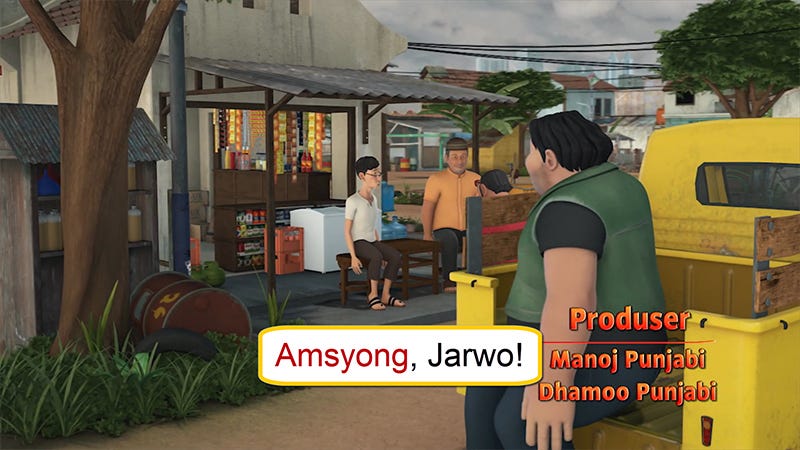
The second example is taken from Adit & Sopo Jarwo (2022), an Indonesian animated movie. Let’s watch the clip below.
Conversation from the clip with English translations.
Baba Chang: Owe, udah ga bisa lagi kasih lu orang toleransi, Jarwo. Udah terlalu sering lu orang bikin owe punya bisnis jadi kacau. Amsyong, Jarwo! (I can’t tolerate this anymore, Jarwo. You’ve messed up my business too many times. This is a complete mess!)
Jarwo: Iya, Ba, iya. Ee, saya.. anu.. minta maap, Ba. (Yes, Ba… I… I’m really sorry.)
Baba Chang: Urusan maap, pasti owe maapin, Wo. Tapi owe udah ga bisa lagi nerima lu orang kerja sama owe. (Sure, I forgive you, Wo. But I can’t let you work for me anymore.)
In this scene, Baba Chang is having a lot of trouble with his business because of Jarwo. That’s why he says, “Amsyong, Jarwo!” meaning it’s bad for his business.
Let’s hear again the part where Baba Chang says the word [amsyong].
Baba Chang: Amsyong, Jarwo! (This is a disaster, Jarwo!)
Vocabulary From the Clip
[Owe] means [I], usually used by older Chinese Indonesians when they speak.
[Udah] is short for [sudah] = already.
[Ga] = [enggak] = [engga] = [ngga] = no.
[Lu orang] is usually used by Chinese Indonesians, which means the same as [lu], but they usually add the word [orang]. [Lu orang] means you, used only in an informal situation.
[Terlalu sering] = too often.
[Ee] and [anu] are just filler words. They don’t have meaning. It is usually used as filler words when speaking. But sometimes [anu] can mean [that].
[Maap] is the casual way of saying [maaf]. When speaking, some people in Indonesia, as you can see from the scene, pronounce [maap] instead of [maaf]. Those two words, [maap] and [maaf], have the same meaning: sorry.
[Nerima] is short for [menerima] = to accept. As in this scene, Indonesian people tend to drop syllables in daily conversation.
The third example is taken from a movie called Teka Teki Tika (2021). Let's watch the clip below.
Conversation from the clip with English translations.
Arnold: Tapi emangnya networking harus begitu banget? (Does networking really have to be like that?)
Andre: Ya, ngga harus. Tapi kan gua nyesuaiin ama kliennya. Itu bupati doyannya party. Gimana dong? Kan ga semua orang hidupnya boring kek elu. (It doesn’t. I’m just adjusting to the client. The regent loves to party. What do you want me to do? Not everyone lives a boring life like you, man.)
Arnold: Wah! (Oh, come on!)
Their Father: An, jangan begitu. (An, that’s enough.)
Arnold: Dengerin ya! Jaman tu lagi susah. Harusnya pengeluaran juga dihemat. Kalo tiap hari main golf, buka botol di hotel bintang lima. Menurut lu, amsyong ngga? (No, you listen! Times are tough right now. We need to cut back on expenses. If you’re playing golf and popping bottles at five-star hotels every single day, don’t you think that’s reckless?)
Andre: Trus lu mau gua ngelobinya pake apa? Main bulu tangkis? Makan di warteg? Ini bupati, boy! Bukan pak RW. (Oh, so how do you expect me to lobby him? Play badminton? Grab lunch at some hole-in-the-wall? This is the regent we’re talking about, bro — not some local council guy.)
Their Mother: Cukup! (Enough!)
In this scene, Arnold gets into an argument with his brother over Andre’s spending. He says that if Andre keeps doing it, it’s going to hurt their business.
Arnold says, “Menurut lu, amsyong ngga?”
It means that if Andre keeps lobbying the regent that way — spending that much money on him — it’s going to hurt their business in the long run.
Let’s hear again the part where Arnold says the word [amsyong].
Arnold: Menurut lu, amsyong ngga? (Don’t you think that’s reckless?)
Vocabulary From the Clip
[Emangnya] is a common reduction for [memangnya]. [Memangnya] is a word that you use when you start questioning something.
[Harus begitu banget?] is used when you are questioning what someone did that you think is excessive and not really necessary. [Harus begitu banget?] = Do you really have to do that?
[Gua] is informal for [saya] = I. [Gua] is used between friends, and you will hear it a lot being spoken in Jakarta and its surrounding cities like Bogor, Depok, Tangerang, and Bekasi.
[Nyesuaiin] is what we say in conversational Indonesian for [menyesuaikan] = adapting.
[Doyan] = [suka] = like.
[Kek] = [kaya] = [seperti] = like.
[Dengerin ya] is said when you want someone to listen to you.
[Tu] is a common reduction for [itu] = that.
[Pengeluaran] = expenditure.
[Buka botol] literally means open a bottle, but in this context, [buka botol] means that you drink a fancy drink in a 5-star hotel.
[Warteg] stands for WARung TEGal. [Warung] means small shop, but in this context, it means small restaurant. [Tegal] is the name of a city in Central Java. Why is it called Warung Tegal? Usually, the people who run that small restaurant are people from Tegal.
[RW] stands for Rukun Warga. It’s a division of a region in Indonesia.
[Pake] is what we say in conversational Indonesian for [pakai] = to use.
[Dihemat] comes from the word [hemat], which means frugal.
The fourth example is taken from Marcel's YouTube channel. Let's watch the clip below.
Conversation from the clip with English translations.
Marcel: Nah, di video ini gue mau menantang nih. Abang-abang di sini kan badannya gede-gede nih. Harusnya berani nih. Ya, kan? (Alright, in this video, I wanna throw you guys a challenge. You guys are big dudes. You should be brave enough for this, right?)
Theodorus Ginting: Bisa aja loe, Cel, Cel. Ah! (Oh, come on, Cel!)
Fajar Ibel: Dia yang lebih gede, dia. (He’s bigger than me! Him, not me!)
Marcel: Jadi, tantangannya adalah kita akan bermain Russian roulette, bang. (So, the challenge is… we’re gonna play Russian roulette, bro.)
Theodorus Ginting: Waduh, lagi-lagi Russian roulette. (Oh man, Russian roulette again?)
Marcel: Pernah tahu, ya? (You’ve heard of it, right?)
Theodorus Ginting: Tahu, gue. Pokoknya yang apes, amsyong. Udah gitu aja. (Yeah, I know it. Basically, whoever’s unlucky is screwed. That’s it.)
Fajar Ibel: Iya, Russian roulette yang kaya tembakan-tembakan gitu, kan? (Yeah, Russian roulette… that thing with the gun and all that, right?)
Marcel: Iya, iya, betul, betul. (Yeah, yeah, exactly.)
Theodorus Ginting: Satu peluru diputer, tek, siapa yang kena, dia yang sial. (You load one bullet, spin the cylinder, click… whoever gets it is dead.)
Let’s hear again the part where Theodorus Ginting says the word [amsyong].
Theodorus Ginting: Pokoknya yang apes, amsyong. (Basically, whoever’s unlucky is screwed.)
Basically, [apes] and [amsyong] have similar meanings. [Apes] just means “unlucky,” but [amsyong] feels stronger — like really unlucky, or seriously screwed.
Vocabulary From the Clip
[Menantang] = to challenge.
[Abang] is an honorific used to address someone older than you.
[Badan] = body.
[Gede] = [besar] = big.
[Gede-gede] is the plural form of [gede].
[Harusnya] is a common reduction for [seharusnya] = should.
[Bisa aja loe] or [bisa aja] is something you say when someone gives you a compliment.
[Tahu] here means “to know,” not tofu.
[Lagi-lagi…] is used when something keeps happening repeatedly, or when something happens again.
[Diputer] is the informal form of [diputar], which means “spun.”
[Tek] here is just him mimicking the sound of the revolver when it stops spinning.
[Siapa yang kena] = the ones who get hit. <--- [siapa] in this phrase refers to someone.
If you found this article helpful and would like to support my work, you can buy me a coffee. Thank you for your support!
That wraps up this article. If you have any questions, feel free to leave them in the comments below. Thank you very much!