

Halo semuanya, ketemu lagi sama saya, Iman Prabawa. In this article, I want to talk to you about the meaning of the word [banget] in Indonesian. As always, we will also watch examples from movies where the word [banget] is spoken by Indonesians to better understand the meaning and how to use this word.
Meaning of Banget
[Banget] is informal for [sekali], which means very much so. [Banget] can also be used to emphasize the exact identity of a particular person or thing.
Let’s look at these three sentences below to better understand the word [banget].
Example sentence number one.
1. Nasi goreng ini enak banget deh! (This nasi goreng is so delicious!)
If I turn this sentence into a formal one, it will become [nasi goreng ini enak sekali!]
Example sentence number two.
2. Cewe itu tinggi banget. (That woman is very tall.)
[Banget] in these two sentences means very.
Example sentence number three.
3. Harus hari ini banget ya kita perginya? (Do we have to go this very day?)
[Banget] in the third sentence is used to emphasize the word [hari ini (today)].
How to Pronounce Banget
This is how you pronounce the word [banget] in bahasa Indonesia.
Next, we will watch examples from movies to better understand how Indonesians use the word [banget] in their everyday lives.
Examples of Banget In Use
The first clip we are about to watch is from Surga Belok Kanan, Episode 11 (2023). Let’s watch the clip below.
Conversation from the clip with English translations.
Sakti: By the way, si Gagah mana ya? (By the way, where is Gagah?)
Abud: Gagah? Ngga tau. Gue dari tadi ngga ngeliatin nih dia. Gue kan fokus sama nasi gorengnya teh Siti doang. Enak banget ini! (Gagah? I don’t know. I have yet to see him around. My focus was just on this Siti’s nasi goreng that she made for me. So delicious!)
[Banget] in this scene means [very], and it is common to hear Indonesians say the word [banget] instead of [sekali] in conversational Indonesian.
Vocabulary From the Clip
[Gagah mana ya?] is a phrase used by Sakti because he was looking for his friend, Gagah. You can use this phrase if you are looking for someone in Indonesian. Gagah is the name of a person.
[Ngga tau] or [ngga tahu] means I don’t know.
[Gue] is informal for [saya] = I. For more about this, you can read my article here:
Gue In Indonesian

Halo semuanya. Apa kabar? Ketemu lagi sama saya, Iman Prabawa. Today, we’re going to talk about what [gue] means in Indonesian. As always, I’ll show you some examples from movies, YouTube videos, comics, and other real-life situations where Indonesians use this word.
[Gue dari tadi ngga ngeliatin nih dia] is the way Abud says it. For a more proper sentence, you can say, “Gue dari tadi ngga ngeliat dia,” and if I turn it into a more formal sentence, it will become, “Saya dari tadi tidak melihat dia.”
[Ngeliat] is the conversational way of saying [melihat] = to see.
[Ngeliatin] is the conversational way of saying [melihati] = to see something or someone repeatedly.
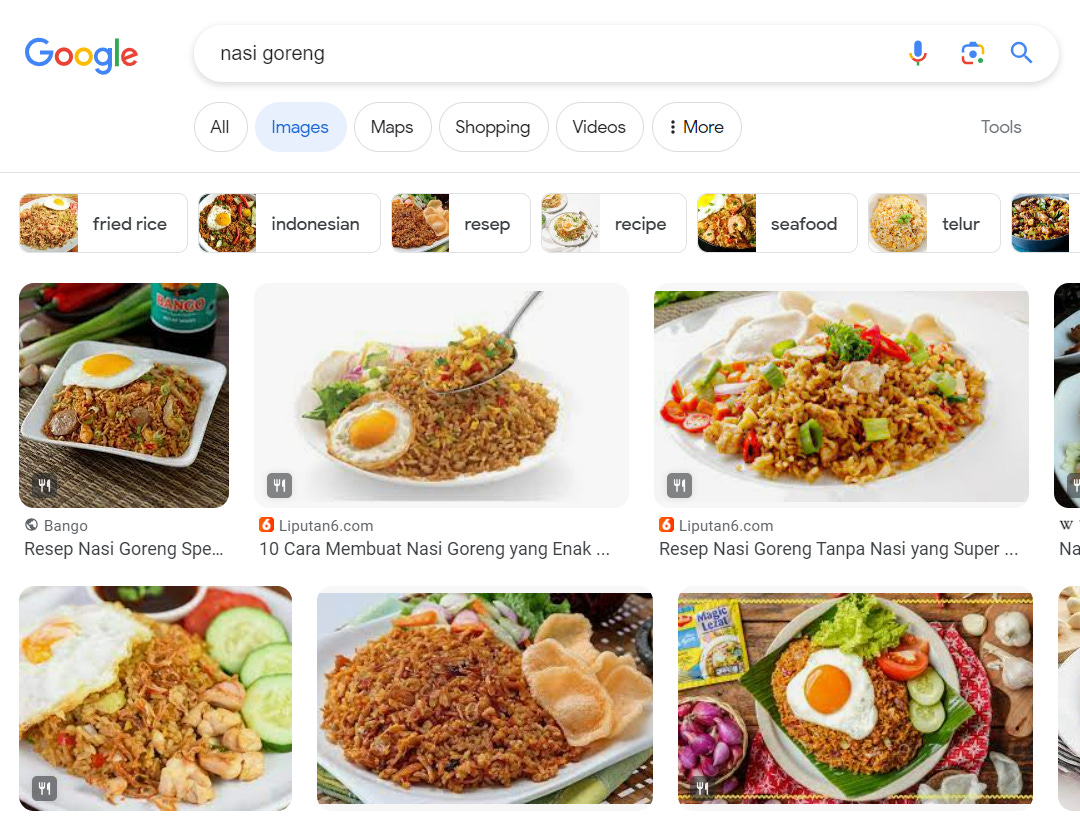
[Nasi goreng] is one of the Indonesian dishes.
[Teh Siti] <--- the word [teh] here is short for [teteh]. [Teteh] comes from the Sundanese language. It is an honorific title to address a female person older than you, or if you just want to be more polite to her. In this case, Abud says the name Siti with the honorific title [teh] is just to give respect to her.
The second clip we are about to watch is from Suami-suami Masa Kini, Season 2, Episode 6 (2023). Let’s watch the clip below.
Conversation from the clip with English translations.
Tania: Elu ciuman sama Tobi? (You kissed Tobi?)
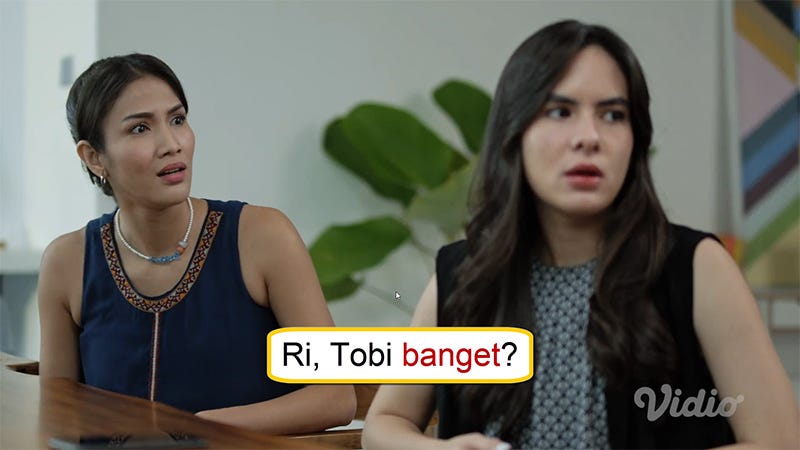
Rumi: Ri, Tobi banget? (Ri, that very Tobi?)
Indri: Ya, iya, Tobi. (Yeah, Tobi.)
In this scene, Rumi says [Tobi banget?] to emphasize the exact identity of a particular person named Tobi that the three of them know. She is using [banget] after the name Tobi because she wants to ensure that Indri kisses Tobi, whom she knows.
Vocabulary From the Clip
[Ciuman] = kissing.
[Sama] = with.
[Iya] = yes.
The third clip we are about to watch is from Suami-suami Masa Kini, Season 2, Episode 7 (2023). Let's watch the clip below.
Conversation from the clip with English translations.
Rumi: Mas. Mas Bima. (Bima.)
Bima: Hmm? (Yeah?)
Rumi: Maaf ya ganggu meditasinya. Kita ke rumah sakit, yuk? Pagi ini. Dokter Rahmat udah masuk lagi katanya. (I’m sorry to interrupt your meditation session. Let’s go to the hospital. This morning. I heard that Doctor Rahmat is already back to work again.)
Bima: Harus pagi ini banget, Rumi? (Does it have to be this very morning, Rumi?)
Rumi: Iya. Kan waktu itu kita ngga jadi check up. Trus tadi aku dikabarin katanya ada yang cancel. Jadi, slotnya dikasih ke kita. Kamu bisa nganterin aku, kan? (Yes. Last time, we canceled our appointment, right? The hospital informed me just now that someone had canceled their appointment, so they gave the slot to us. You can take me there, right?)
[Banget] in this scene is used by Bima to emphasize the word [pagi ini]. [Pagi ini] means [this morning]. If you omit the word [banget], the sentence’s meaning doesn’t change, but the emphasis is gone. Bima wants to make sure that [pagi ini banget] or [this very morning] they must go to the hospital.
Vocabulary From the Clip
[Mas] is an honorific title to politely address a male person older than you. For more about this, you can read my article: Mas Meaning In Bahasa. In this scene, Rumi addresses her husband with [mas] because, culturally, in Indonesia, it is common to address your husband using an honorific title [mas].
[Ganggu] = interrupt.
[Rumah sakit] = hospital.
[Yuk] is used when you invite someone to do an activity with you.
[Pagi] = morning.
[Udah] is short for [sudah] = already.
[Harus] = must.
[Dikabarin] is the informal way of saying [dikabari] = [diberi kabar] = someone informs her.
[Nganterin] is the conversational way of saying [mengantarkan] = to take someone to someplace.
[Kan?] = right?
The fourth clip we are about to watch is from Hubungi Agen Gue, Season 1, Episode 1 (2023). Let's watch the clip below.
Conversation from the clip with English translations.
Luna: Buruan, Dhis! Gue lagi latian moge. Kenapa? Kenapa? (Can you make it quick, Dhis? I’m practicing riding the bike. What’s going on?)
Yudhis: Lo lupa, ya? Hari ini ada interview dan photo session sama Woman’s World. (Aren’t you forgetting something? Today, we have an interview and photo session with Woman’s World.)
Luna: Hah?! Hari ini banget? Haaahh! (What?! “Today,” as in today? Damn!)
Yudhis: Kok lo masih latian moge? Katanya udah jago? Aduh, ini kan adegan kunci banget buat film besar kita, Lun. (Why are you still practicing riding a bike? You said you had already mastered it. This is a very important part in our big hit movie, Lun.)
In this scene, [banget] is said twice by Luna and Yudhis. [Banget] in [hari ini banget] said by Luna means that Luna wants to make sure that it is really today, whereas [banget] said by Yudhis means very important that Luna doesn’t want to be missed.
Vocabulary From the Clip
[Buruan] is used by Luna here to tell Yudhis to just talk about the important matter because she is in the middle of doing something. For more about this, you can read my article: Buruan Meaning in Indonesian.
[Moge] is a combined word. It combines the words [MOtor] and [GEde]. [Moge] means a big bike, like a Harley-Davidson or something similar.
[Kenapa? Kenapa?] is usually said by someone when they want to know what is happening.
[Lo] or [elu] or [loe] is informal for [Anda] = you. For more about this, you can read my article here:
Loe In Indonesian

Halo semuanya, apa kabar? Ketemu lagi sama saya, Iman Prabawa. In this article, I want to talk about the meaning of the word [loe] in bahasa Indonesia. Not only talk about the meaning of the word, but I will also show you some examples from movies and other real-life situations where Indonesians use this word.
[Lupa] = forget.
[Latian] = [latihan] = practice.
[Jago] in this scene means that someone already has the skills.
[Besar] = big.
If you found this article helpful and would like to support my work, you can buy me a coffee. Thank you for your support!
I guess that’s all for now. If you have any questions, feel free to leave them in the comments below. Thank you for reading my article, and I’ll see you soon.