

Halo, ketemu lagi sama saya, Iman Prabawa. In this article, I want to talk to you about the meaning of the word [baper] in Indonesian. As always, we are going to be watching examples from movies, YouTube videos, and whatnot, where Indonesians use the word [baper], so you can understand it better.

Baper Meaning
[Baper] is an acronym for [BAwa PERasaan]. [Bawa] means to bring, and [perasaan] means feeling. So, if translated word-for-word, [baper] implies that you bring your feelings.
[Baper] means you get emotional or show strong emotion, and sometimes you overreact because of that.
Example sentences:
Aku gampang baper kalo nonton film yang sedih-sedih. (I’m easily moved to tears when watching sad movies.)
Dia mah orangnya baperan. Gampang kesinggung orangnya. (She is a very sensitive person. You need to watch your language. Otherwise, she’ll be mad at you.)
Jiah, dia baper! Padahal omongan gue barusan itu bukan ke dia, eh malah dia yang tersinggung. (Oh my God, she’s so sensitive. What I just said actually was not about her, but she is the one who gets angry.)
Jangan baperan deh jadi orang! Ntar orang malas berteman sama loe. (Don’t be such a temperamental person! People will not want to be friends with you!)
Kok loe jadi baper gitu sih? Gue ngga bermaksud ngingetin loe sama dia lho. (Why are you being emotional like this? I didn’t mean to make you remember him again.) (Note: being emotional here is in the sense of being sad.)
Kedekatan dan romansa pasangan ini membuat orang-orang jadi pada baper. (The closeness and the romance that this couple had made many people jealous.)
4 film ini dijamin akan membuat kalian baperan deh! (These four movies, I guarantee, will make you sob like a sucker.)
Next, let’s hear how to pronounce the word [baper].
How to Pronounce Baper
Let’s hear how to pronounce [baper] in bahasa Indonesia.
Next, let’s watch example scenes from movies where the word [baper] is spoken by Indonesians.
Examples of Baper in Use
The first example is taken from a movie called Pacar Jago Dagang (2017). Let’s watch the clip below.
Conversation from the clip with English translations.
Maudy: Lo ngapain sih? Lo ngikutin gue! (Hey, what are you doing? You’re following me!)
Gilang: Eh! Loe itu ngambil pelanggan gue! Sekarang ngga ada lagi yang beli sama gue. (You took all of my customers! Now, nobody wants to buy from me!)
Maudy: Ya, derita lo lah! Lagian, baru putus, baper. Hii, nangis termehek-mehek. Lebay loe jadi cowo! (That’s your problem. Not me. You broke up with your girlfriend, then you’re sobbing like a sucker, and you put the blame on me. You’re such a drama king!)
Gilang: Loe ngambil kesempatan dalam kesempitan ya? (You’re taking advantage of my situation, aren’t you?)
Maudy: Apaan sih lo? (What are you talking about?)
Gilang: Ngaku aja loe! (Just admit it!)
Maudy: Ih! Enak aja. (No, I’m not!)
In the clip, Maudy says this:
Lagian, baru putus, baper.
In this scene, Gilang has just broken up with her girlfriend, and Maudy accuses him of getting emotional because of that reason.
[Baper], in this context, means that because he had just broken up with his girlfriend, he was temperamental and vented his anger toward her.
Vocabulary From the Clip
[Loe] is informal for [Anda] = you. For more about this, you can read my article here: Loe In Indonesian.
[Gue] is informal for [saya] = I. For more about this, you can read my article here: Gue in Indonesian.
[Ngapain] is the colloquial way of saying [melakukan apa]. You can read my article How to Say What Are You Doing in Indonesian for more about this.
[Sih] falls into the category of phatic expression. It has no meaning, and for more about this, you can read my article here: Sih in Indonesian.
[Ngikutin] is the conversational way of saying [mengikuti] = to follow (someone).
[Ngambil] is the conversational way of saying [mengambil] = to take (something).
[Pelanggan] = customer.
[Beli] = buy.
[Derita loe lah] is how to say [itu masalah Anda] in daily conversation = it’s your problem.
[Nangis] is the conversational way of saying [menangis] = to cry.
[Nangis termehek-termehek] is when you cry so hard.
[Lebay] means that you exaggerate something. For more about this, you can read my article here: Lebay in Indonesian.
[Cowo] = [cowok] = [pria] = [laki-laki] = men.
[Ngambil kesempatan dalam kesempitan] is an Indonesian expression that is well-known and is used a lot. It means that you take advantage of someone’s problem or you take advantage of someone’s kindness.
[Apaan sih] can have many meanings based on the context. I have discussed this in my article here, Apaan Sih In Indonesian. But in this context, it means [what are you talking about].
[Ngaku] is short for [mengaku] = to confess.
[Aja] is short for [saja] = just.
[Enak aja] is when you disagree with what someone says about you. For more about this, you can read my article here: Enak Aja in Indonesian.
The second example is taken from a TV Program called Opera Van Java. Let's watch the clip.
Conversation from the clip with English translations.
Najwa Shihab: Tolong dibuktikan kelihaian Anda! (Show me your sweet-talking skills!)
Denny Cagur: Sama? (To whom?)
Najwa Shihab: Anda berani tidak merayu saya? (Do you have the courage to sweet-talk me?)
Parto: Den.. Ayo, Den! (Come on, Den!)
Denny Cagur: Tim Kreatif, bisa ngga gue ngga usah gombalin mba Najwa? Takutnya gue baper, pake perasaan. (Creative team, may I please not sweet-talk to Najwa? I’m afraid that I’ll get caught up in love, involving my feelings in this.)
Najwa Shihab: Jago emang dia. Jago ya? (He’s so good. Isn’t he?)
In this scene, Denny Cagur is known as a man of sweet talk. Najwa Shihab challenged him to sweet-talk her. But Denny said that he was too afraid that he’d involve his heart in this because she is Najwa Shihab.
That’s why he said this:
Takutnya gue baper.
It means he was afraid he’d involve his feelings in this sweet-talking thing and fell in love with Najwa Shihab. This is taken from a comedy show, so Denny says this is to make people laugh and not really mean it.
Vocabulary From the Clip
[Tolong] is used when you ask someone to do something politely.
[Dibuktikan] comes from the base word [bukti], and you add di-kan to it, and it means to prove (about something).
[Sama] here means [kepada siapa] in formal Indonesian = to whom.
[Gombalin] is the conversational way of saying [menggombali] = to sweet-talk (someone). For more about [gombal], read my article, Gombal Meaning In Indonesian.
[Takut] = afraid.
[Pake] is informal for [pakai] = use.
[Emang] is short for [memang] = indeed.
[Jago] is when you are skillful at something.
The third example is taken from Najwa Shihab and Nicole Zefanya's conversation on Najwa Shihab's YouTube channel. Let's watch the clip below.
Conversation from the clip with English translations.
Niki: Iya. Itu single ketiga dari album Niki yang mau nanti dikeluarinnya September. It’s called Moon Child. Iya, aku ada feeling sih kayanya Indonesia bakalan suka lagu ini karena biasanya orang Indonesia tuh sukanya yang baper. Yang bisa galau, gitu. (Yeah, that’s my third single from my album, which will be released in September. It’s called Moon Child. I had a feeling that Indonesian people would like this song because, as far as I know, most Indonesian people love sentimental things. Things that could make them get caught in an emotional moment.)
Najwa Shihab: Kamu tahu banget! Tahu banget deh! (You know it so well! Yeah, you know Indonesian people really well!)
Niki: Ya, kan? (Am I right?)
Here, Niki used the word [baper] in the sense of things that could make people get caught in an emotional feeling. Niki said that Indonesian people love songs that can get them caught in an emotional feeling. This is the meaning of baper in this context.
Vocabulary From the Clip
[Dikeluarin] is the conversational way of saying [dikeluarkan] = will be released. The base word for this is [keluar], and then you add the prefix and suffix di-in, and it becomes [dikeluarin]. [Dikeluarin] is passive, and Bahasa Indonesia is big on passive voice. [Dikeluarin] is informal, and [dikeluarkan] is formal.
[Bakalan] = [akan] = will.
[Galau] is a condition when you feel sad, confused, overwhelmed, and uneasy, all mixed together.
[Banget] means very. For more about this, you can read my article here: Banget in Indonesian.
The fourth example is from a post that I saw on Facebook. Let's see the screenshot below where the word [baper] is used.
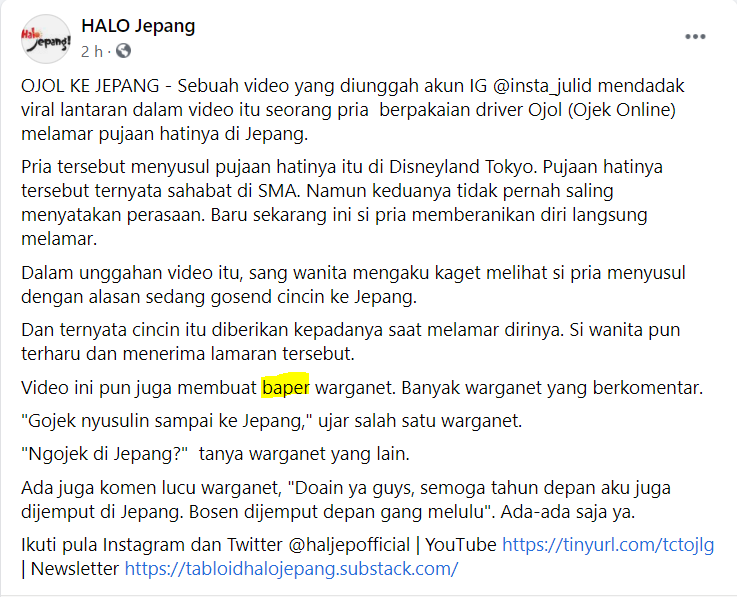
The sentence in which the word [baper] is found is in this sentence.
Video ini pun juga membuat baper warganet. (This video moved the Indonesian netizens.)
This is a post about a man who proposes to his partner. He comes far away from Indonesia to Japan to do this. He gives a ring, proposes to his partner in Tokyo Disneyland, and makes a video about it. And then, Indonesian netizens who watch the video get emotional, in the sense that they admire what the man has done by coming far away from Indonesia to give a ring and propose to his partner.
If you found this article helpful and would like to support my work, you can buy me a coffee. Thank you for your support!
I guess that wraps up today’s article. If you have any questions, feel free to leave them in the comments below. Thank you for reading my article, and I’ll see you soon.