

Halo semuanya, apa kabar kalian? This time, I will talk to you about the meaning of [bawel] in Bahasa Indonesia. We're also going to watch scenes that I took from Indonesian movies where this word [bawel] is spoken.

Meaning of Bawel
Let’s look at Kamus Besar Bahasa Indonesia (KBBI), the meaning of the word [bawel] below.
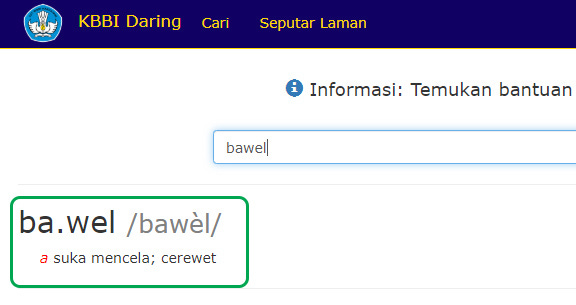
According to Kamus Besar Bahasa Indonesia, the meaning of [bawel] is [suka mencela; cerewet]. In English, it means chatty or talkative. A person called [bawel] annoys other people with their words.
Example Sentences Using Bawel
Example sentence number 1:
Loe jadi orang bawel banget sih? (You're so noisy, don't you know that?)
Example sentence number 2:
Biasanya sih yang bawel cewe, nah ini cowo bawel! (Usually, girls talk a lot, not boys like you!)
Example sentence number 3:
Atasan kamu bawel? Sabar aja! (Your boss talks too much? Just be patient!)
How to Pronounce Bawel
Here is how you pronounce [bawel] in bahasa Indonesia.
Moving on, we’ll look at examples where Indonesians use the word [bawel].
Examples of Bawel In Use
The first example is from a movie, Cek Toko Sebelah (2016). Let’s watch the clip.
Conversation from the clip with English translations.
Son: Lho? Papa mo ke mana? (Hey, where are you going, Dad?)
Father: Mancing. (I’m going fishing.)
Son: Lama ngga? (Is it gonna take a while?)
Father: Ngga. (Nope.)
Son: Eh, pah. Pelan-pelan. (Dad, would you go slowly, please?)
Father: Bawel! Loe belum lahir, gue udah balap liar. (You’re so noisy! Before you were born, I had done illegal street racing.)
Here, the father is annoyed with what his son just said to him. His son asked him to ride slowly on his motorbike because he cared about him. But he felt that his son’s speech was so annoying, so he said the word [bawel].
Vocabulary From the Clip
[Mo] is informal for [mau]. It means [want].
[Papa] also [pah]; it means [daddy].
[Papa mo ke mana?] comes from a full sentence [Papa mau pergi ke mana?]. He drops the word [pergi]. [Pergi] means [to go]. Papa mau ke mana? <--- If translated literally into English, it will be, “Where do you want to go, Daddy?”
[Mancing] is informal for [memancing] = going fishing.
[Pelan-pelan] = slowly.
[Udah] is short for [sudah] = already.
[Balap liar] = street racing.
The second example is from a famous TV serial in Indonesia, Si Doel Anak Sekolahan (1994). Let’s watch the clip.
Conversation from the clip with English translations.
Wife: Bang, kopinya taro di mana, nih? (Where should I put your coffee?)
Husband: Bawa ke sini! (Bring it here!)
Wife: Emangnya belon kelar juga ini oplet? (Haven’t you finished fixing the car yet?)
Husband: Haduh, dikit lagi! (In just a minute!)
Wife: Yah, ntar si Doel ketelatan lagi, bang. Kemarin dia ngedumel tuh. (Doel will be late again then! Yesterday, he complained about it.)
Husband: Bawel amat sih jadi orang! (You talked a lot!)
Wife: Doel! Cepet, Doel! (Doel! Hurry up, Doel!)
As you can see, the wife in that scene complains a lot to her husband. That’s why he said to her, “bawel.”
Vocabulary From the Clip
[Taro] is informal for [taruh]. It means [to put]. For more about this, you can read my article: Taro and Taruh in Indonesian.
[Emang] is short for [memang]. You will hear [emang] a lot in daily conversation.
[Belon] is informal for [belum]. This [belon] is usually spoken by the indigenous people of Jakarta, or we call them the Betawi people.
[Dikit] is short for [sedikit] = a little.
[Ntar] is informal for [nanti] = later, then.
[Telat] = late.
[Cepet] is the same as [cepat]. In this context, it means [hurry up].
The third example is from a movie called Perahu Kertas 1 (2012). Let's watch the clip below.
Conversation from the clip with English translations.
Noni: Kamu tuh ngga ada inisiatif banget sih? Buat nelpon dia, nanya sekarang pake baju apa, nomor telponnya berapa. (Why don’t you have an initiative? Called him, for example, or to ask him what shirt he wears, what’s his phone number.)
Eko: Pake apaan? Pake apaan bawel? (Using what? What should I use, you chatty?)
Noni: Ih! Bener-bener ya! Ngga ada inisiatif! Terus sekarang kamu terakhir ketemu ama dia kapan? (Oh my! You really have no initiative! When was the last time you met him?)
Eko: SD. (Since elementary school.)
Noni: SD? (Since elementary school?)
Eko: Iya. (Yes.)
Noni: Sekarang udah lupa mukanya kaya gimana? (And now you have forgotten his face?)
Eko: Lupa. (Yes, I have forgotten his face already.)
In this scene, Eko’s girlfriend, as you can see, talks too much. That’s why he called her [bawel].
Vocabulary From the Clip
[Nanya] is informal for [bertanya] = to ask.
[Nelpon] is short for [menelpon] = to make a phone call.
Bener-bener ya! <--- This expression is usually used when someone gets upset with someone. It’s hard to translate this into English. Maybe it’s kind of like [you’re being such an asshole]
[Ama] is short for [sama] = with.
The fourth example is from a movie called Radio Galau (2012). Let's watch the clip below.
Conversation from the clip with English translations.
Rio Bramantyo: Woi! Ada apaan mas bro? Pacar lau ngambek lagi? Ha? (Hey, what’s up? You fought with your girlfriend again? Hey?)
Bara Mahesa: Udah deh, loe jangan bawel deh. Gue lagi pusing nih. (Please, don’t be a chatty person. I have a lot of things on my mind right now.)
Rio Bramantyo: Heh. Punya pacar ribet ya? Ngerepotin ya? Kan gue udah bilang dari kemarin. Gue udah bilang! Loe itu emang udah nasibnya kaya gue. Jadi jomblo. (Having a girlfriend makes you trouble, ha? Bothersome, isn’t it? I’ve told you, right? I’ve told you, bro! Your fate is to be just like me. Being alone.)
Here, Mahesa had a fight with his girlfriend, and then his friend Rio Bramantyo came along. Then, Rio talked too much, and Bara felt annoyed by all the words that Rio was saying to him. That’s why he said:
Jangan bawel.
[Jangan bawel], in this context, means that he asks his friend to stop talking.
Vocabulary From the Clip
[Ada apaan?] <--- This phrase is usually used when you want to know what just happened.
[Pusing] literally means dizzy or a headache. [Pusing], in this context, is used figuratively, which means being confused and not knowing what to do.
[Ribet] means complicated.
[Ngerepotin] is informal for [merepotkan] = troublesome.
[Gue udah bilang!] = I’ve told you! “Gue udah bilang” is used in an informal situation, and if you want to use it in a formal situation, you need to change it into “Saya sudah katakan.”
[Jomblo] means that someone doesn’t have any girlfriends or boyfriends.
The fifth example is from a movie called Office Watch (2020). Let’s watch the clip below.
Conversation from the clip with English translations.
Tiffany: Ini beli di mana, kak? (Where did you buy this, sis?)
Sarah: Ih! Ini gue yang masak! (OMG! I’m the one who cooked this! Don’t you believe me?)
Tiffany: Oke, chill. (Okay, relax.)
Sarah: Tadi kakak beli bahan-bahannya di supermarket, terus.. Iiih! Loe dengerin gue ngga sih? Tadi loe tanya soal masakan ke gue sekarang gue jelasin elo ngga denger. (I bought the ingredients at the supermarket, and then-- Hey! Are you listening to me? You just asked about the dishes, and now I’m explaining to you, and you don’t listen to me.)
Tiffany: Ih! Bawel banget sih loe! Udah ah! Cepetan cari cowo. Biar gantian gue yang masakkin buat elo. (You’re so annoying! Go get a boyfriend! So that I can cook for you instead of you cooking for me.)
Sarah has just made spaghetti in this scene, and then her sister comes in and asks where she bought the spaghetti, and Sarah answers that she made it herself.
Her sister seemed not to believe in her, so Sarah explained it to her sister, and while she was explaining it to her sister, her sister didn’t listen to her but was just busy taking a selfie. Then, Sarah got angry with her sister because she wasn’t listening when she spoke.
And then her sister said this:
Bawel banget sih loe!
She was kind of annoyed by her sister trying to explain too much information that she didn’t need. That’s why she said the word [bawel].
Vocabulary From the Clip
[Loe], [elo], [lu], [elu], and [lo] are the same word and also have the same meaning. You will see Indonesian people write it down in many variations, but it is the same word, so don’t confuse that.
[Udah ah!] is used to end the conversation. Usually, people who say [udah ah] want to end the conversation. [Udah] is short for [sudah], and [ah] is just an exclamation word.
[Cepet] is also the same as [cepat], which means [hurry up, quick]. So, [cepetan] is the same as [cepatan], but you will hear [cepetan] more in daily conversation in Indonesia. The literal translation of [cepetan] or [cepatan] is [be quick]. This is usually used when you want someone to be in a hurry.
The sixth example is from Wedding Proposal (2021). Let’s watch the clip below.
Conversation from the clip with English translations.
Bisma: Nih, pak. (Here you go, Dad.)
Father: Oke. (Okay.)
Ito: Ngga pake gula, kan? (You didn’t put sugar in it, right?)
Bisma: Bawel! (You talk too much, you know that?)
Ito: Bohong ni, ni punya gue nih. Kebiasaan. (Hey, that one is mine. You’re always like that!)
Bisma made coffee for the three of them, and then Ito usually drinks coffee without adding sugar to it, and he wanted to make sure that Bisma didn’t put sugar into his coffee. When Ito asks Bisma about it, Bisma replies with [bawel], which, in this context, he knows, and Ito doesn’t have to ask him to make sure.
Vocabulary From the Clip
[Nih] has the same meaning as [ini] = this. [Nih] is usually said when you are giving something to someone. Like in this example, Bisma gives her father coffee. For more about this, you can read my article: Ini, Ni, and Nih in Indonesian.
[Bohong] = lie.
[Kebiasaan] is something that you usually do. In this case, Ito said [kebiasaan] to Bisma because it’s Bisma’s habit to exchange his coffee with Ito’s coffee.
If you found this article helpful and would like to support my work, you can buy me a coffee. Thank you for your support!
That wraps this article. If you have any questions, feel free to leave them in the comments below. Thank you for reading my article, and I’ll see you soon.