

Halo semuanya. Apa kabar? Ketemu lagi sama saya, Iman Prabawa. Today, we’re going to talk about what [bokap] means in Indonesian. As usual, I’ll show you some examples from movies, YouTube videos, comics, and other real-life situations where Indonesians use this word.

Meaning of Bokap
Bokap is a casual Indonesian word for ‘father.’ It’s slang, so you won’t find it in formal writing. But you’ll often hear it in Indonesian movies, especially ones set in Jakarta.
Example Sentences
Here are three example sentences using the word [bokap].
Bokap loe ada di rumah ngga? (Is your dad home?)
Sebentar ya, gue mau nelpon bokap gue dulu. (Just a sec. I’m just gonna call my dad.)
Bokap loe kerja di mana, bro? (Where’s your dad working, bro?)
How to Pronounce Bokap
Here is how you pronounce [bokap] in bahasa Indonesia.
Now, let’s check out some examples of [bokap] in use.
Examples of Bokap In Use
The first example is from the movie Ada Apa Dengan Cinta 1 (2002). Go ahead and watch the video below, where I also break down the vocabulary in the clip.
Conversation from the clip with English translations.
Alya: Tapi bokap gue berantem sama nyokap, Cinta. Bukan sama gue. (But it was my dad who was fighting with my mom, Cinta. Not me.)
Cinta: Tapi kan loe udah sering banget jadi korban kaya gini, Al. (Yeah, but you’re the one who always ends up being the victim, Al.)
Alya: Gimana sih gue mesti ngejelasin ke elo semua? Terserah ya, sekarang lo mau percaya apa engga, bokap gue kalo udah.. kalo udah ngamuk kaya gitu. Kek orang ngga sadar, tau ngga? Habis ngamuk dia bisa nangis kaya anak kecil, nyesel abis, nyiumin kaki nyokap gue, melukin gue. (How am I supposed to explain this to you guys? Look, believe it or not — when my dad… when he loses it like that — it’s like he’s not even himself, you know? After he blows up, he can suddenly start crying like a little kid… totally regret everything he did… kiss my mom’s feet, hug me…)
This movie is set in Jakarta, so it’s normal for teenagers to use slang when they’re talking to their friends. Here, [bokap] means [father]. Alya uses the word [bokap] to refer to her dad.
Let’s hear again the part where Alya says the word bokap.
Alya: Tapi bokap gue berantem sama nyokap, Cinta. (But it was my dad who was fighting with my mom, Cinta.)
Vocabulary From the Clip
[Gue] = [gua] means I. It’s an informal word used mostly by Jakartans and the people who live in its surrounding cities like Bogor, Depok, Tangerang, and Bekasi.
[Loe] = [lo] = [elo] = [lu] means you. [Loe] and [gue] are usually used in pairs.
[Berantem] is the colloquial way of saying [berkelahi] = having a fight.
[Udah] is short for [sudah]. In conversational Indonesian, people usually pronounce it [udah] instead of [sudah]. [Sudah] is more formal.
[Sering banget] = [sering sekali] = very often. [Banget] is used a lot in informal or daily conversation. [Banget] means very.
[Ngejelasin] is the colloquial way of saying [menjelaskan = me+jelas+kan] = to explain.
[Ngamuk] is a state in which someone is very angry.
[Nangis] is the colloquial way of saying [menangis = me+tangis] = to cry.
[Nyiumin] is the colloquial way of saying [menciumi = me+cium+i] = to kiss again and again.
[Melukin] is the colloquial way of saying [memeluki = me+peluk+i] = to hug.
[Nyesel] is the colloquial way of saying [menyesal = me+sesal] = to regret.
[Kaya] = [kek] = like.
[Tau] = [tahu] = know. There’s a difference between [tahu], which means [know], and [tahu], which means [tofu]. [Tahu], which means [tofu], is always pronounced with the letter [h] in it, and [tahu], which means [know], is pronounced without the letter [h] in it. It is pronounced [tau].
[Kalo] = [kalau] = if.
[Nyesel abis] = to regret something one has done deeply.
The second example is from Cek Toko Sebelah (2018). Let’s watch the video below, and I’ll walk you through the vocabulary.
Conversation from the clip with English translations.
Aming: Banyak kenangan sama papih dari mangkok ini. Lu ngga bakal ngerti, Loy! ( This bowl brings back a lot of memories of my dad. You wouldn’t get it, Loy.)
Aloy: Biasa aja kali, Ming! Emang lu doang? Bokap gua juga udah mati! (Chill, Ming. You’re not the only one. My dad’s dead too.)
Vincent: Yatim-yatim kok sombong? (Why are you two acting all proud about being fatherless?)
Aming: Gue tau bokap loe udah mati, Loy! Tapi bokap gue tu mati duluan! (I know your dad is dead, Loy. But mine died first.)
Aloy: Ya elah! Beda seminggu doang! Abis bokap lu stroke kan, minggu depannya bokap gua ketularan. (Oh, come on! It was only a week apart! Your dad had a stroke, then a week later, my dad “caught” it too.)
Yohan: Stroke tu ga nular, Loy. (Strokes aren’t contagious, Loy.)
Vincent: Betul tu, Han. Memangnya diabetes? (Exactly, Han. It’s not like diabetes.)
Yohan: Diabetes juga ga nular, Cent. (Diabetes isn’t contagious either, Cent.)
In this clip, [papih] basically means the same thing as [bokap] — it means [dad]. But [bokap] is used more often in casual conversation between friends, especially in Jakarta.
Let’s hear again the part where Aloy says the word [bokap].
Aloy: Bokap gua juga udah mati! (My dad’s dead too.)
Vocabulary From the Clip
[Banyak] = a lot.
[Kenangan] = memories.
[Papih] = [papi] = dad, father.
[Ngerti] is short for [mengerti]. In daily conversation, it’s common for native speakers to shorten words, like in this example.
[Biasa aja kali!] is a phrase used to calm someone down or to not overreact to something.
[Yatim] is a term for someone whose father has died; an orphan.
[Sombong] = arrogant.
[Udah] is short for [sudah] = already.
[Mati] = die, dead.
[Seminggu] = [satu minggu] = one week.
[Tu] is short for [itu] = that.
[Nular] is short for [menular] = infectious.
The third example is from the movie Generasi Micin (2018). Let’s watch the scene below.
Conversation from the clip with English translations.
Kevin: Akhirnya, bokap mewujudkan cita-citanya. Punya toko sendiri. (Finally, my dad made his dream come true — owning his own shop.)
Customer: Bisa lah? (Come on, just a little discount?)
Kevin’s Father: Ngga bisa! (No!)
Customer: Kan udah sering ke sini? (But I’m a regular here.)
Kevin’s Father: Ngga bisa! (Nope!)
Kevin: Mengumpulkan cuan demi cuan. (Saving up, penny by penny.)
What Kevin says in the clip, in the sentence: “Akhirnya, bokap mewujudkan cita-citanya.” The word [bokap] refers to his father.
Let’s hear again the part where Kevin says the word [bokap].
Kevin: Akhirnya, bokap mewujudkan cita-citanya. (Finally, my dad made his dream come true)
Vocabulary From the Clip
[Akhirnya] = finally.
[Sering] = often.
[Mengumpulkan = me+kumpul+kan] = to collect something.
[Cuan] = money.
[Ngga bisa] here is used to refuse someone’s request.
The fifth example is taken from Bang Mpin's YouTube Channel. Let's watch the clip below.
Conversation from the clip with English translations.
Bang Mpin: Awalnya keliling atau emang udah mangkal? Atau? (Did you start out going around selling, or did you already have a fixed spot? Or what?)
Tukang Sate: Kalo jaman bokap itu keliling. Baru mangkal, habis mangkal itu baru di situ..(*inaudible). (Back in my dad’s time, he used to go around selling. Later on, he set up a fixed spot. After that, he started… (inaudible).)
Bang Mpin: Tapi dulu bokap keliling, ye? Kelilingnya sekitaran-sekitaran sini? (So your dad used to sell by going around, right? Around this area?)
Tukang Sate: Keliling dulu. Jamannya pikulan dulu. (Yeah, he went around. Back in the day, he carried everything on a shoulder pole.)
Bang Mpin: Ooo. Kek gini bang, ya? Kaya baju saya? (Ohhh. Like this, right? Like the one on my shirt?)
Tukang Sate: Nah, iya bener! (Yeah, exactly!)
Bang Mpin: Nah, yoi! (Nice!)
As you can see, they use the word [bokap] when they talk. It is common to hear the word [bokap] spoken in Jakarta.
Let’s hear again the part where Bang Mpin says the word [bokap].
Bang Mpin: Tapi dulu bokap keliling, ye? (So your dad used to sell by going around, right?)
Vocabulary From the Clip
[Awalnya] = at first, from the start.
[Keliling] means that the person is not selling to someone by staying at one place. They sell it by going around.
[Mangkal] is selling something by staying in one place.
[Atau] = or.
[Kalo] is informal for [kalau] = if.
[Baru] = new, after that.
[Tukang sate] is someone who sells satay on the street.
[Sekitaran-sekitaran] = around (some place).
[Sini] = here.
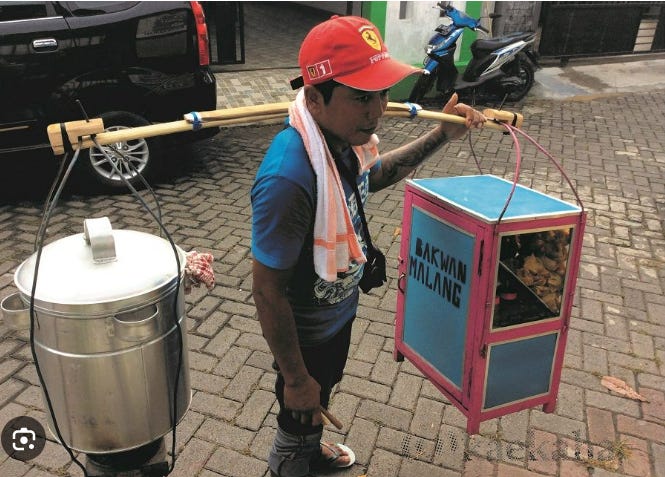
[Pikulan] is something that you carry on your shoulder. [Sate pikulan] means satay sold by someone carrying the cart on their shoulder, like in the picture below.
[Kek] = [kaya] = like.
[Nah] is used when you agree with what someone says.
[Bener] is informal for [benar] = correct, true.
If you found this article helpful and would like to support my work, you can buy me a coffee. Thank you for your support!
That wraps up this article. If you have any questions, feel free to leave them in the comments below. Thank you very much.