

Halo semuanya, ketemu lagi sama saya, Iman Prabawa. In this article, I want to talk to you about the meaning of the word [boleh] in Indonesian. Here, we’re also gonna be watching examples where Indonesians use this word to better understand how to use it.

Boleh In Indonesian
1. [Boleh] means that something is allowed and not prohibited. You can also use [boleh] when you ask for permission.
Example sentences:
1. Tidak boleh membawa kamera di ruangan ini. (No cameras are allowed in this room.)
2. A: Boleh saya permisi ke belakang? (May I go to the bathroom?)
B: Silakan. (Yes, you may.)
2. [Boleh] is used when someone offers something to you, and you agree to accept it. It can also be used when someone comes up with an idea, and you agree with that person because you think it sounds good.
Example sentence:
1. A: Loe mau teh ngga? (You want tea?)
B: Boleh. (Sure.)
2. A: Eh, gimana kalau kita sekarang nyari makan aja dulu? (Hey, how about if we look for something to eat now?)
B: Wah, boleh tuh. (Sounds good.)
How to Pronounce Boleh
Here is how you pronounce [boleh] in bahasa Indonesia.
Moving on, let’s look at examples below where Indonesians use the word [boleh].
Examples of Boleh In Use
The first example we are about to watch is from Cek Toko Sebelah 2 (2022). Let's watch the clip.
Conversation from the clip with English translations.
Erwin: Nanti kalo udah di Jakarta, masih boleh ketemu, ngga? (When I return to Jakarta, can I still meet you?)
Natalie: Boleh. Nanti yah kalo ban mobilnya kempes lagi. (*tertawa) (Yes, you can. But only when my car has a flat tire again.) (*laughing)
Erwin: Hah, sebatas montir panggilan ternyata. Serius tapi? Ga papa? Ga ada yang marah? Ketawa sih? (Oh my! So I’m no more than just a mechanic then. But, seriously? Is it okay? No one’s gonna be angry? Why are you laughing?)
Natalie: Aduh! Cowo tu kaya ngga punya teknik lain. (Oh my God! Men seemed to have no other way to say it.)
Erwin: Teknik apaan? (No other way to say what?)
Natalie: Pasti nanyanya gitu. Entar ngga ada yang marah? (They always ask, like, what you just did. No one’s gonna be angry?)
Erwin: Emang harusnya nanyanya gimana? (How should I ask, then?)
Natalie: Ya, tanya aja langsung. Udah punya pacar belom? Gitu. Kalo berani. (Just be direct. Do you have a boyfriend? Things like that. I mean, if you have the balls.)
In this scene, Erwin and Natalie meet in Bali, but they actually live in Jakarta. They came to Bali for work, and they met each other in Bali accidentally.
Natalie had a flat tire and needed help changing it. Erwin happened to be crossing that road and saw Natalie. Erwin helped Natalie change the tire, and then they got to know each other. That’s how they became friends.
Erwin then begins to like Natalie. That’s why he asks if he can meet her again when he returns to Jakarta. He asks for permission to meet again by saying this:
Masih boleh ketemu, ngga? (Can I still meet you?)
And then Natalie allows him to meet her by saying:
Boleh. (Yes, you can.)
So, [boleh] in this clip refers to the first meaning of [boleh] that I explained above, which is to give someone permission (to do something).
Vocabulary From the Clip
[Nanti] = later.
[Kalo] is informal for [kalau] = if.
[Udah] is a common reduction for [sudah] = already.
[Ketemu] is the conversational way of saying [bertemu] = to meet.
[Ban mobil] = car’s tire.
[Ban mobil kempes] = flat tire.
[Lagi] = again.
[Tertawa] = laughing.
[Montir] = mechanic.
[Montir panggilan] = a mechanic you can call whenever you have trouble with your car.
[Ga papa] = [tidak apa-apa] = okay, no problem.
[Ga ada ] = [tidak ada] = no one.
[Marah] = angry.
[Ketawa] = [tertawa] = laughing.
[Sih] here has no meaning. Its function is just to emphasize. For more about this, you can read my article here: Sih In Indonesian.
[Cowo] = [cowok] = [pria] = men.
[Tu] is informal for [itu] = that. For more about this, you can read my article here: Tu In Indonesian.
[Pasti] = certain.
[Nanyanya gitu] = [bertanyanya seperti itu] = ask like that.
[Ngga] = [ga] = no.
[Nanya] is the conversational way of saying [bertanya] = to ask.
[Tanya] = [nanya] = [bertanya] = to ask.
[Pacar] = boyfriend or girlfriend.
[Berani] = brave.
The second example is from a TV Program, Lapor Pak (2022). Let's watch the clip.
Conversation from the clip with English translations.
Wendy Cagur: Iya, betul. Kalau masalah itu memang kita bisa selesaikan, pak. Tapi kita butuh nama bapak dulu. Bapak mau buah, ga? (That’s right. For that matter, we can handle it, sir. But we are going to need your name first. By the way, do you want some fruit?)
Pak Bolot: Boleh tuh. (Don’t mind if I do.)
In this clip, Wendy offers Pak Bolot fruits, and Pak Bolot accepts the offer by saying [boleh tuh]. So, [boleh] here refers to the second meaning I explained above, which is when someone offers you something, and you accept it.
Vocabulary From the Clip
[Iya] = yes.
[Betul] = correct.
[Masalah] = problem.
[Pak] is used to address men in Indonesian. For more about this, you can read my article here, Pak in Indonesian.
[Butuh] = [perlu] = need.
[Buah] = fruit.
[Tuh] and [tu] are informal for [itu] = that.
The third example is from Bang Mpin's YouTube channel. Let's watch the clip.
Conversation from the clip with English translations.
Bang Mpin: Oke, Uda. Biasanya di kuahnya ada tetelannya, Uda. Ada tetelannya ngga, Uda? (Okay, sir. Usually, there are flanks in the sauce, sir. Are there any flanks in the sauce, sir?)
Penjual Sate Padang: Ada. (Yes, there are.)
Bang Mpin: Mantep! (Awesome!)
Penjual Sate Padang: Ini kebetulan lagi banyak sekarang. (This happens to be a lot right now.)
Bang Mpin: Serius? Kalo tetelan nambah lagi, ngga? (For real? If I want to have the flanks, should I pay more?)
Penjual Sate Padang: Boleh. (Okay.)
Bang Mpin: Boleh? (Okay?)
Penjual Sate Padang: Boleh. (Okay.)
Bang Mpin: Boleh nambah atau boleh gratis, nih? (Do I need to pay for that, or can I get it for free?)
Penjual Sate Padang: Hehe, gratis, bos. Tetelannya tu gratis. (Haha, it’s free, boss. Flanks are free.)
Bang Mpin: Saya pesen sepuluh daging, sepuluh usus. Ketupatnya dikit aja. Katupeknya dikit aja, pake ini tetelan. Oke. (Oke. I’ll have ten meat skewers, ten intestine skewers. For the ketupat, just a little. For the ketupat, just a little, and please add flanks on that. Okay.)
In this clip, Bang Mpin asks the seller if he can get the flanks, and then the seller replies with [boleh]. [Boleh] here can mean two things: that is, you can get the flanks, but for that, you need to pay extra money, and [boleh] here can also mean that you can get the flanks for free without the need to pay extra money for it.
That’s why Bang Mpin asks the seller to clarify whether he can get the flanks for free, or he can get the flanks but needs to pay extra money for it. And the seller says that he can get the flanks for free.
Vocabulary From the Clip
[Penjual] = seller.
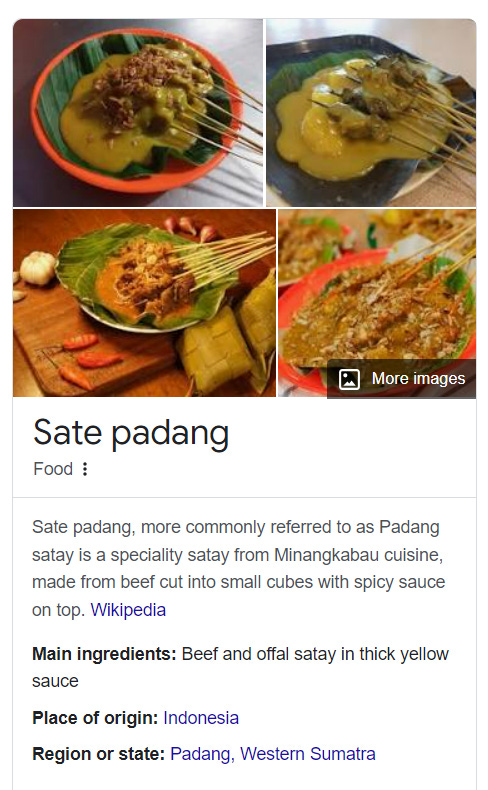
[Sate Padang] is one of the Indonesian cuisines that looks like the one in the photo below.
[Uda] is an honorific title to address older males from West Sumatra.
[Tetelan] = flanks.
[Ada] = exist. For more about this, you can read my article here: Ada In Indonesian.
[Banyak] = a lot.
[Sekarang] = now.
[Itu] in [tetelan itu gratis] = is. [Tetelan itu gratis] = [tetelan adalah gratis]. [Itu] can also mean [that]. For more about this, you can read my article here: Itu, Tu, and Tuh In Indonesian.
[Mantep] is informal for [mantap] = awesome.
[Nih] is informal for [ini] = this. For more about this, you can read my article here: Ini, Ni, and Nih In Indonesian.
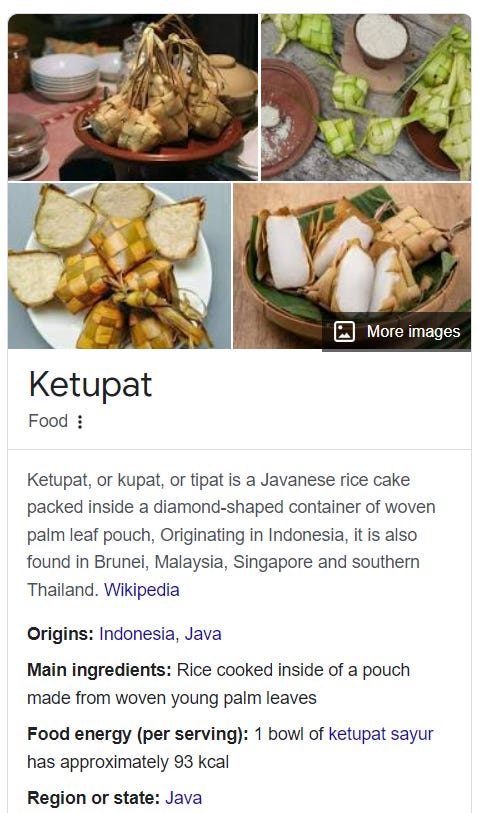
[Katupek] is the Padang language for [ketupat]. Ketupat is something that looks like the photo below.
[Nambah] = [tambah] = add. In this context, it means to add more money or not (free) to get the flanks.
[Pake] is informal for [pakai] = use.
The fourth example is from Gadis Kretek, Episode 3 (2023). Let’s watch the clip.
Conversation from the clip above with English translations.
Lebas: Mau lanjut baca surat lagi, ngga? (Wanna continue reading the letters?)
Arum: Boleh. (Okay.)
The two of them are reading letters, and then they stop to take a rest for a while. After having taken a rest, Lebas says to Arum whether they can start to read the letters again, and then Arum replies with the word [boleh].
If you found this article helpful and would like to support my work, you can buy me a coffee. Thank you for your support!
So, that’s gonna be it for now. Thank you for reading this article, and I’ll see you soon.