

Halo semuanya. Ketemu lagi sama saya, Iman Prabawa. This time, I will talk about the meaning of [buset] in the Indonesian language. As always, we will also watch clips from movies where the word [buset] is used by Indonesians.
Buset In the Indonesian Language
[Buset], [busyet], or [bused] is a word you say when you’re surprised or amazed by something. You can also say [buset] when you feel annoyed with something. You must look at the context first to know how to use it correctly.
[Buset] often collocates with the word [deh] or [dah], so it’s gonna be [buset deh] or [buset dah]. The two of them have the same meaning. [Buset dah] is mostly spoken by people in Jakarta, and [buset deh] is spoken by people outside Jakarta.
Example sentences:
1. Buset! Nama loe panjang bener?! (Oh, my God! Your name is so long!)
2. Ini anak buset deh! Dikasih tahu ngga mau nurut! (This kid is so unbelievable! He doesn’t want to listen to what I just said!)
Sentences number 1 and number 2 are just showing the feeling of surprise. In sentence number 2, I give advice to a kid, and then the kid won’t listen to me. I felt annoyed with him because he didn’t want to listen to my advice. So, [buset] in sentence 2 shows the feeling of annoyance from the speaker who said [buset].
3. Buset dah ini tempat! Berantakan banget! (Holyshit! Look at this place! What a mess!)
How to Pronounce Buset
Here is how you pronounce [buset] in bahasa Indonesia.
And below is how you pronounce [buset deh].
Below is how you pronounce [buset dah].
Next, let’s watch examples where Indonesians use the word [buset] in their daily lives.
Examples of Buset In Use
In this section, we will watch examples I took from movies, YouTube videos, and others where Indonesians use the word [buset].
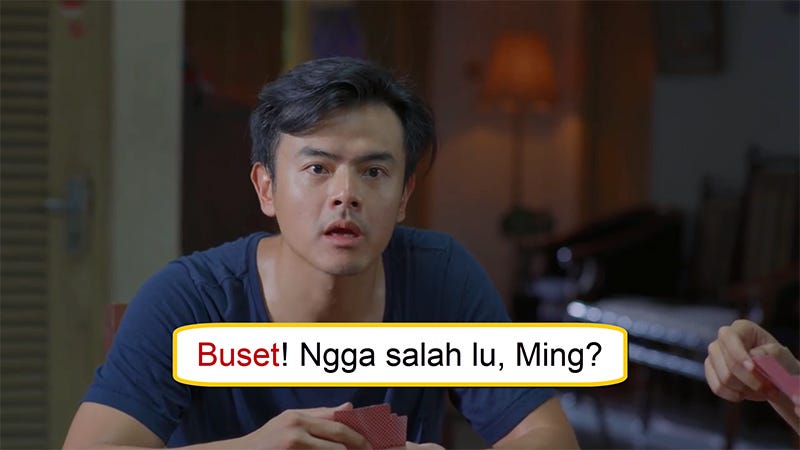
The first example we are about to watch is from the movie Cek Toko Sebelah (2019). Let’s watch the clip.
Conversation from the clip with English translations.
Yohan: Buset! Ngga salah loe, Ming? (Holyshit! For real, Ming?)
Vincent: Ini mah bukan dituang! Ditimba! (You can’t pour this with a spoon. You need a bucket!)
Roy: Ini mah porsi dapur umum, Ming. (This is a soup kitchen’s portion, Ming.)
Aming is going to eat a bubur kacang hijau, a Southeast Asian sweet porridge (bubur) made from mung beans (kacang hijau), coconut milk, and palm sugar or cane sugar. And Yohan is amazed by how big the bowl is. That’s why he says, “Buset!”
So, [buset] in this context means that you are amazed by something. In this clip, Yohan was amazed by how big the bowl was.
Let’s learn the vocabulary used in this short clip.
Vocabulary From the Clip
[Ngga salah] in direct translation means [not wrong]. This phrase is used by Yohan because he is surprised by how big the bowl is, and he makes sure that Aming is going to eat all of that.
[Lu] is informal for [Anda] = you. [Lu] is used mostly in Jakarta and its surrounding cities like Bogor, Depok, Tangerang, and Bekasi. Other variations of writing this word would be [lo], [loe], [elo], and [elu]. Those have the same meaning.
[Ini] = this.
[Mah] has the same meaning as [sih]. [Ini mah bukan dituang!] = [Ini sih bukan dituang!]. These words have no meaning. They fall into the category of phatic expression. Their function is just to emphasize.
[Bukan] = not.
The second example is taken from Nex Carlos’s YouTube Channel. Let’s watch the clip.
Conversation from the clip with English translations.
Livy: By the way, enak nasinya. (By the way, this rice is delicious.)
Nex Carlos: Enak nasi kecombrangnya? (Do you think this Nasi Kecombrang is good?)
Livy: He’eh. (Yup.)
Nex Carlos: Aroma yang khas itu adalah kecombrang namanya. (That distinctive aroma is called kecombrang.)
Livy: Panas, buset! (It’s hot, oh my God!)
Nex Carlos: Jadi, nasinya itu tadi. (So, that was the rice.)
Livy: Woi, panas! Buset. You.. you enak pake sendok. (Oh, damn! It’s hot! You’re okay because you use the spoon.)
In this clip, Livy is surprised by how hot the chicken she is going to eat is. That’s why she says, “Buset.” She is eating with her hand so she can feel that the chicken is still very hot.
Let’s learn the vocabulary used in this short clip.
Vocabulary From the Clip
[Enak] = delicious.
[Nasi] = rice.
[Nasi Kecombrang] is one of the Indonesian cuisines.
[He’eh] is when you agree with what someone says.
[Sendok] = spoon.
[Woi] is used to attract attention.
If you found this article helpful and would like to support my work, you can buy me a coffee. Thank you for your support!
That wraps up this article. If you have any questions, feel free to leave them in the comments below. Thank you for reading my article, and I’ll see you soon.