

Halo semuanya, ketemu lagi dengan saya, Iman Prabawa. In this article, I want to talk to you about the meaning of the word [gih] in Indonesian. As always, we are also going to be watching examples from movies, YouTube videos, comics, and whatnot where Indonesians use the word.

What is Gih in Indonesian?
[Gih] is a word commonly used in casual Indonesian to add emphasis when encouraging or urging someone to do something. It usually comes at the end of a sentence or phrase.
Here are some examples:
Tidur, gih! Udah malem. (Why don’t you go to sleep? It’s late.)
Makan, gih. Nanti kamu sakit lho kalau ngga makan. (Why don’t you eat? You’ll get sick if you don’t eat.)
Duluan aja, gih. Nanti aku nyusul kalian kelar aku nyelesaiin ini. (You guys go ahead. I’ll catch up with you after I finish this.)
In the first sentence, [tidur] means [to sleep]. By adding [gih], the speaker is encouraging the other person to go to sleep. It doesn’t have a direct English equivalent here, but it adds an extra sense of emphasis or encouragement.
In the second sentence, the speaker is encouraging someone to eat. The [gih] makes the suggestion sound more urging, especially because the speaker is concerned that the person might get sick if they don’t eat.
In the third sentence, [duluan aja] means [go ahead] or [you guys go first]. Adding [gih] makes it sound a little more like the speaker is encouraging them to go ahead rather than wait for them.
Depending on the context and tone of voice, [gih] can sound gentle, encouraging, persuasive, or slightly insistent. It’s mostly used in casual conversation.
There isn’t always one specific English word that translates [gih]. Its meaning is often conveyed through the speaker’s tone or through expressions such as [come on], [go ahead], [why don’t you...], or [you should...]
How to Pronounce Gih
Here is how you pronounce [gih] in Bahasa Indonesia.
Moving on, let’s look at examples where Indonesians use the word [gih].
Example of Gih In Use
The first example is taken from a movie called Cek Toko Sebelah 2 (2022). Let’s watch the clip below.
Below is the transcript from the clip, along with the English translation:
Natalie: Ada keinginan tapi belum dapet. (There’s something I want, but I haven’t gotten it yet.)
Erwin: Ha? (Huh?)
Natalie: Ada keinginan tapi belum dapet. (There’s something I want, but I haven’t gotten it yet.)
Erwin: Ngomong apa sih? (What are you talking about?)
Natalie: Ada keinginan tapi belum dapet. (There’s something I want, but I haven’t gotten it yet.)
Erwin: Oooh. Maksudnya gimana, ya? (Ohhh. Wait! What do you mean?)
Natalie: Makan sayur, gih! (I think you need to eat vegetables!)
Erwin: Rumput sayur, kan? Rumput.. rumput sayur lah, ya? Sayur lah! Kan ijo, daun. Gitu, kan? (Grass is a vegetable, right? Grass... Grass counts as a vegetable, doesn’t it? Yeah, vegetables! It’s green, it’s got leaves. That’s a vegetable, right?)
In this clip, Erwin asks Natalie whether she has a boyfriend because he likes her and wants to know if she is single. Natalie simply answers, [ada], which literally means [there is] or [I have], and then goes silent.
Natalie actually doesn’t have a boyfriend at the moment. She deliberately answers [ada] and then stays quiet because she wants to see how Erwin will react. She then continues by explaining that she does have a desire to have a boyfriend, but she doesn’t have one yet.
When Natalie says, “Ada keinginan tapi belum dapet,” she means that she wants to have a boyfriend, but she hasn’t found one yet. In other words, she is still single.
When Erwin finally understands what she means, he says, “Oooh,” showing that he gets it. But then he asks, “Maksudnya gimana, ya?” which means something like, “Wait, what do you mean?”
Natalie then tells Erwin to eat vegetables. This is related to an earlier dinner scene in which they go out to eat, and Erwin orders Indomie noodles without any vegetables because he doesn’t like vegetables.
By saying, “Makan sayur, gih!” Natalie is playfully encouraging Erwin to start eating vegetables. She jokes that maybe eating vegetables will make him smarter and help him understand what she just said.
So, this whole exchange is playful and flirtatious. Natalie is indirectly telling Erwin that she is single and interested in having a boyfriend, while teasing him because he doesn’t immediately understand what she means.
Vocabulary From the Clip
[Ada] means there is. For more about this, you can read my article: Ada in Indonesian.
[Keinginan] comes from the base word [ingin] with an added affix [ke-an]. [Keinginan] = wishes, intentions, hopes.
[Tapi] = but.
[Belum] = not yet.
[Dapet] is informal for [dapat] = able, get.
[Ngomong] = [berbicara] = to speak.
[Oooh] is a word that you use when you start to understand something that has just been explained to you.
[Maksudnya gimana, ya?] is a sentence you say when you don’t understand someone’s explanation.
[Makan] = eat.
[Sayur] = vegetables.
[Kan] is used when you are sure about something. For more about this, you can read my article: Kan in Indonesian.
[Ijo] is the colloquial way of saying [hijau] = green.
The second example is taken from a Twitter post by Fiersa Besari. Let’s look at the picture below.
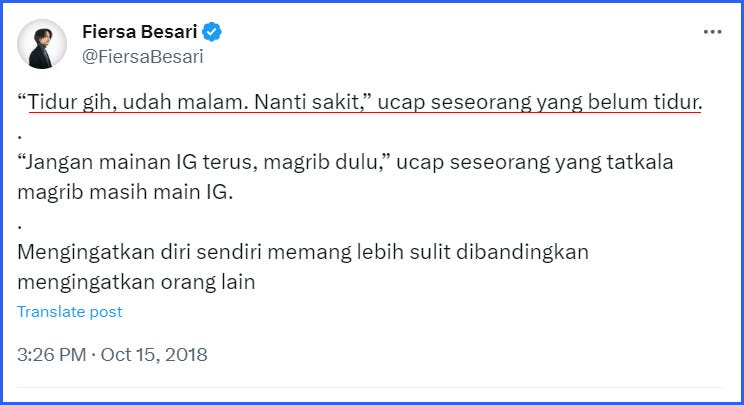
Here is what he wrote in his Twitter post using the word [gih], along with the English translation:
“Tidur, gih, udah malam. Nanti sakit,” ucap seseorang yang belum tidur. (Why don’t you go to sleep? It’s already late. You might get sick if you don’t get enough sleep,” says someone who is still awake.)
As we can see from the sentence above, [gih] is used when someone encourages or urges another person to do something. In this case, the speaker is encouraging the other person to go to sleep.
If you found this article helpful and would like to support my work, you can buy me a coffee. Thank you for your support!
That’s gonna be it for now. If you have any questions, just leave them in the comments below, and I’ll be happy to answer them.
Thank you for reading my article, and I’ll see you soon. Bye now!