

Halo semuanya. Apa kabar? Ketemu lagi sama saya, Iman Prabawa. Today, we’re going to talk about what [gue] means in Indonesian. As always, I’ll show you some examples from movies, YouTube videos, comics, and other real-life situations where Indonesians use this word.
Gue, Gw, Gua, Gwe In Indonesian
So, [gue] is an informal way to say [saya], which means [I].
But here’s the interesting part — there are many ways to write it. You might see it written as [gue], [gua], [gwe], [gw], or even just [g].
Don’t worry — they all mean the same thing. It just depends on how people like to type it.
Now, where do people usually use [gue]?
Mostly in Jakarta and nearby cities like Bogor, Depok, Tangerang, and Bekasi.
And usually, [gue] comes as a pair with [loe] or [lu], which means [you]. So, you may hear something like:
Gue udah bilang ama loe! (I’ve told you!)
If you’re in Jakarta, it sounds totally normal.
But if you’re in other cities — for example, Jogjakarta — don’t use [gue]. People there usually say [aku] instead. It sounds more natural in that area.
Now, when can you use [gue]?
You can use it with close friends or people your age.
But be careful — don’t use [gue] when talking to your boss, your parents, your teachers, or someone older than you… unless you’re really close and they’re okay with it. Otherwise, it might sound disrespectful.
Alright, now let’s look at an example.
We’re about to watch a clip taken from a movie called Devil On Top (2021).
In this scene, there’s a conversation between a woman and a man. The woman is the boss, and the man is her employee.
Let’s see how they use [gue] in this situation.
Below is the transcript from the clip, along with the English translation:
Sarah: Istirahat dulu, yuk? (Wanna take a break for a bit?)
Angga: Ah, iya. (Oh, sure.)
Sarah: Kita ngapain sekarang? (So, what should we do now?)
Angga: Hmm, saya ada permainan sih, mba. (Hmm… I actually have a game, ma’am.)
Sarah: Sarah. Kan ini di luar jam kantor. (Just call me Sarah. We’re off the clock.)
Angga: Iya. Sarah, gue ada permainan. “Gue—loe“ aman kan, ya? (Right, Sarah, I’ve got a game. Is it okay if I use “gue—loe” when I talk to you?)
Sarah: He’eh. (Yeah, that’s fine.)
Angga: Oke. (Alright then.)
In this scene, as you can see, Angga starts off using formal language. He says [saya] instead of [gue], and he calls his boss [mba] as an honorific title.
Then his boss tells him to just call her Sarah, without using [mba], because they’re outside office hours.
After that, Angga asks if it’s okay for him to use [gue-loe] instead of the more formal [saya-kamu], and Sarah says she’s fine with it.
So as you can see, it’s not common to use [gue-loe] in the office or in formal situations. But if you’re close enough to the person, and that’s how you usually talk to each other, then it can be okay.
And just like Angga, you can always ask first whether it’s okay to use [gue-loe] with them. That way, you’re being respectful while still keeping things casual.
How to Pronounce Gue
Here is how you pronounce [gue] in bahasa Indonesia.
And here is how you pronounce [gua] in bahasa Indonesia.
Some Indonesians say [gue], and some Indonesians say [gua]. I, myself, sometimes say it [gua], and sometimes say it [gue]. So, it is all the same, and it is okay to combine both when you are speaking.
Examples of Gue In Use
In this section, I’ll show you examples where [gue] and its writing variations are used by Indonesians.
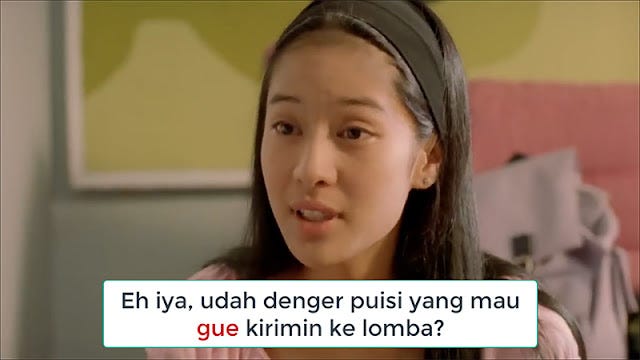
The first example is from a movie called Ada Apa Dengan Cinta 1 (2002). Let’s look at the clip below.
Below is the transcript from the clip, along with the English translation:
Cinta: Eh iya, udah denger puisi yang mau gue kirimin ke lomba? (Guys! Have you heard the poem I’m submitting to the contest?)
Maura: Mana, mana, mana? (Wait, what? Lemme see!)
Cinta: Gitar, gitar, gitar, gitar. (Guitar, guitar, guitar, guitar!)
Karmen: Puisi loe yang baru? (Is that your new poem?)
Cinta: Iya. (Yeah.)
Milly: Nih. (Here you go.)
Cinta is talking to her close friends, so she is using [gue] to them, and the setting of this movie is in Jakarta, so it is normal to hear high school students use [gue] and [loe] when they speak to each other.
Let’s hear again the part where Cinta says the word gue.
Cinta: Eh iya, udah denger puisi yang mau gue kirimin ke lomba? (Guys! Have you heard the poem I’m submitting to the contest?)
Vocabulary From the Clip
[Eh iya] is used when you suddenly remember something.
[Udah] is a common reduction for [sudah] = already.
[Kirimin] is the colloquial way of saying [kirimkan] = to send.
[Mana] literally means [where], but in this clip, [mana] is used by one of Cinta’s friends because she was excited to hear Cinta’s new poem.
[Nih] is used when you give something to someone. It’s like [here you go] in English.
The second example is from a movie called Perahu Kertas 1 (2012). Let’s look at the clip below.
Below is the transcript from the clip, along with the English translation:
Eko: Ada yang perlu gue bantu ngga? (You need a hand?)
Keenan: Ngga usah. (Nah, I’m good.)
Eko: Nah. Tu kamar loe situ tuh! Depan WC. (There. Your room’s over there! Right across from the bathroom.)
Keenan: Iya. (Got it.)
Eko: Bentar ya. (Hang on a sec.)
Eko and Keenan are brothers, and as you can see, they used [gue] and [loe] when talking to each other.
Let’s hear again the part where Eko says the word gue.
Eko: Ada yang perlu gue bantu ngga? (You need a hand?)
Vocabulary From the Clip
[Ada yang perlu gue bantu?] is used when you want to offer help to someone.
[Tu] and [tuh] are informal for [itu] = that.
[Situ] is used to point to a place far from the speaker.
[Bentar ya] is used when you ask someone to wait for you for a short time.
The third example is also from Perahu Kertas 1 (2012). Let's watch the clip below.
Below is the transcript from the clip, along with the English translation:
Noni: Muah. Yeah, teman gue pintar! (Muah! That’s my girl! Total brainiac!)
Kugy: Eh.. dan, dan, dan.. Bentar! Dan siang ini juga, gue mau merayakan kebersamaan kita sebagai.. drum roll.. Pura-Pura Ninja. (Oh! And, and, and—hold up! This afternoon, we are officially celebrating our epic togetherness as… drum roll, please… the Fake Ninjas!)
What you just saw in this clip is a convo between close friends, and as you can see, they use [gue]. [Gue] and [loe] are very common to hear in Jakarta.
Let’s hear again the part where Noni says the word gue.
Noni: Yeah, teman gue pintar! (Muah! That’s my girl! Total brainiac!)
Vocabulary From the Clip
[Pura-pura ninja] comes from the phrase [kura-kura ninja], which means Teenage Mutant Ninja Turtles. This movie is famous in Indonesia, and Teenage Mutant Ninja Turtles is translated in Indonesian as [Kura-Kura Ninja]. [Kura-kura] is a turtle. Here, Kugy changes [kura-kura] into [pura-pura], and changing the letter also changes the meaning. [Pura-pura] in bahasa Indonesia means to pretend. So, [pura-pura ninja] means pretending to be a ninja.
[Pintar] = smart.
[Siang] = afternoon.
[Kita] = us.
[Kebersamaan] = togetherness.
The fourth example is taken from a YouTube web Series titled Usia Panik (2019). Let’s watch the clip below.
Below is the transcript from the clip, along with the English translation:
Tiara: Gin, loe fokus sama kerjaan itu boleh. Loe tapi jangan lupa fokus sama soal percintaan. (Gin, it’s fine if you wanna focus on work. But don’t forget about your love life too, okay?)
Gina: Aduh! Apa sih? Cinta-cintaan mulu. Udah ah, udah ngga jaman ah. Gue tuh mendingan fokus ke bisnis gue deh. Udah. Nih, bisnis gue nih masih perlu sesuatu yang lebih wah lagi. (Ugh, what is it with you and romance? You’re always talking about love. That stuff’s so not my thing anymore. I’d rather just focus on my business. Seriously. Look at this — my business still needs something bigger. It needs more spark.)
Gina and Tiara are close friends, and they use [gue] and [loe] when talking to each other.
Let’s hear again the part where Gina says the word gue.
Gina: Gue tuh mendingan fokus ke bisnis gue deh. (I’d rather just focus on my business.)
Vocabulary From the Clip
[Sama] = with.
[Kerjaan] is a common reduction for [pekerjaan] = jobs.
[Boleh] = allow, acceptable.
[Soal] = [tentang] = [mengenai] = about.
[Percintaan] = [cinta-cintaan] = romance, love life.
[Udah ngga jaman] means something that is outdated.
[Sesuatu yang lebih wah] = [sesuatu yang jauh lebih baik] = something that is much better than this.
The fifth example is taken from a TV series called The East (2015). Let's watch the clip below.
Below is the transcript from the clip, along with the English translation:
Clarissa: Yaah! Tapi kalau misalnya gue taro di meja gue nanti gue batal lagi puasanya! Taro sini aja dulu deh! (Ugh! If I leave this on my desk, I’m totally gonna break my fast. I’ll just stash it here for now.)
In this clip, Clarissa is talking to herself, and as you can see, she uses the word [gue] to refer to herself.
Let’s hear again the part where Clarissa says the word gue.
Clarissa: Tapi kalau misalnya gue taro di meja gue nanti gue batal lagi puasanya! (If I leave this on my desk, I’m totally gonna break my fast.)
Vocabulary From the Clip
[Yaah] is used to express disappointment.
[Taro] is informal for [taruh] = to put (something).
[Batal] in [batal lagi puasanya] means if she put the food in her cubicle, she could be tempted to eat it, and therefore it would break her fast. This scene is set in the month of Ramadhan, a month when Indonesians usually fast.
[Aja] is a common reduction for [saja] = just.
The next example is from pictures that I took screenshots of. Below is taken from YouTube animasinopal.

As you can see, it is written as [gua].
Gua jual juga lu… (Bruh, don’t make me snap!)
If this phrase [gua jual juga lu…] is translated word for word, then the translations would be [I’ll sell you too…]
And below is also written as [gua]. This is taken from an Instagram post by Komikpolisi.
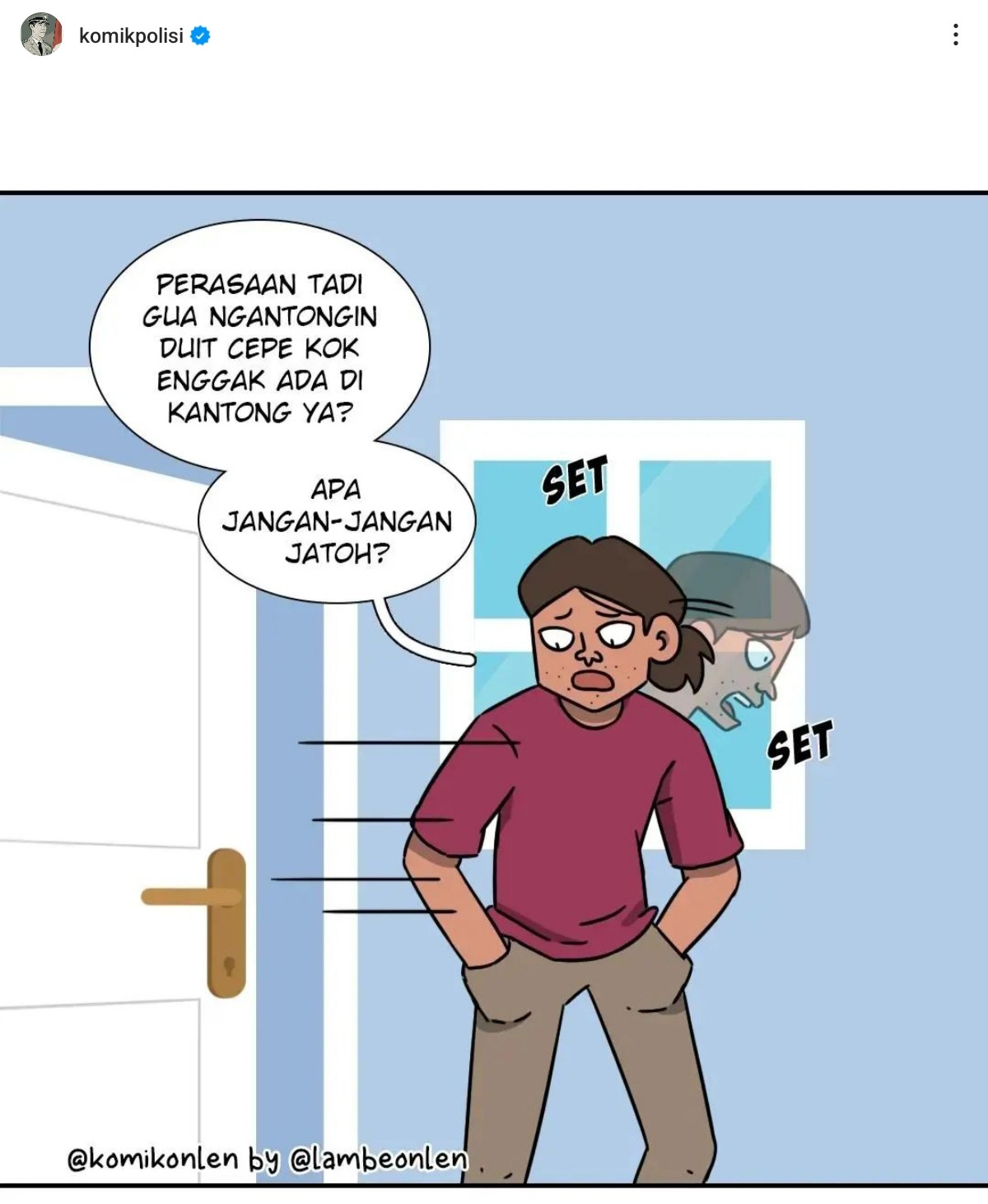
Perasaan tadi gua ngantongin duit cepe kok enggak ada di kantong ya? (I’m pretty sure I had a hundred bucks in my pocket earlier. Why did it go? Did it fall out or something?)
Below is an example that I took a screenshot of the YouTube Channel Neo Japan. Let’s look at the picture below.
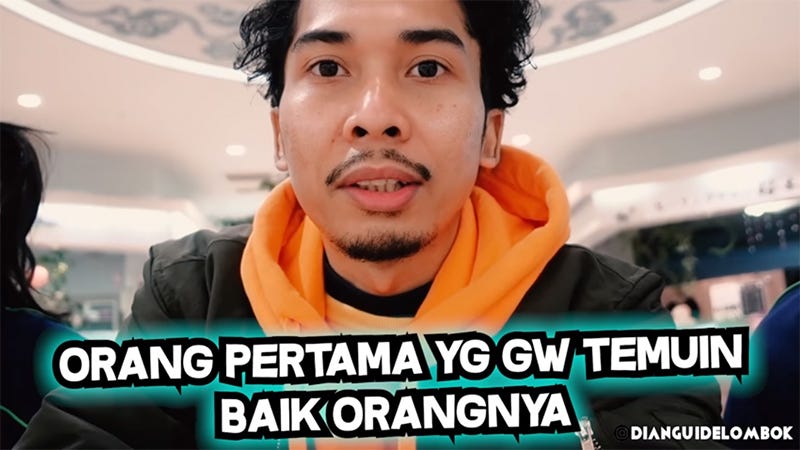
He writes it as [gw].
Orang pertama yang gw temuin baik orangnya. (The first person that I met was a nice person.)
Below is also written as [gw]. This is taken from an Instagram post by Komikpolisi.
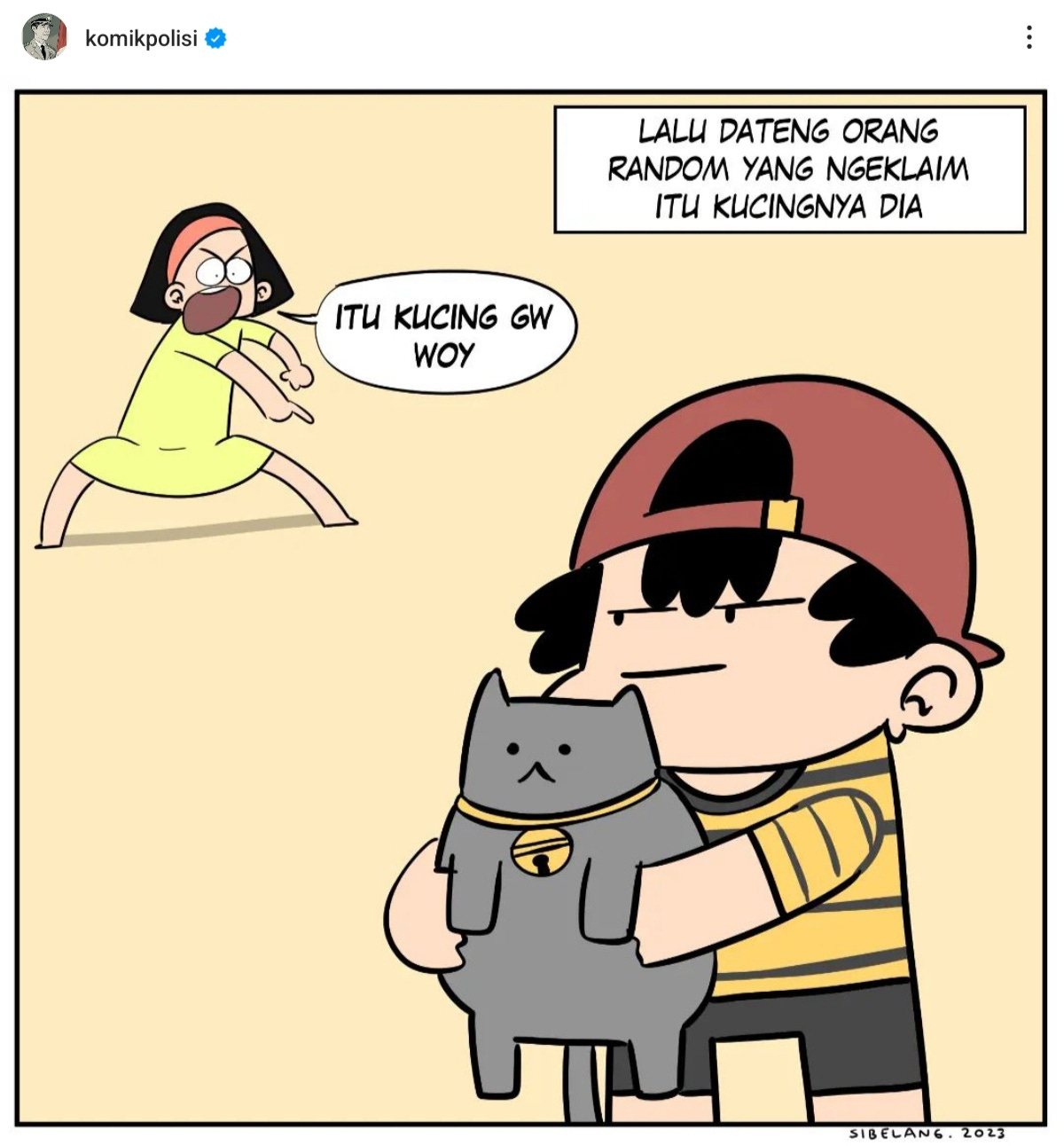
Lalu dateng orang random yang ngeklaim itu kucingnya dia.
A: Itu kucing gw woy.
(Then, some random girl showed up out of nowhere, claiming it was her cat.
A: “Yo! That’s my cat!”)
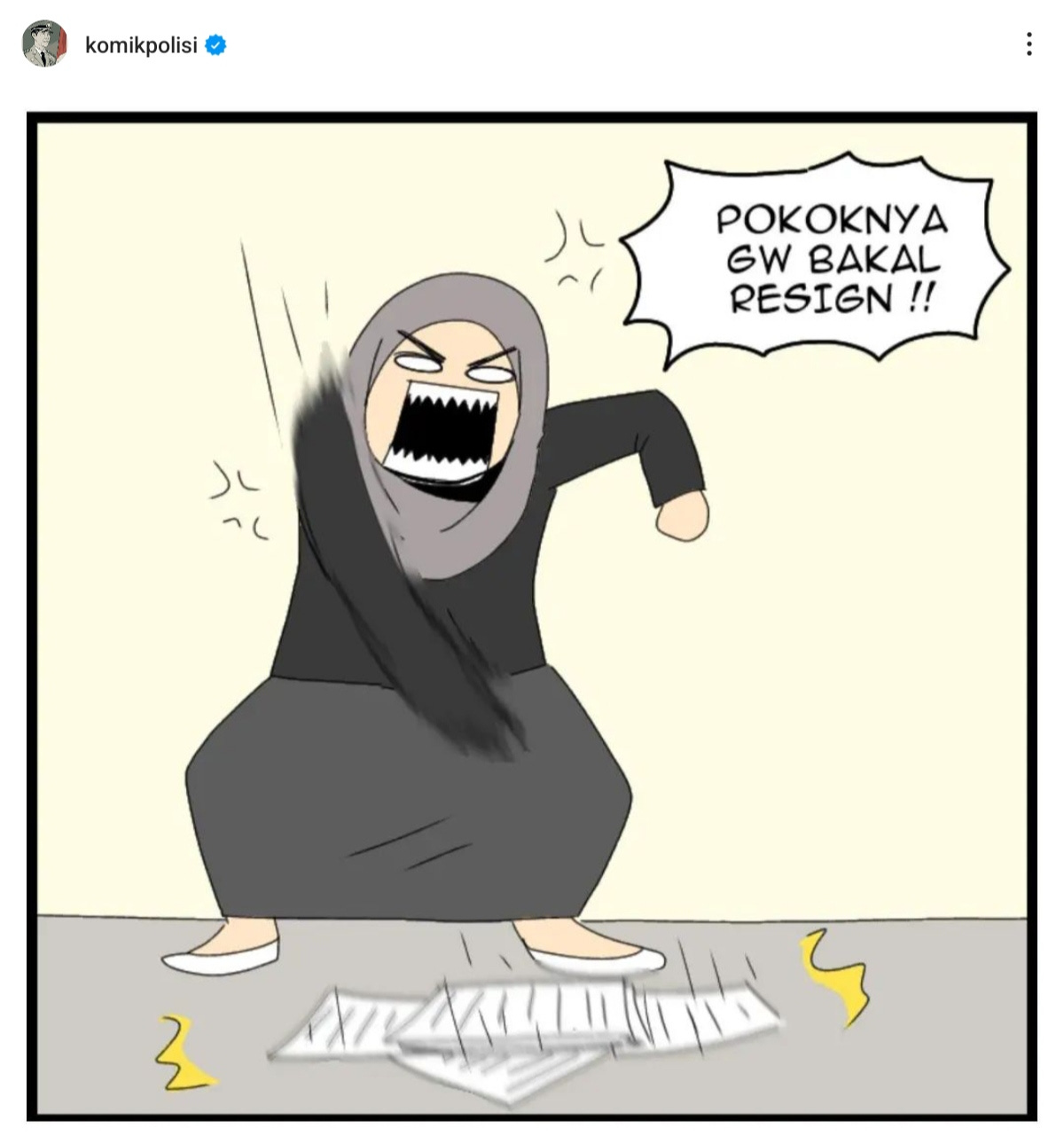
Pokoknya gw bakal resign!! (That is. I’m quitting!)
And the last example is taken from an Instagram post by Megonokomik. Here, it is written as [gwe].
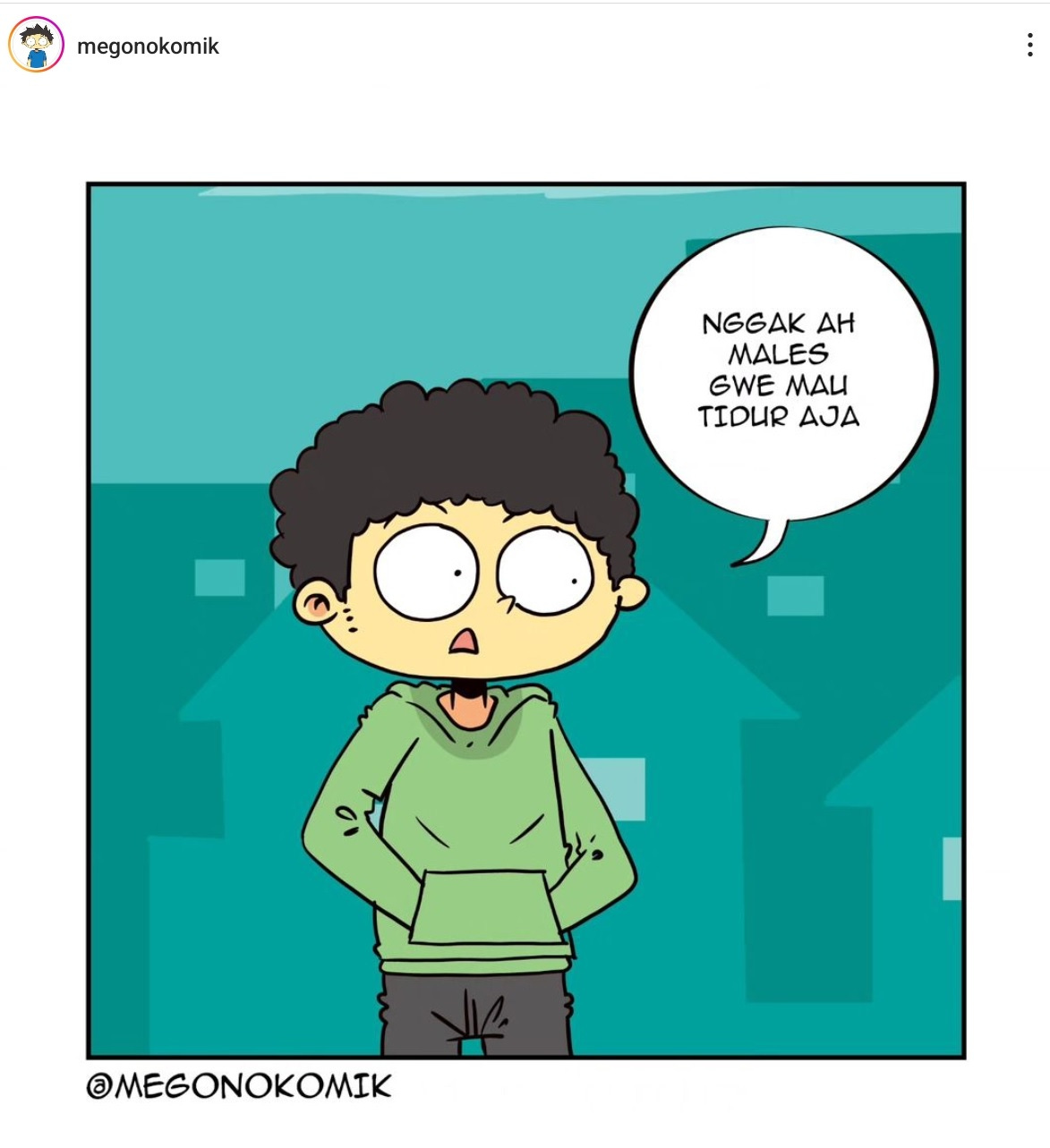
Nggah ah, males! Gwe mau tidur aja. (Nah, I don’t feel like it. I’m just gonna sleep.)
[Males] is usually spoken by Indonesians when they don't want to do something or are reluctant to do something.
If you found this article helpful and would like to support my work, you can buy me a coffee. Thank you for your support!
That wraps up this article. If you have any questions, just leave them in the comments below. Thank you for reading my article, and bye now.