

Halo semuanya, apa kabar? Ketemu lagi sama saya, Iman Prabawa. In my last article, I discussed how to say thank you in Bahasa Indonesia, and now we’re going to learn how to reply when someone is saying [terima kasih], or thank you in the Indonesian language, to you.
As always, we will watch examples from movies where Indonesians reply to someone who says [terima kasih] to them.
How to Reply If Someone Says Terima Kasih to You
If someone says, “Terima kasih” to you, you can reply by saying:
Sama-sama.
And here is how you pronounce [sama-sama].
If the person says, “Makasih ya,” you can reply by adding the word [iya] before [sama-sama]. Here it is:
Iya. Sama-sama.
And here is how you pronounce [Iya. Sama-sama].
You can also reply by saying:
Terima kasih kembali.
And here is how you pronounce [terima kasih kembali].
You can also reply by saying:
Kembali kasih.
But native Indonesian speakers rarely reply with this, so if they hear you reply with this, they will be impressed and maybe ask you questions such as, “Who taught you this?”
And here is how you pronounce [kembali kasih].
In literal meaning, [terima] means to accept, and [kasih] means love. So, [terima kasih] in literal meaning means you accept the love, so when you reply with [kembali kasih], [kembali] means to return, and [kasih] means love. [Kembali kasih] literally means that you return the love to the person who first gave it to you.
Examples of How Indonesians reply to Terima Kasih
In this section, you will watch examples, mostly from movies, where Indonesian people are replying to the phrase [terima kasih] said to them.
The first example we are about to watch is taken from a TV serial called Mimpi Metropolitan, Episode 1 (2019). Let’s watch the clip below.
For the conversation from the above scene with English translations and vocabulary explanations, you can read my article here:
How To Say Thank You In Indonesian

Halo semuanya, ketemu lagi dengan saya, Iman Prabawa. In this article, I want to talk to you about how to say [thank you] in the Indonesian language. We will also watch examples from movies where this phrase is spoken by the Indonesian people.
You can see that the woman says this:
Iya, sama-sama.
That’s because Bambang says, “Makasih ya,” with the added word [ya] at the end of the word [makasih]. So, the woman first replies with [iya], then says [sama-sama].
The second example we are about to watch is still from the same movie, Mimpi Metropolitan, Episode 1 (2019). Let's watch the clip below.
In this clip, Bambang also says [makasih ya], and the waiter first responds with the word [oke], followed by [sama-sama].
The waiter says this:
Oke, sama-sama.
[Oke] comes from the English word [okay]. Again, it’s just showing that the waiter is receiving that you thank him.
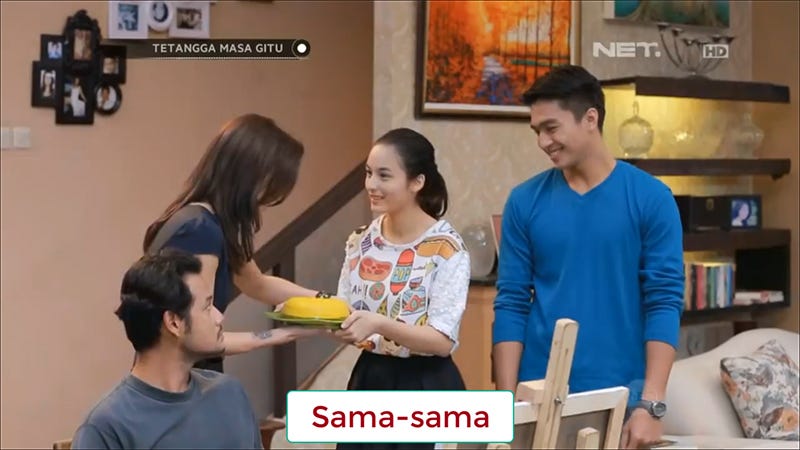
The third example is from a TV series called Tetangga Masa Gitu, Episode 1 (2014). Let's watch the clip below.
Conversation from the clip with English translations.
Adi: Tuh, siapa tuh? (Who is that?)
Bintang: Hai. (Hi.)
Adi: Huh, males! (Huh, I don’t like this!)
Bintang: Ini tadi aku bikin puding buah, buat mba Angel dan mas Adi. Mari dicoba. (I made fruit pudding for you, Angel, and Adi. Please try it.)
Angel: Tuh! Makasih ya. (See? Thank you.)
Bintang: Iya. Sama-sama. (You’re welcome.)
Angel: Masukin kulkas dulu ya. (I’ll put this in the refrigerator first.)
Bintang: Iya. (Okay.)
In this clip, Angel says:
Makasih ya.
And then Bintang replies by saying [iya] first, and then followed by [sama-sama].
Iya. Sama-sama.
So, if someone says [makasih] or [terima kasih] with the added word [ya] at the end, then it is better if you first reply with [iya] and then follow with [sama-sama].
Vocabulary From the Clip
[Siapa] = who.
[Tuh] is usually used to point at something or when you want to show something to your friends. [Tuh] = [itu] = that. For more about this, you can read my article: Itu, Tu, and Tuh in Indonesian.
[Males] in this context is said by Adi, which means that when he knows who comes to his house, he doesn’t feel comfortable because he doesn’t like his new neighbor. For more about this, you can read my article: Males Meaning in Bahasa.
[Tadi] = just now.
[Bikin] is the colloquial way of saying [membuat] = to make something.
[Buat] = [untuk] = for.
[Mari dicoba] = [silakan dicoba] = please try it.
[Masukin] is the colloquial way of saying [masukkan] = to put something in.
[Kulkas] = fridge.
The fourth example is from a TV serial called Suami-suami Masa Kini, Episode 2 (2022). Let’s watch the clip below.
Conversation from the clip with English translations.
Tania: Bye. (Bye.)
Everyone: Bye. (Bye.)
Tania: Ndri, Rumi. Makasih ya. (Ndri, Rumi. Thank you.)
Rumi: Iya, mba. Sama-sama. (Yeah. You’re welcome.)
Tania: Ti-ati. (You take care.)
Ical: Dah semua. Bye. (Bye, you all. Bye.)
Indri: Yok. (Let’s go.)
Tobi: Bye, guys. See ya. (Bye, guys. See ya.)
In this clip, Tania says [makasih] followed by the word [ya], and then, as you can see, Rumi first replies with [iya], and then she says [sama-sama].
Vocabulary From the Clip
[Mba] is an honorific title used to address a female older than you. In this scene, Tania is older than Rumi, and that’s why Rumi uses [mba] when addressing Tania. For more about this, you can read my article: Mba Meaning In Bahasa.
[Ti-ati] is a common reduction for [hati-hati]. You say this phrase when you say goodbye to your friends. [Hati-hati] here means take care.
If you found this article helpful and would like to support my work, you can buy me a coffee. Thank you for your support!
That’s gonna be it for now. If you have any questions, feel free to leave them in the comments below. Thank you for reading my article, and I’ll see you soon.