

Halo, ketemu lagi sama saya, Iman Prabawa. This time, we are going to learn how to say good morning in the Indonesian language. We will also watch scenes from movies to see how Indonesian people say good morning in the Indonesian language.
Good Morning In Bahasa Indonesia
Good morning in Bahasa Indonesia is [selamat pagi]. [Selamat pagi] is usually spoken between 5:30 AM and 10 AM. You can say it in the whole phrase [selamat pagi], or you can just say it [pagi].
If we translate this phrase word for word, [selamat] means to congratulate or be safe, and [pagi] means morning. So, [selamat pagi], if translated word for word, means safe morning or to congratulate the morning. It’s kind of weird and doesn’t make any sense, actually, if translated word for word, but nice to know.
How to Pronounce Selamat Pagi
Below is how you pronounce [selamat pagi] in bahasa Indonesia.
You can also say it [pagi], and below is how you pronounce it.
Moving on, we will watch examples where Indonesians say good morning in bahasa Indonesia.
Examples of Selamat Pagi In Use
The first example is from a movie called Mimpi Metropolitan (2018). Let’s watch the clip below.
Here’s what he says in the clip above:
Alan: Selamat pagi, kakak cantik. Kakak, kalau kuperhatikan ya, betul-betul cantik lho kak. (Good morning, pretty sister. Sis, if I look closely at you, you are truly pretty.)
He says [selamat pagi] instead of just [pagi].
Vocabulary From the Clip
[Kakak] is an honorific title to address older sisters or older brothers, but on Sumatra island, [kakak] is used to address only the older sisters and not the older brothers. For more about this, you can read my article here: Kakak In Indonesian.
[Kak] is short for [kakak].
[Kuperhatikan] = [aku perhatikan] = I look closely at you.
[Perhatikan] means to look closely at something.
[Cantik] means pretty.
[Kalau] = if.
[Betul-betul] = truly.
[Lho] here is to emphasize. He is emphasizing that she is really pretty. For more about this, you can read my article here: Lho In Indonesian.
The second example is still from the same movie, Mimpi Metropolitan (2018). Let’s watch the clip below.
Conversation from the clip with English translations.
Melani: Pagi, mas Alexi. (Morning, Mr. Alexi.)
Alexi: Oh, pagi. Menjelang siang sih tepatnya. (Morning. It’s almost noon, to be exact.)
In this clip, Melani and Alexi say [pagi] instead of [selamat pagi]. So, you can choose to say it [pagi] or [selamat pagi].
Vocabulary From the Clip
[Mas] is an honorific title to address older brothers in Java Island. For more about this, you can read my article here: Mas In Indonesian.
[Menjelang] = [me+jelang] = near the turn of something. Here, [menjelang siang] means the morning is near the turn into the afternoon.
[Siang] = afternoon.
[Tepatnya] = to be exact.
The third example is from a movie called Strawberry Surprise (2014). Let’s watch the clip below.
Conversation from the clip with English translations.
Guard: Pagi, mas. (Morning, sir.)
Timur: Pagi, mas. (Morning, sir.)
Guard: Masnya ini nunggu siapa ya? (Excuse me, who are you waiting for?)
Timur: Ee, saya nunggu galerinya buka. (I’m waiting for this gallery to open.)
Guard: Galerinya itu bukanya jam 8, mas. (This gallery opens at 8 AM, sir.)
In the clip, they both say [pagi] instead of [selamat pagi].
Vocabulary From the Clip
[Nunggu] is the colloquial form of the word [menunggu] = to wait. In conversational Indonesian, you will hear Indonesian people drop words and syllables here and there, like in this scene.
[Siapa] = who.
[Saya] = I.
[Buka] = open.
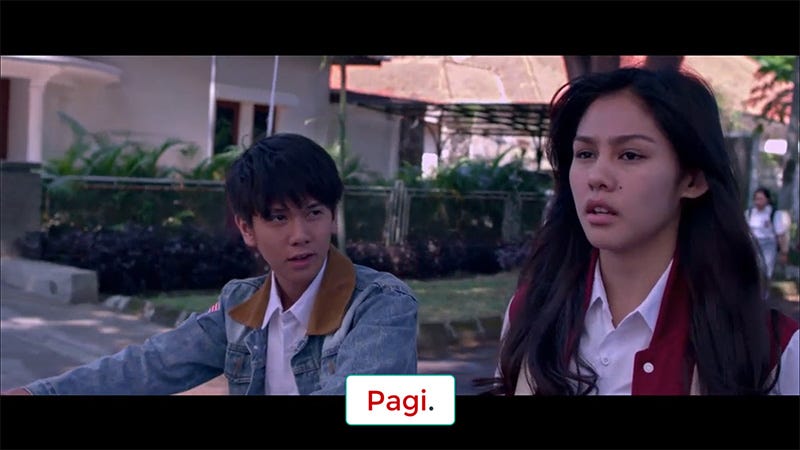
The fourth example is from a movie called Dilan 1990 (2018). Let’s watch the clip below.
Conversation from the clip with English translations.
Dilan: Selamat pagi. (Good morning.)
Milea: Pagi. (Morning.)
Dilan: Kamu Milea, ya? (You are Milea, aren’t you?)
Milea: Iya. (Yes.)
Dilan: Boleh aku ramal? (May I predict the future for you?)
Milea: Ramal? (Predict the future?)
Dilan: Iya. Aku ramal nanti siang kita akan bertemu di kantin. Mau ikut? (Yes. I predict that we will meet this afternoon in the cafeteria. Do you want to ride with me?)
Milea: Ngga, makasih. (No, thank you.)
Dilan: Tapi suatu hari nanti kamu pasti akan naik motorku. Percayalah. Duluan ya. (But one day I bet you will ride my bike. Believe me. I’m taking a leave now.)
In the clip above, Dilan says [selamat pagi] while Milea replies with just [pagi].
The fifth example is from a movie called Susah Sinyal (2017). Let’s watch the clip below.
In the clip above, she says [pagi] instead of the full phrase [selamat pagi] to her grandma. [Oma] means grandma.
The sixth example is from a movie called Devil On Top (2021). Let’s watch the clip below.
In the clip above, he says [pagi] to his boss, Sarah.
The seventh example is also from Devil On Top (2021). Let’s watch the clip below.
Conversation from the clip with English translations.
Angga: Selamat pagi. (Good morning.)
Sarah: Selamat pagi, Angga. Kamu hampir telat. Tepatnya 1 menit 25 detik. (Good morning, Angga. You are almost late—1 minute and 25 seconds, to be exact.)
In the clip above, both Sarah and Angga say [selamat pagi] instead of just [pagi]. So, from the examples that I gave you, you can see that some Indonesians say [selamat pagi], and some Indonesians just say [pagi].
So, you can choose whether to say it in a full phrase [selamat pagi] or just say [pagi]. It’s up to you.
If you found this article helpful and would like to support my work, you can buy me a coffee. Thank you for your support!
I think that’s gonna be it for now. If you have any questions, feel free to leave them in the comments below. Thank you for reading my article, and I’ll see you soon.