

Halo semuanya, ketemu lagi dengan saya, Iman Prabawa. In this article, I want to talk to you about how to say [thank you] in the Indonesian language. We will also watch examples from movies where this phrase is spoken by the Indonesian people.
Thank You In Indonesian
Thank you in bahasa Indonesia is:
Terima kasih.
And here is how you pronounce [terima kasih].
And you will also hear Indonesian people say this:
Makasih.
And here is how you pronounce [makasih].
[Makasih] is a common reduction for [terima kasih]. The difference between [makasih] and [terima kasih] is that [terima kasih] is more formal than [makasih]. [Makasih] is usually used in daily conversations.
Sometimes, you will hear them add [ya] to the phrase [terima kasih]. So, it is:
Terima kasih ya.
[Ya], in this case, doesn’t have any meaning. It’s just a filler word. And here is how you pronounce [terima kasih ya].
And sometimes, you will also hear Indonesians say this:
Terima kasih lho.
[Lho] in here also has no meaning. It’s just a filler word. Here is how you pronounce [terima kasih lho].
You can also add [ya] to [makasih], and it’s common, and you will hear Indonesian people saying this a lot.
Makasih ya.
And here is how you pronounce [makasih ya].
Also, you will hear Indonesians say [makasih lho].
Makasih lho.
And here is how you pronounce [makasih lho].
And, if you want to say [thank you very much], you can say this:
Terima kasih banyak.
And here is how you pronounce [terima kasih banyak].
[Banyak] means a lot. Next, we will watch examples from movies where these phrases are spoken by the Indonesian people.
Examples of Terima Kasih In Use
The first example we are about to watch is taken from a TV series called Mimpi Metropolitan (2019). In this clip, the phrase [makasih ya] is used.
Let’s watch the scene below.
Conversation from the clip with English translations.
Pelayan: Kopi, kopi, teh. (Coffee, coffee, tea.)
Bambang: Hm, mas mas. Saya mau kopi. Hee, masnya malah bengong. Ngga usah grogi di depan saya. Santai aja. Sini. (Hei! I want a cup of coffee, please. Hey, don’t be dumbfounded like that. Don’t be nervous with me. Just relax. Bring the coffee here.)
Pelayan: Iya, iya, iya. (Okay.)
Bambang: Gitu. Makasih ya. (That’s my boy. Thank you.)
Pelayan: Oke, sama-sama. (You’re welcome.)
The situation in this scene is between Bambang and a waiter. This waiter is serving coffee and tea and offering tea and coffee to the people in that location.
Vocabulary From the Clip
[Kopi] = coffee.
[Teh] = tea.
[Mas] is an honorific title to address older men in Indonesia or strangers on the street. For more about this, you can read my article: Mas Meaning In Bahasa.
[Mau] = want.
[Bengong] = dumbfounded.
[Grogi] = nervous.
The second example is still from the same movie, Mimpi Metropolitan (2019). In this scene, the phrase [makasih ya] is used.
Let’s watch the clip below.
Conversation from the clip with English translations.
Woman: Eh, iya nih. Makan nih. (Hey, I got this for you. You can eat this.)
Bambang: Buat saya mba? (This is for me?)
Woman: Iya, buat loe. Oh iya, jangan lupa ya dialognya. Yang tawuran itu, yang naskah. (Yes, that is for you. Don’t forget about the dialogue, the script about the fighting scene from the script.)
Bambang: Siap! (Okay.)
Woman: Awas lho! Udah, gue pergi dulu ya? (Please, do not forget! Okay, I got to go now.)
Bambang: Makasih ya, mba. (Thank you.)
Woman: Iya, sama-sama. (You’re welcome.)
In this clip, a woman gives [nasi kotak] to Bambang. [Nasi kotak] is food in a box. Here is what [nasi kotak] looks like.
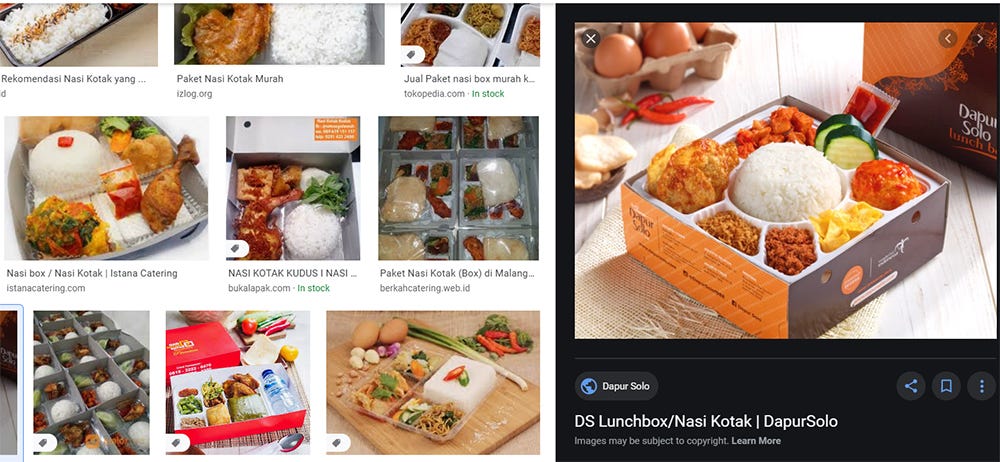
[Nasi kotak] is very common in Indonesia. And then Bambang is saying thank you to the woman who gave him [nasi kotak] using the phrase [makasih ya].
Vocabulary From the Clip
[Eh, iya nih] is a phrase used when you want to start talking about something and to attract the attention of the person you are talking to.
[Makan] = eat.
[Makan nih] is used when you offer someone food, like in this scene. The woman gives Bambang food to eat.
[Buat saya?] comes from the full sentence [ini buat saya?], which is usually said when you want to make sure that something is really for you.
[Oh iya] is used when you suddenly remember something to say.
[Loe] is informal for [Anda] = you. For a more detailed explanation of this, you can read my article here:
Loe In Indonesian

Halo semuanya, apa kabar? Ketemu lagi sama saya, Iman Prabawa. In this article, I want to talk about the meaning of the word [loe] in bahasa Indonesia. Not only talk about the meaning of the word, but I will also show you some examples from movies and other real-life situations where Indonesians use this word.
[Jangan lupa] = don’t forget. [Jangan lupa] is usually used to remind people about something and to warn them not to forget about something important.
[Siap], in literal meaning, means [ready], but [siap] is usually used when someone orders you to do something, and you are willing to do it. In this scene, the woman orders him not to forget about the dialogue, and he says yes.
[Tawuran] is when you fight not one by one but as a group, or many people fighting altogether.
[Awas lho!] is used when you threaten someone.
[Pergi] = to leave a place.
[Gue] is informal for [saya] = I. For a more detailed explanation of this, you can read my article here:
Gue In Indonesian

Halo semuanya. Apa kabar? Ketemu lagi sama saya, Iman Prabawa. Today, we’re going to talk about what [gue] means in Indonesian. As always, I’ll show you some examples from movies, YouTube videos, comics, and other real-life situations where Indonesians use this word.
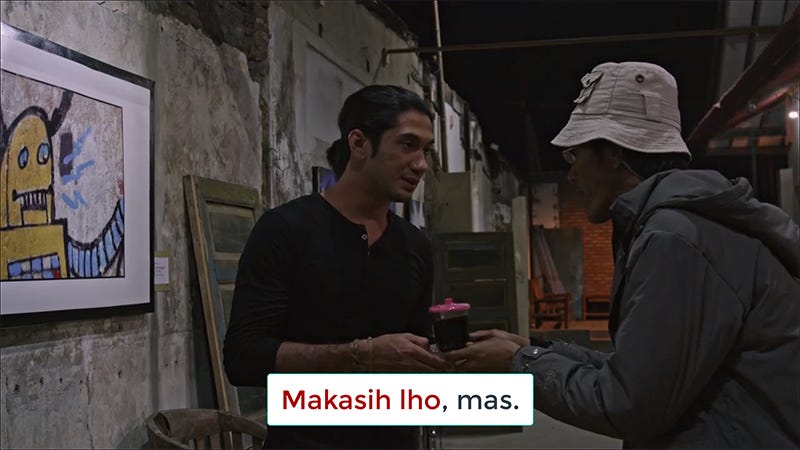
The third example is taken from a movie called Strawberry Surprise (2014). In this clip, the phrase [makasih lho] is used.
Let’s watch the clip below.
Conversation from the clip with English translations.
Man 1: Mas, ngopi dulu, mas. (Here is coffee for you.)
Man 2: Makasih lho, mas. (Thank you.)
Man 1: Silakan duduk. (Please, have a seat.)
Man 2: Iya. (Okay.)
Let’s learn the vocabulary used in this scene.
Vocabulary From the Clip
[Ngopi] is the colloquial way of saying [minum kopi]. It means drinking coffee.
[Ngopi dulu] is usually used to offer someone coffee, like in the scene. If you say [ngopi dulu yuk?] to your friends, it means that you are asking your friends to drink coffee with you.
[Silakan duduk] is a phrase used when you ask someone to sit down.
The fourth example is still from the same movie, Strawberry Surprise (2014). In this scene, the phrases [makasih lho] and [terima kasih banyak] are used.
Let’s watch the clip below.
Conversation from the clip with English translations.
Guard: Maaf, mas itu mau lihat galeri atau mau apa? (Sorry, do you want to see the gallery or else?)
Timur: Oh, sebenarnya saya mau ketemu sama mba Aggi. (Actually, I want to meet mba Aggi.)
Guard: Oh, mba Aggi ya? (Oh, you want to meet mba Aggi?)
Timur: He’eh. (Yes.)
Guard: Sebentar, mas. Tak buka’e dulu. Sik, sik, sik. (Wait a minute. I will open this for you. Just a sec.)
Timur: Wah, makasih lho, mas. Terima kasih banyak. (Thank you. Thank you very much.)
Guard: Maaf lho, mas. (Please come in.)
In this clip, the guard uses a mix of Indonesian and Javanese languages.
Vocabulary From the Clip
[Maaf] is usually used as a polite way before asking something to a person.
[Mau apa?] is used when you ask what someone wants or wants to do.
[Sebenarnya] If translated literally, the truth is.
[Mba] is an honorific title to address women. For more about this, you can read my article: Mba in the Indonesian Language.
[Sik, sik, sik] comes from the Javanese language. [Sik] in this context has the same meaning as [sebentar]. It means to wait for a second.
[Maaf lho, mas] literally means [I’m sorry, sir], but in this scene, this phrase is used just to be polite. That’s why I translated the phrase into [please come in].
The fifth example is taken from a serial called Wedding Agreement, Season 1, Episode 1 (2022). Let's watch the clip below.
In this scene, [terima kasih] is used. [Terima kasih] is the most formal form of all.
If you found this article helpful and would like to support my work, you can buy me a coffee. Thank you for your support!
That’s gonna be it for now. If you have any questions, feel free to leave them in the comments below. Thank you for reading my article, and I’ll see you soon.