

Halo semuanya. Apa kabar kalian? Hello, all of you. What’s going on? This time, I’m gonna talk about “what does ibu mean in the Indonesian language.” Maybe you’ve heard it but didn’t know what it means.
As always, we’re going to look at examples where Indonesians say this word.
Ibu In Bahasa Indonesia
Ibu means madam or Mrs. This is an honorific title when we address women in the Indonesian language. Ibu can also mean [mother]. Some people in Indonesia call their mother with [ibu] or [bu]. [Bu] is the short version of [ibu]. So, if you hear someone call [ibu] or [bu], it means the same thing.
To Whom Should You Address Ibu?
You should use this honorific title [ibu] for women who are older or young women who already have babies. Ibu is usually used in a formal situation.
Sometimes you will find that when you address someone with [ibu], she refuses to be called with that honorific title [ibu]. She will tell you if she doesn’t want to be called with that honorific title [ibu]. Maybe it’s because she still feels that she’s young enough to be called with the honorific title [ibu].
How to Pronounce Ibu
Here is how you pronounce [ibu] in bahasa Indonesia.
Next, I give you three example sentences using the word [ibu].
Example Sentences Using Ibu
Example sentences number 1:
Ibu, ayah pergi ke mana? (Mommy, where did Daddy go?)
Example sentences number 2:
Selamat malam bapak-bapak dan ibu-ibu yang saya hormati. (Good evening, ladies and gentlemen.)
Example sentences number 3:
Kami persilakan kepada Ibu Prapto untuk naik ke atas panggung. (We invite Mrs. Prapto to come on stage.)
Let’s hear the audio version of the three example sentences above.
Next, let’s watch examples, mostly from movies, where Indonesians use the word [ibu].
Examples of Ibu In Use
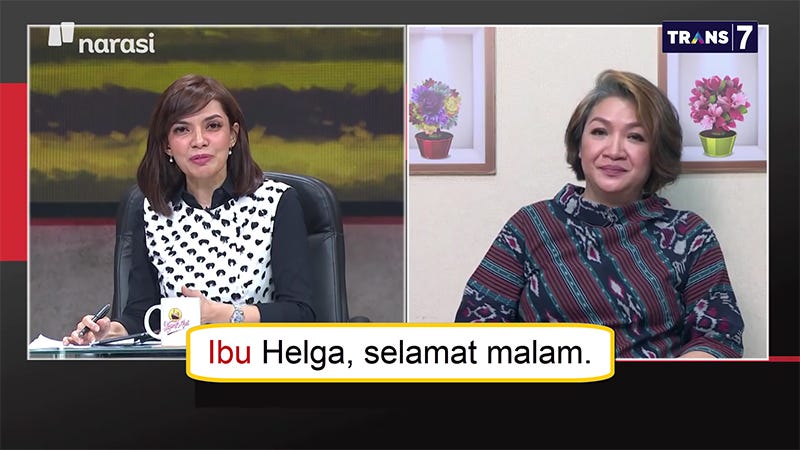
The first example we are about to watch is from a famous TV Program in Indonesia called Mata Najwa. Let’s watch the clip below.
Conversation from the clip with English translations.
Najwa: Selamat malam, Ibu Helga. (Good evening, Madam Helga.)
Helga: Selamat malam. (Good Evening.)
Najwa: Ibu Helga, selamat malam. (Madam Helga, good evening.)
Helga: Selamat malam. (Good evening.)
In the clip, Najwa called Helga with the honorific title [ibu] before her name, so she said Ibu Helga instead of just Helga.
The second example is taken from a TV Series called In the Kost (2020). Let’s watch the clip below.
Conversation from the clip with English translations.
Rina: Ini tuh Ibu.. Bu Tedjo, ya? (You are-- Mrs. Tedjo, right?)
Bu Prapto: Bukan! (Nope!)
Rina: Ibu siapa sih? (Who are you, ma’am?)
Bu Prapto: Aku ini tetangganya Bu Tedjo. (I’m Mrs. Tedjo’s neighbor.)
Rina: Bu.. (Mrs--)
Bu Prapto: Tahu Bu Broto? (You know Mrs. Broto?)
Rina: Ah, iye Bu Broto. (Ah, yes, I know Mrs. Broto.)
Bu Prapto: Saya sebelah rumahnya Bu Broto. (I live next to Mrs. Broto’s house.)
Rina: Jadi, Ibu Surti? (So, you are Mrs. Surti?)
Bu Prapto: Ah, itu! (You got it!)
Rina uses the honorific title [bu], which is short for [ibu] when addressing Mrs. Prapto. It is considered polite to use [bu] or [ibu] when addressing an older woman, and it is considered impolite if you just call her by her name and do not use the honorific title [ibu] when addressing her.
If you found this article helpful and would like to support my work, you can buy me a coffee. Thank you for your support!
That wraps up today’s article. If you have any questions, feel free to leave them in the comments below. Thank you for reading my article, and I’ll see you soon.