

Halo semuanya, apa kabar? Ketemu lagi sama saya, Iman Prabawa. In this article, I want to talk about the meaning of the word [loe] in bahasa Indonesia. Not only talk about the meaning of the word, but I will also show you some examples from movies and other real-life situations where Indonesians use this word.
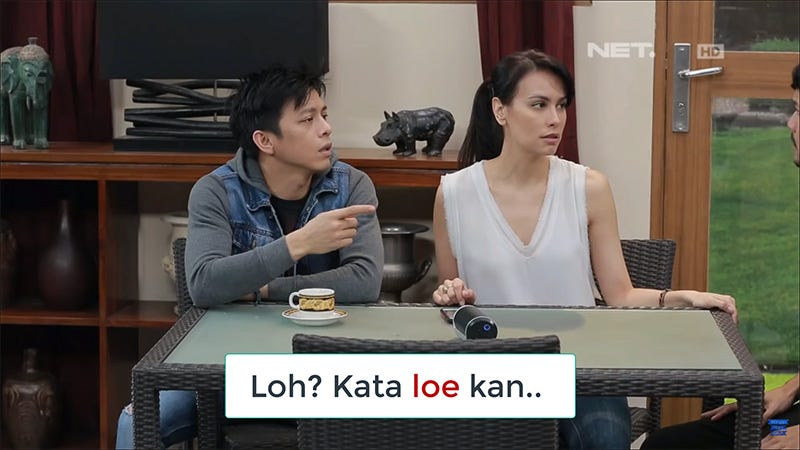
Loe In Indonesian
So, [loe] basically means [you], but in an informal way. It’s super casual. You might see it spelled in different ways, like loe, lo, elo, lu, eloe, or even luh. Don’t get confused — they all mean the same thing. Just different spellings, same meaning, same casual vibe.
And usually, [loe] goes together with [gue].
So, it’s like:
Gue = I
Loe = you
It’s kind of like a package deal.
Now, where do people use it? Mostly in Jakarta and nearby cities like Bogor, Depok, Tangerang, and Bekasi. People often call this area JaBoDeTaBek.
But nowadays, because a lot of Indonesian movies and shows are produced in Jakarta, words like [gue] and [loe] have spread to other cities too. So, even if someone’s not from Jakarta, you might still hear them using these words.
How to Pronounce Loe
Some Indonesians pronounce this word as [lo]; I’ll show it in the video below.
And some Indonesians pronounce this as [lu]; I will also show you in the video below.
[Lu] and [loe] have the same pronunciation.
Let’s hear it in a sentence using [lu] or [loe].
Loe dari mana? (Where have you been?)
And now let’s hear it in a sentence using [lo].
Lo dari mana? (Where have you been?)
Can you hear the difference?
So, you can choose to pronounce it as the first (lu or loe) or the latter (lo). Don’t worry, both are correct.
Examples of Loe In Use
Let’s look at the picture below. It is written as [lu].
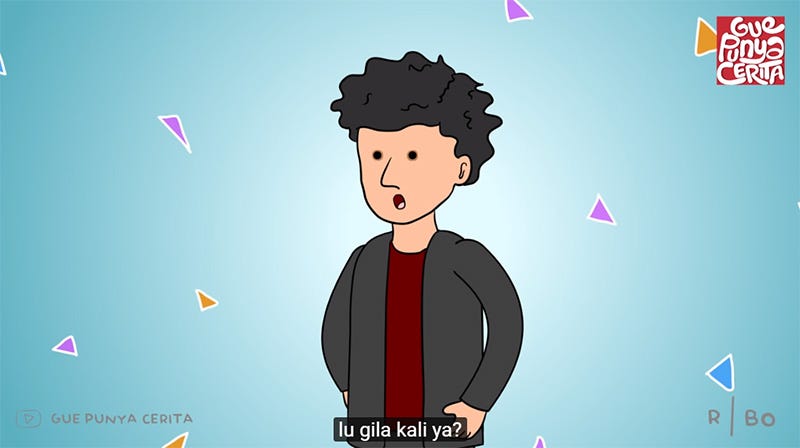
It says:
Lu gila kali ya? (Are you out of your mind?)
And let’s look at another example. This is from an ad that I saw on the street, so I stopped for a while and then took a picture of it.
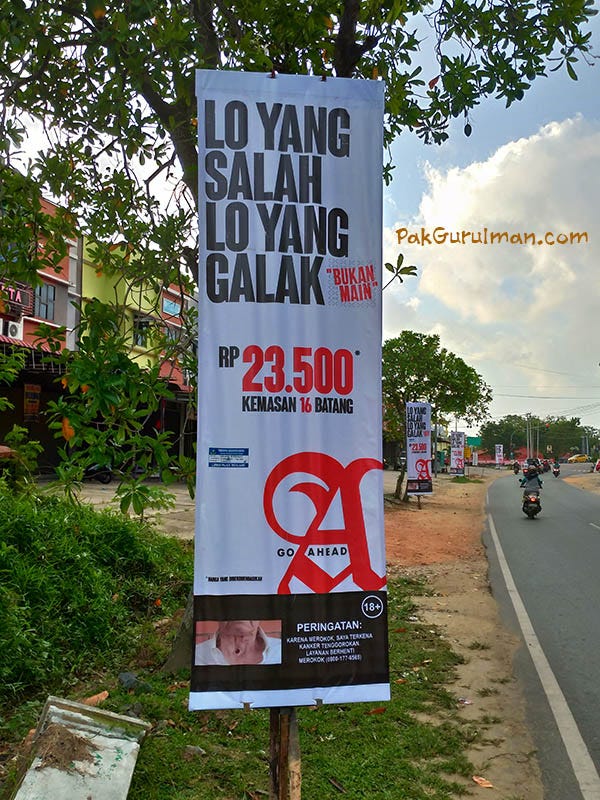
It says:
Lo yang salah, lo yang galak. (You’re the one at fault, and you’re acting angry?)
Now, let’s look at other examples. This time, we’ll look at examples from movies.
The first example from movies is taken from a TV Serial called Tetangga Masa Gitu (2014). Let’s watch the clip.
Conversation from the clip with English translations.
Angel: Sini, sini, dengerin! Album barunya. Keren deh! (Hey, come here, come here! Listen to this! It’s his new album. It’s awesome!)
Adi: Engga, ini si.. Panda, loe ngapain pagi-pagi di sini? (No, wait — Panda, what are you doing here this early?)
Panda: Loh? Kata loe kan, gue disuruh jemput pagi-pagi ke sini? Kan kita mau ketemu anak-anak di mall? Lupa ya? (Huh? You told me to come pick you up early, remember? We’re meeting the guys at the mall. Don’t tell me you forgot?)
Adi: Amnesia! (Guess I’ve got amnesia!)
This is a conversation between friends, and as you can see, they use [gue] and [loe].
Let’s hear again the part where Adi says the word loe.
Adi: Panda, loe ngapain pagi-pagi di sini? (Panda, what are you doing here this early?)
Vocabulary From the Clip
[Sini] is used when you invite someone to come near you.
[Dengerin] is used to ask someone to listen to something.
[Keren] = awesome.
[Engga] = [ngga] = [tidak] = no.
[Ngapain] = [melakukan apa?] is a question word when you want to ask what somebody is doing.
[Pagi-pagi] = early morning.
[Anak-anak] is usually translated into [children], but in this context, it refers to guys, or their friends who are waiting at the mall.
[Lupa] = forget.
The second example from movies is taken from a TV Series called The East (2015). Let’s watch the clip.
Conversation from the clip with English translations.
Gista: Rin! Sini. Tadi loe nanya, kan? Kapan gue tahu kalau gue jatuh cinta sama suami gue? Jadi mo denger ga? (Rin! Come here. You asked me earlier, right? When did I know I was falling in love with my husband? So... you wanna hear it?)
Karin: Oh ya, kalo loe mau cerita, cerita aja. Gue cuman lagi riset doang kok buat Ini Talk Show. (Oh yeah? If you wanna tell me, just tell me. I’m just doing some research for Ini Talk Show anyway.)
Gista: Oke. Eh, sini, sini, sini, sini! Gue ceritain ya. (Okay, come here. Seriously, get over here! Alright, I’ll tell you.)
Gista and Karin are coworkers. They use informal Indonesian when talking to each other. As you can see, they use [gue] and [loe] when talking.
Let’s hear again the part where Gista says the word loe.
Gista: Tadi loe nanya, kan? (You asked me earlier, right?)
Vocabulary From the Clip
[Tadi] = earlier.
[Nanya] is informal for [bertanya] = to ask (about something).
[Mo] is informal for [mau] = want.
[Jatuh cinta] = falling in love.
[Suami] = husband.
[Denger] here is colloquial for [mendengar] = to listen. And in daily conversation like this, Indonesians tend to drop syllables.
[Kalo] is informal for [kalau] = if.
[Cuman] is informal for [hanya] = just.
The third example from movies is taken from a web series called Usia Panik (2019). Let’s watch the clip.
Conversation from the clip with English translations.
Gina: By the way, thanks ya. Selama seminggu ini loe udah mau bantuin gue jadi pacar pura-pura. (Hey, by the way, thanks again for pretending to be my boyfriend this week.)
Ervan: Iya. (Yeah, no worries.)
Gina: Tapi loe bantuin gue kaya gini, cewe loe ngga marah kan? (Your girlfriend didn’t get mad about it or anything, right?)
Ervan: He? Ya ngga lah. (Huh? Nah.)
This conversation is using informal Indonesian, as you will hear in daily conversation in Indonesia.
Let’s hear again the part where Gina says the word loe.
Gina: Tapi loe bantuin gue kaya gini, cewe loe ngga marah kan? (Your girlfriend didn’t get mad about it or anything, right?)
Vocabulary From the Clip
[Seminggu] = [satu minggu] = one week.
[Udah] is short for [sudah] = already.
[Bantuin] is informal for [membantu] = to help.
The fourth example from movies is taken from a web series called Like Me, Please? (2019). Let’s watch the clip.
Conversation from the clip with English translations.
Chris: Heh! Briefing dicancel! Jadi bos itu ada jadwal dadakan makanya meetingnya diundur. Makanya lu kalo bangun lu biasainlah, cek handphone. Lihat ada message dari gua. (Hey, briefing’s canceled! Boss had something come up, so the meeting’s pushed back. Also, you should get in the habit of checking your phone when you wake up. I sent you a message.)
Helga: Ups. (Oops.)
Chris: Coba lihat, ada ngga? (Go ahead, check. Did you get my message?)
Helga: *senyum (*smiles.)
Chris: Hmm, ada kan? Hmm. (Yeah, see? There it is.)
Chris here uses the word [lu] when talking to Helga.
Let’s hear again the part where Chris says the word lu.
Chris: Makanya lu kalo bangun lu biasainlah, cek handphone. (Also, you should get in the habit of checking your phone when you wake up. I sent you a message.)
Vocabulary From the Clip
[Dadakan] means something that happens suddenly and without warning.
[Bangun] = wake up.
[Biasainlah] is the colloquial way of saying [biasakanlah] = get in the habit.
The fifth example from movies is taken from FILOSOFI KOPI, The Series: Episode 1 (2017). Let’s watch the clip.
Conversation from the clip with English translations.
Ben: Nih! Loe cobain kopinya deh. Loe liat tempatnya. Enak kan? Simple. Kopinya juga enak. (Here, try the coffee. Look at this place. Nice, right? Simple. And the coffee’s great too.)
As you can see, Ben’s here uses [loe] when talking to his friend, Jody.
Let’s hear again the part where Ben says the word loe.
Ben: Loe liat tempatnya. (Look at this place.)
Vocabulary From the Clip
[Cobain] is the colloquial way of saying [coba] = try. In daily conversation, word+in is common.
[Liat] is short for [lihat] = look.
[Enak] = delicious, good, great.
If you found this article helpful and would like to support my work, you can buy me a coffee. Thank you for your support!
That wraps up this article. If you have any questions, just leave them in the comments below. I’ll see you soon.