

Halo semuanya. Ketemu lagi sama saya, Iman Prabawa. In this article, I want to talk to you about the word [mas] in bahasa Indonesia. You will hear this word a lot if you are in Indonesia, especially on Java Island.
Mas In Bahasa Indonesia
[Mas] is a common honorific we use in Indonesia to address men, especially those who are older than us. In everyday situations, it can feel a bit impolite if you talk to an older man without using some kind of respectful title like [mas] before his name.
The word [mas] actually comes from Javanese, one of the local languages in Indonesia. But today, it’s used all over the country and has become part of daily conversation.
In English, [mas] is often translated as [brother] or [bro], but it’s not exactly the same. [Mas] sounds more polite and respectful. Later, we’ll look at some scenes from Indonesian movies to see how people really use it in conversations.
So, when do you use mas?
Here are three simple situations to remember:
For older men.
This is the most common use. If a man is older than you, you can call him [mas], or if you know his name, you can add [mas] before his name.
For strangers.
Even if a man is around your age, if you don’t know him, it’s polite to call him [mas] — for example, when talking to someone on the street.
For a male boss (especially if he’s unmarried)
Even if your boss is younger than you, using [mas] before his name sounds more polite and respectful in some situations.
How to Pronounce Mas
Here is how you pronounce [mas] in bahasa Indonesia.
Moving on, let’s look at examples, mostly from movies, where Indonesians use the word [mas].
Example of Mas in Use
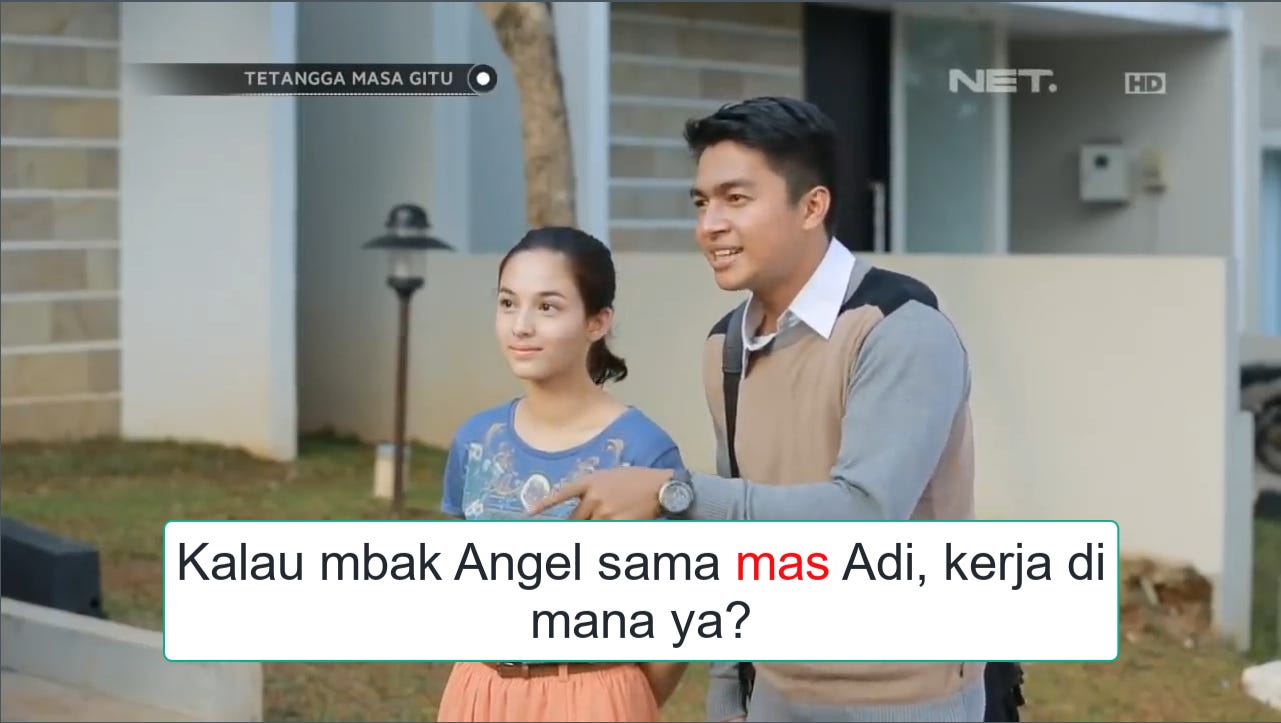
The first example is from a movie called Tetangga Masa Gitu (2014). Let’s watch the clip below.
Below is the transcript from the clip, along with the English translation:
Bastian: Kalau mbak Angel sama mas Adi, kerja di mana ya? (So, where do you guys work?)
Angel: Kalau saya di law firm, kalau suami saya, guru gambar di SMA Matahari. (I work at a law firm, and my husband is an art teacher at Matahari High School.)
Bastian: Oh, guru gambar? Wah, keren banget tuh, mas! Keren ya? (Oh, an art teacher? Wow, that’s awesome, man! Pretty cool, right?)
Bintang: He’eh. (Yeah!)
Adi: Yah, bisa hiduplah. (Well… it pays the bills.)
Angel: Tapi pas-pasan. (Barely—we’re just getting by.)
In this scene, we’ve got two married couples: Adi and Angel, and Bastian and Bintang. Bastian and Bintang have just moved into the same neighborhood as Adi and Angel, so this is their first time meeting each other.
If you pay attention, Bastian calls Adi with an added word [mas] before his name. That’s because Adi is older than him. In Indonesian, using [mas] for men and [mbak] for women is a really common way to sound polite and respectful, especially when you’re talking to someone who’s a bit older.
So here, Bastian is being friendly, but also showing good manners by using [mas] and [mbak] when talking to his new neighbors.
Vocabulary From the Clip
[Kerja] = work.
[Suami] = husband.
[Guru gambar] = drawing teacher.
[Keren] = awesome, cool.
[He’eh] is informal for [iya], and it is used when you agree with someone.
The second example is from a movie called The East (2015). Let’s watch the clip below.
Below is the transcript from the clip, along with the English translation:
Mutia: Iya, mas. (Yes, sir.)
Dhewo: Mutia, habis live ke ruangan saya ya. (Mutia, after the live session, can you come to my office?)
Mutia: Baik, mas. (Okay, sir.)
In the clip, Dhewo asks Mutia to come to his office after the live session. Dhewo is Mutia’s boss, and Mutia addresses him using the honorific [mas].
Mutia uses [mas] when speaking to her boss simply as a sign of respect. She could use [pak] instead, but addressing Dhewo as [pak] would make him sound older than he actually is. Since Dhewo is still young and unmarried, Mutia prefers to address him as [mas] rather than [pak].
The third example is from a movie, Mimpi Metropolitan (2018). Let’s watch the clip below.
Below is the transcript from the clip, along with the English translation:
Supir Bis: Mas, lihat! Kampung Rambutan itu bagian dari Jakarta. Sekarang masnya mau Jakarta bagian mana? Jakarta Barat, Jakarta Selatan, Jakarta Utara, atau Jakarta Timur? (Sir, look! Kampung Rambutan is part of Jakarta. Which part of Jakarta are you heading to? West Jakarta, South Jakarta, North Jakarta, or East Jakarta?)
Bambang: Kalau Utara, arahnya ke mana ya, mas? Kalau di kampung saya, Utara itu patokannya Gunung Merapi. (Which direction is north? Back in my village, we use Mount Merapi as a reference point for north.)
In the clip above, Bambang is at a bus station. Since he doesn’t know the way, he asks a bus driver for directions, and the driver explains the route to him.
As we can see, Bambang uses the honorific [mas] when speaking to the bus driver, and the bus driver likewise uses [mas] when speaking to Bambang.
So, it is common in Indonesia to use the honorific [mas] when talking to a stranger, especially a man, in everyday situations.
The fourth example is from a movie, Strawberry Surprise (2014). Let’s watch the clip below.
Below is the transcript from the clip, along with the English translation:
Penjaga Rumah: Pagi, mas. (Morning, sir.)
Timur: Pagi, mas. (Morning, sir.)
Penjaga Rumah: Masnya ini nunggu siapa, ya? (Who are you waiting for?)
Timur: Ee, saya nunggu galerinya buka. (Uh, I’m waiting for the gallery to open.)
Penjaga Rumah: Galerinya itu bukanya jam 8, mas. (The gallery opens at 8, sir.)
In this scene, the two men are strangers to each other. As you can see, they both use the honorific [mas] when speaking to each other.
The last example is from a movie, 3 Dara 2. Let’s watch the clip below.
Below is the transcript from the clip, along with the English translation:
Ani: Kamu investasi apa sih, mas? Sampai kita habis-habisan kaya gini. Berapa besar uang yang hilang? (What did you invest in, exactly? We’ve lost everything because of this. How much money did we lose?)
Affandi: Maafin aku, Ni. (I’m sorry, Ni.)
Ani: Ani perlu tahu, mas. Supaya Ani bisa bantu. Mas, ngga perlu nanggung semua ini sendirian, mas. Kita hadapin sama-sama. (I need to know, Mas. So I can help. You don’t have to deal with all of this on your own. We’ll face it together.)
Here, Ani is talking to her husband, Affandi. In Indonesia, it is common for wives in Java to address their husbands as [mas], either by using [mas] before their husband’s name or simply calling him [mas]. This is a common practice in Java, although it is not necessarily in other parts of Indonesia.
If you found this article helpful and would like to support my work, you can buy me a coffee. Thank you for your support!
That wraps up for today’s article. If you have any questions, feel free to leave them in the comments below. Thank you for reading my article, and I’ll see you again soon. Bye for now!