

Halo semuanya. Apa kabar? Ketemu lagi sama saya, Iman Prabawa. In this article, I want to talk to you about the meaning of the word [mbak] in bahasa Indonesia.
To better understand this, as always, we will look at examples, mostly from movies, where Indonesians use this word.
Mbak In Bahasa Indonesia
[Mbak] is an honorific title used to address women in Indonesia, especially those who are a bit older than you. In Indonesian culture, using the right honorific matters — it can feel impolite if you use the wrong one when talking to someone.
You might also see it written as mba (without the letter “k” at the end). I personally prefer writing in that way too, [mba]. So, you will see it written as mbak or as mba. Both are acceptable.
The word [mbak] originally comes from Javanese, but it’s now commonly used all across Indonesia.
In English, [mbak] is closest to “older sister.” But it’s not only used for family — you’ll hear it in everyday conversation as well.
To help you understand how it’s actually used, we’ll look at a few scenes from Indonesian movies later in this article.
So, when do you use [mbak]?
Here are three common situations:
When talking to a woman who’s older than you.
She should be slightly older than you.
When speaking to a female stranger.
For example, if you meet a woman around your age on the street, you would still use [mbak] since you don’t know her.
When addressing your female boss.
Even if she’s younger than you, it’s still more polite to use [mbak], especially in a professional setting.
How to Pronounce Mbak
Here is how you pronounce [mbak] in bahasa Indonesia.
Next, let’s look at examples from movies where Indonesians use the word [mbak].
Examples Of Mbak In Use
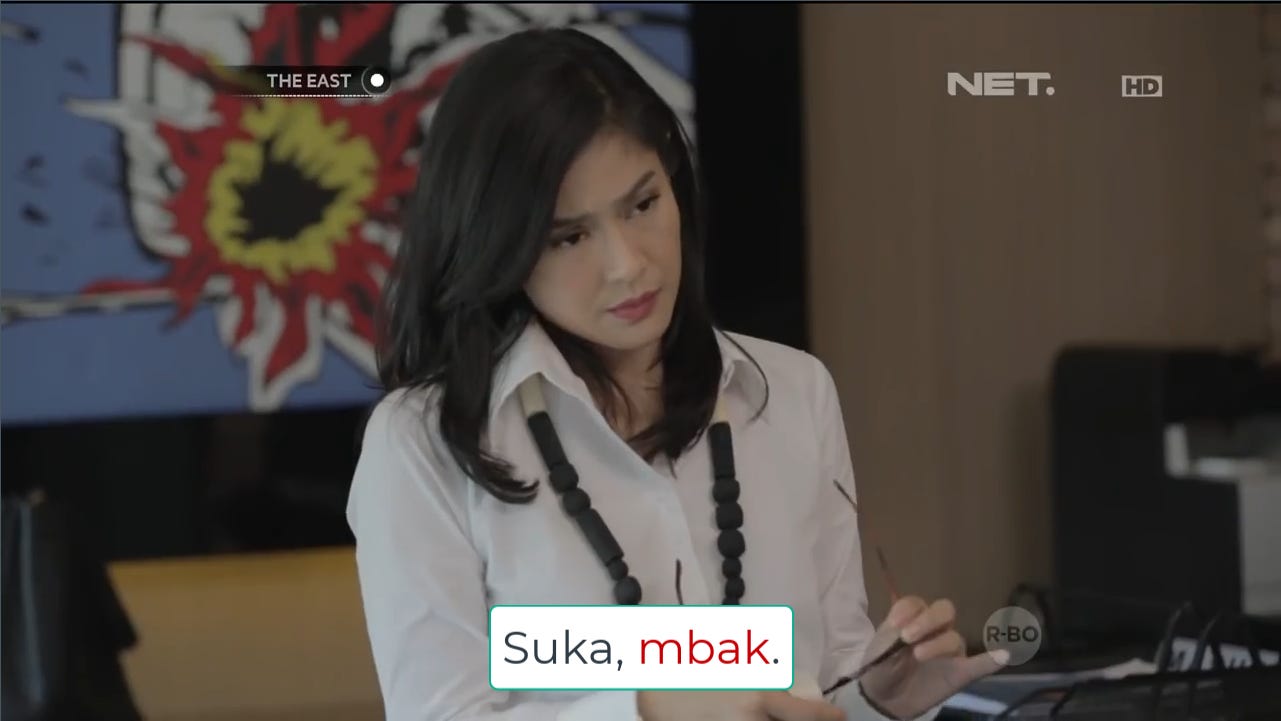
The first example is from a movie called The East (2015). Let’s watch the clip below.
Conversation from the clip with English translations.
Dhewo: Maaf, mbak. Soal tayangan yang salah itu, begini, mbak. Ini.. (Sorry, ma’am. About the wrong broadcast—I can explain. It’s just that...)
Dian Sastro: Kalo mo ngomong tu duduk dulu! Bisa ngga, sih? (If you want to talk, sit down first. Can you do that?)
Dhewo: Soal tayangan yang salah itu, begini, mbak. Kita.. (About the wrong broadcast... I can explain. We...)
Dian Sastro: Siapa yang bilang lo udah bisa ngomong, sih? Dhewo! Jabatan lo tu apa sih? (Who said you could speak? Dhewo! What exactly is your position here?)
Dhewo: Kepala Departemen, mbak. (I’m a department head, ma’am.)
Dian Sastro: Suka sama jabatan lo? (And do you even like your position?)
Dhewo: Suka, mbak. (Yes, ma’am.)
In this scene, Dhewo makes a mistake—he airs the wrong broadcast. When Dian Sastro, his boss, finds out, she calls him into her office to talk about it.
Now, pay attention to how they address each other.
You’ll notice that Dhewo uses [mbak] when speaking to his boss. Even though Dian Sastro is actually much younger than him, she’s still his superior, so he uses this honorific to show respect.
Meanwhile, Dian simply calls him “Dhewo” without adding [mas] before his name. Since he’s her subordinate, this is completely normal—there’s no need for her to use an honorific when addressing him.
Vocabulary From the Clip
[Maaf] = sorry.
[Kalo] is informal for [kalau] = if.
[Mo] is informal for [mau] = want.
[Tu] is short for [itu] = that.
[Lo] is informal for [Anda] = you. For a more detailed explanation, you can read my article here:
Loe In Indonesian

Halo semuanya, apa kabar? Ketemu lagi sama saya, Iman Prabawa. In this article, I want to talk about the meaning of the word [loe] in bahasa Indonesia. Not only talk about the meaning of the word, but I will also show you some examples from movies and other real-life situations where Indonesians use this word.
[Sih] has no meaning; its function is just to emphasize. For more about this, you can read my article here:
Sih In Indonesian

Halo semuanya. Apa kabar? Ketemu lagi sama saya, Iman Prabawa a.k.a Pak Guru Iman. In this article, I want to talk to you about the meaning of the word [sih] in Indonesian. As always, we are also going to be watching examples from movies, comics, and others to better understand the meaning and to see how Indonesians use the word [sih] in their daily con…
[Udah] is short for [sudah] = already.
[Ngomong] is informal for [berbicara] = to talk.
[Suka] = like.
[Jabatan] = position.
The second example is still from the same movie, The East (2015). Let’s watch the clip below.
Conversation from the clip with English translations.
Mutia: Mana Gista? (Where is Gista?)
B: Toilet, mbak. (She’s in the toilet.)
Here, Mutia asks B where Gista is, and B is Mutia’s subordinate, and that’s why B calls Mutia with the prefix [mbak] because it is considered not polite if B calls Mutia without the prefix [mbak].
The third example is from a web series, Di Balik Kubikal (2018). Let’s watch the clip below.
Conversation from the clip with English translations.
Rina: Shinta! Masa mainan handphone lagi sih? Bantuin mikir dong! Kita bakalan telat. (Shinta! Seriously, are you playing with your phone again? Help us figure this out! We’re gonna be late!)
Shinta: Mba Rin, aku kan punya online shop ya dan ini lagi banyak banget pesanan. Atau mungkin mba Rina mau mesan di aku juga? Aku jual semua barang yang ada di dunia. (Mba Rin, I run an online shop, remember? I’ve got tons of orders right now. Maybe you’d like to buy something from me, too? I sell just about everything under the sun.)
In this scene, Shinta, who is younger than Rina, used the word [mba] when she addressed her.
Vocabulary From the Clip
[Masa] is a word you use when you want to ask about something.
[Mainan] = [bermain] = to play with something.
[Bantuin] is the conversational way of saying [bantu] = help.
[Mikir] is the conversational way of saying [berpikir] = to think.
[Bakalan] = akan.
[Telat] = late.
[Aku] is informal for [saya] = I. For more about this, you can read my article here:
Aku In Indonesian

Halo, semuanya? Apa kabar? This time, we are going to talk about the meaning of [aku] in Indonesian. As always, we are also going to be watching examples from movies, YouTube videos, and whatnot, where Indonesians use this word.
[Banget] is the conversational way of saying [sekali] = very.
[Banyak banget] = banyak sekali = a great many of something.
[Mesan] is short for [memesan] = to order.
[Jual] = sell.
[Dunia] = world.
If you found this article helpful and would like to support my work, you can buy me a coffee. Thank you for your support!
That’s gonna be it for now. If you have any questions, feel free to leave them in the comments below. Thank you for reading my article, and I’ll see you soon.