

Halo semuanya. Ketemu lagi sama saya, Iman Prabawa. This time, I want to talk to you about the meaning of the word [mpok] in the Indonesian language. Actually, it is a Betawi word, but sometimes you will hear it when you watch Indonesian movies.
As always, we will watch scenes from movies where this word [mpok] is spoken to better understand the meaning.
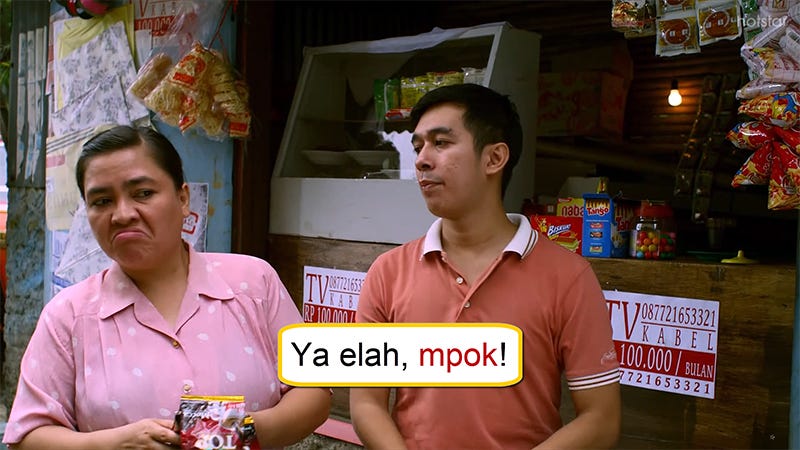
Mpok Meaning In Indonesian
[Mpok] is a word that comes from the Betawi language. [Mpok] is an honorific title used to address females who are older than us. It’s like [mbak] in the Javanese language or [teteh] in the Sundanese language.
In Indonesia, almost every region has its own regional language, and the language in one region differs from the language in another region. So, it is good for you to know about the meaning of the word [mpok] because if you are in Jakarta, you will sometimes hear people say this word.
You may find variations in the way this word is written. For example, in the picture below that I found.
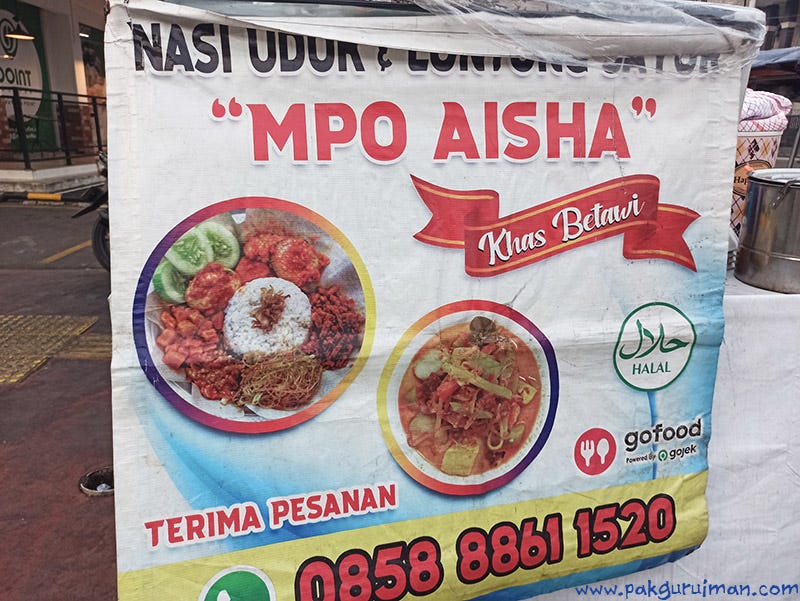
The person who sells this food is a Betawi person, and she writes it like this, without the letter [k] in the end. By the way, [nasi uduk] and [lontong sayur] are the names of the dishes she sells.
How to Pronounce Mpok
Let’s hear how to pronounce [mpok] in the video below.
Next, we will look at examples where the word [mpok] is used by Indonesians.
Examples of Mpok In Use
In this section, I gathered examples where the word [mpok] is used by Indonesians so you can better understand how Indonesians use this word.
The first example is from Bajaj Bajuri The Movie (2014). Let’s watch the clip below.
Conversation from the clip with English translations.
Woman: Liat noh! Si Soleh baru dibeliin sepeda baru. (Look at him! Soleh just got a new bike.)
Man: Ya elah, mpok! Namanya juga orang baru jual tanah. Warga sini emang gitu. (Oh, come on! His family has just got a lot of money from selling their land. Things like that are common here.)
As you can see in the clip, the man addresses the woman with an honorific title [mpok]. You can still address a female person with [mpok] even though she is your age. It is just to be polite.
Vocabulary From the Scene
[Liat] is the colloquial form of [lihat] = to see, look.
[Noh] = [itu] = that. [Noh] is a word that the Betawi people use. [Lihat noh!] = [Lihat itu!]
[Baru] = new, just.
[Dibeliin] is the colloquial form of [dibelikan] = bought.
[Sepeda baru] = new bike.
[Ya elah] is an expression spoken when you don’t believe what the person is saying, or you think the person is not being serious.
[Namanya juga...] <--- This phrase is usually used when it is common or natural for someone to act like that. For example, [Yah, namanya juga anak-anak. Wajar aja kalau mereka main melulu. = Yeah, they are just kids. It’s normal if they play a lot.]
[Emang] is the colloquial form of [memang] = indeed.
The second example is still from the same movie, Bajaj Bajuri The Movie (2014). Let's watch the clip below.
Conversation from the clip with English translations.
Oneng: Eh! Op, op, bang! Op, op, op, op, op. Eh, berenti! Mundur, mundur. Terus mundur, mundur. Op, op, op, op, op, op. Op, op, udeh, udeh. Di sini kan baru pas tuh ame pintu. Tinggal masuk. (Hey, stop! Stop! Stop. Hey, stop! Go back. More and more. Okay, stop! Here is good. You see? Here is lined up with the door.)
Motorbike Rider: Timbang kelewatan dikit, mpok. (Just missed a little bit, ma'am.)
Oneng: Nih, nih, nih. Udah ngga usah ngomong. Makasih ye. (Here you are. Don’t say any more. Thank you.)
Motorbike Rider: Iye. (You’re welcome.)
Oneng: He’eh. (Okay.)
In the clip, the motorbike rider addresses Oneng with the word [mpok]. He does this just to be polite to her. The motorbike rider in the clip is called [ojek]. [Ojek] is a person who rides a motorbike and gives a ride to people in exchange for money.
Vocabulary From the Clip
[Op] is short for [stop].
[Berenti] is the colloquial form of [berhenti] = to stop.
[Mundur] = go back.
[Terus], in this context, is asking to go back more and more. [Terus] can also mean [then].
[Udeh] is the way the Betawis say [sudah] = already, but here, [udeh] means [okay, this is enough].
[Ame] is how the Betawis say [sama] = with.
[Pintu] = door.
[Timbang] in this context here means [hanya] = just.
[Dikit] is the colloquial way of saying [sedikit] = just a little.
[Udah] is the colloquial way of saying [sudah]. [Udah] in the sentence [udah, ngga usah ngomong] means [enough]. She wanted to make sure that the motorbike rider didn’t say anything again.
[Iye] is how the Betawis say [iya] = yes, okay.
[He’eh] means okay. For more about this, you can read this article: He’eh in the Indonesian Language.
The third example is from the movie Pacar Kontrakan (2010). Let's watch the clip below.
Caty: Woi! Lo tu mo bunuh diri apa mo nyebrang jalan sih? (Hey! You wanna commit suicide or wanna cross the road?
Caty’s Friend: Loe kalo mo bunuh diri jangan di jalanan. Noh, di Monas noh! Loe terjun bebas. Dijamin langsung pasti tamat. (If you wanna commit suicide, don’t do it here, on the street. Do it at the Monas! Just free-falling from there, and I guarantee you will surely die.)
Aladin: Heh! Ini kok cewe-cewe yang marah sih? Mustinya gue yang marah, tau ngga? (Hey! Why are you guys the ones who are mad at me? Aren’t I the one who’s supposed to be mad at you?)
Caty: Ya jelas gue marah lah. Kalo lo mati, gimana tadi? Gue ditangkep polisi. Ya lo mah enak langsung mampus, lha gue? Mana mobil sewaan! (Of course, I am mad at you. If you were dead, the police would arrest me. It would be easier for you because you would just be dead, but me? Not to mention, this is a rental car.)
Aladin: Gini aja deh, mpok. (How about this, mpok?)
Caty: Gue jauh-jauh dari Amerika lo panggil mpok? (I’m from America, far away from here, and you called me mpok?)
In this clip, Aladin addresses Caty with the word [mpok] just to be polite. Still, because Caty is not originally a Betawi person, she doesn’t accept being called using the honorific title [mpok].
In Indonesia, there are many honorific titles that you can use when addressing a person. In Central Java, they use [mba] and [mas], and in West Java, they use [teteh] and [akang]. In Padang, they use [uni] and [uda]. So, different regions have different honorific titles.
Vocabulary From the Clip
[Lo] is the informal way of saying you.
[Tu] is short for [itu] = that.
[Mo] = [mau] = want.
[Apa] in this context, in the sentence, functions like the word [atau] = or. The literal meaning of [apa] is [what].
[Nyebrang] is the colloquial way of saying [menyeberang] = to cross the road.
[Sih] has no meaning. For more about this, you can read my article: Sih In The Indonesian Language.
[Kalo] = kalau = if.
[Noh] is used when you want to show something that is very far away. [Noh] = itu = that, but very far away from the speaker.
[Terjun bebas] = free fall.
[Mustinya] = [seharusnya] = should.
[Marah] = angry.
[Tau ngga?] = [tahu ngga?] = you know what?
[Ditangkep] = [ditangkap] = get arrested.
[Gue jauh-jauh dari Amerika] <--- In this sentence, Caty wants to emphasize that she is not a Betawi person, so stop calling her with a Betawi honorific title [mpok].
If you found this article helpful and would like to support my work, you can buy me a coffee. Thank you for your support!
That’s all for now. If you have any questions, feel free to leave them in the comments below. Thank you for reading my article, and I’ll see you soon.