

Halo, ketemu lagi sama saya, Iman Prabawa. In this article, I want to talk about the meaning of the word [ngintip] in bahasa Indonesia. We are also going to be watching examples from movies, YouTube videos, and others where the word [ngintip] is used by Indonesians.
Meaning of Ngintip
The basic word for [ngintip] is [intip]. According to Kamus Besar Bahasa Indonesia, the meaning of [intip] is shown in the picture below.
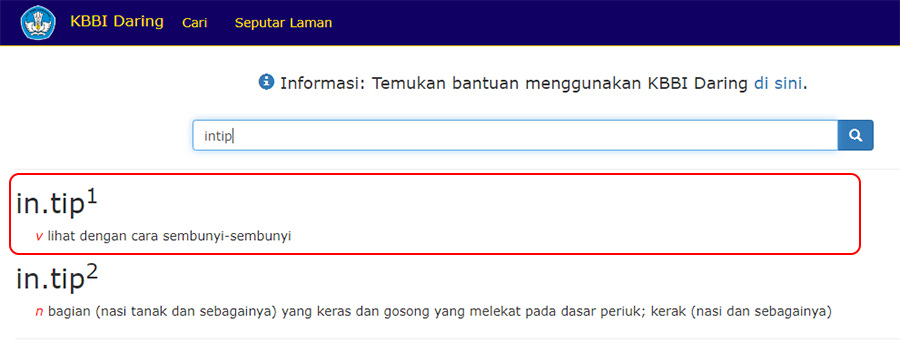
The meaning of [intip] is in the red box up there. If I translated this into English, the translation would be:
Try to look at something without everyone noticing.
[Ngintip] is usually used in conversational Indonesian. [Ngintip] is short for [mengintip], and you will see it in the example sentence that I give you below.
Example Sentences Using Ngintip
Let’s look at these three sentences I gave you using the word [intip].
First sentence.
Mengintip pekerjaan rumah (PR) seseorang itu bukanlah sesuatu yang baik, lho.
The English translation for this sentence is as follows.
It’s not a good thing to take a peek at someone’s homework.
[Mengintip] comes from the basic word [intip], and then you add the prefix [me]. In conversational Indonesian, [mengintip] is usually shortened to [ngintip].
Second sentence.
Loe dari tadi itu diintipin sama dia terus lho.
The English translation for this sentence is as follows.
Don’t you know that he takes a peek at you all the time?
[Diintipin] comes from the basic word [intip], and then you add the prefix [di] and suffix [in] to the basic word. [Diintipin] is passive voice, and in Indonesian, we use passive voice a lot.
Third sentence.
Coba deh loe intip apa yang lagi dia kerjain.
The English translation for this sentence is as follows.
Why don’t you take a peek at what he is doing right now?
How to Pronounce Ngintip
Let’s first hear how to pronounce the word [intip].
And now, let's hear how to pronounce [ngintip] in bahasa Indonesia.
Now, let’s look at examples from movies, YouTube videos, and others where Indonesians use the word [ngintip].
Examples of Ngintip In Use
In this section, we will take a look at examples from movies, YouTube videos, and other sources where Indonesians use the word [ngintip].
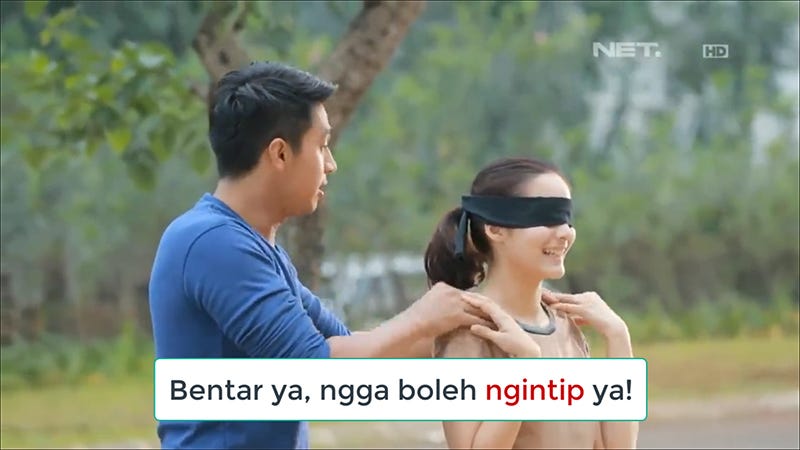
The first example we are about to watch is from a TV Series, Tetangga Masa Gitu (2014-2017). I recommend you watch this series because it uses conversational Indonesian, which is widely used in Indonesia.
Let’s watch the clip.
Conversation from the clip with English translations.
Bintang: Kita mau ke mana sih ini? (Where are we going?)
Bastian: Bentar, Bi. Ini pokoknya ada.. (You just wait, Bi. This is..)
Bintang: Surprise apa sih? (What is it?)
Bastian: Hmm mm, kamu tunggu aja nih. Diem, ya? Diem, ya? (You just have to wait. Just stay still? Just stay still?)
Bintang: Oke. (Okay.)
Bastian: Oke? Bentar ya. Ngga boleh ngintip, ya? (Okay? Just a sec. Please don’t take a peek.)
Bintang: Iya. (Okay.)
Bastian: Aku itung sampai tiga kamu baru boleh liat. Satu.. Tiga.. Taraa! (I’ll count til three, then you can see. One.. Three.. Tara!)
Bintang: Yeah.. Tapi kenapa mataku harus pake ditutup segala sih? (Yeah.. But do I have to close my eyes at all?)
In this clip, Bastian takes his wife to their new house and tells her not to take a peek before he opens the blindfold. So, [ngintip] means to take a peek. [Ngintip] is short for [mengintip], and in conversational Indonesian, it’s common for native Indonesian speakers to drop syllables like in this example.
Let’s learn the vocabulary used in this short clip.
Vocabulary From the Clip
[Sih] has no meaning. It falls into the category of phatic expression. Its function is just to emphasize.
[Bentar] is short for [sebentar]. Here, it means to ask somebody to wait for a second.
[Tunggu] = wait.
[Diem] is informal for [diam] = silent, stay still.
[Itung] is short for [hitung] = count.
[Liat] is informal for [lihat] = look at something.
[Pake] is informal for [pakai] = use.
If you found this article helpful and would like to support my work, you can buy me a coffee. Thank you for your support!
That wraps up today’s article. If you have any questions, feel free to leave them in the comments below. Thank you for reading my article, and I’ll see you soon.