

Halo semuanya. Apa kabar? Today, I want to talk to you about the meaning of the word [pak] in the Indonesian language. We are also going to watch a video where the word [pak] is spoken by Indonesians.
Pak In Bahasa Indonesia
Pak is short for [Bapak], and this is an honorific title when we address men in the Indonesian language. It’s kind of like [sir] or [mister] in English.
Bapak can also mean [daddy]. A lot of Indonesian people call their dad this word [bapak]. Me included! I call my father [bapak].
You will hear this [bapak] thingy being spoken a lot in Indonesia in a formal situation. In a formal situation, you say Bapak, and then you say his name. For example, Bapak Jokowi, Bapak Gatot, Bapak Raffi, and so on and so on.
To Whom Should You Address Pak?
Certainly, men who are older or men who already have babies. Like, maybe a 30-year-old guy and above, you can call him [bapak], or a 23-year-old guy who is already married and has a baby.
The thing is, this [bapak] thingy is a polite way to address someone in the Indonesian language, and when you address him with [bapak], and then he refuses to be called with that honorific title [bapak], he will say that to you.
Maybe he doesn’t want to be called with the honorific title [bapak] because he still feels young enough to be called [bapak].
How to Pronounce Pak
Here is how you pronounce the word [pak] in bahasa Indonesia.
Next, let’s watch examples where Indonesians use the word.
Examples of Pak In Use
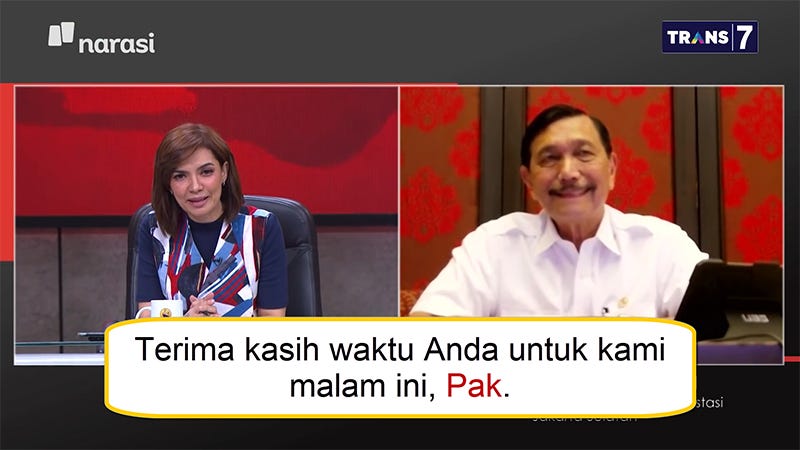
The first example we are about to watch is taken from the famous TV Program in Indonesia, Mata Najwa. Let’s watch the clip below.
Conversation from the clip with English translations.
Najwa: Selamat malam, Pak Luhut. Terima kasih waktu Anda untuk kami malam ini, Pak. (Good evening, Mister Luhut. Thank you for your time with us tonight, sir.)
Luhut: Selamat malam, Najwa. (Good evening, Najwa.)
As you can see, Najwa calls Mister Luhut with an honorific title [pak] before his name. Mister Luhut, in this video, actually said [selamat] so fast that we can barely hear [sela] in the word [selamat]. So, it's like we just heard him say [mat malam] instead.
The second example is from Cek Toko Sebelah (2016). Let’s watch the clip below.
Conversation from the clip with English translations.
Nandar: Martin!
Martin: Nandar! Ah, pak Nandar maksudnya. (Nandar! I mean Mr. Nandar.)
Nandar: Kamu Martin yang sodaranya kang Maman, kan? (You’re Martin, Kang Maman’s brother, right?)
Martin: Iya. (Yes, I am.)
In the scene, when Nandar calls his name, Martin replies by calling just his name, Nandar. But then he realized that Nandar is older than he is, and he is going to work at Nandar’s shop, so it is considered impolite if he doesn’t add an honorific before his name.
That’s why he says, “Pak Nandar maksudnya.” There, he adds the honorific title [pak] before his name, Nandar.
Vocabulary from the Clip
[Kamu] = you.
[Sodara] is informal for [saudara] = siblings.
[Kan] is used to emphasize. For more about this, you can watch my video here:
If you found this article helpful and would like to support my work, you can buy me a coffee. Thank you for your support!
That’s gonna be it for now. If you have any questions, feel free to leave them in the comments below. Thank you for reading my article, and I’ll see you soon.