

Halo semuanya, ketemu lagi sama saya. Iman Prabawa. In this article, I want to talk to you about the meaning of [PHP] in bahasa Indonesia, and as always, we are going to be watching examples from movies, YouTube videos, and others where [PHP] is used by Indonesians, so you can understand how to use it better.
PHP In Bahasa Indonesia
PHP is an abbreviation for Pemberi Harapan Palsu. Sometimes, it is written as [pehape].
PHP, or Pemberi Harapan Palsu, is when you give false hope to someone. For example, if you’re a man and you’re being nice to a woman, and the woman feels like the man is attracted to her, but in fact, the man was just trying to be nice to her. And we can call the man PHP, or the one who gives false hope to the woman.
Example Sentences
Ah, loe mah emang tukang PHP-in orang deh! Kasihan tahu, anak orang jadi berharap gitu sama loe! (Ah, you always give false hope to people! This is so not good! She will have high hopes for you, dude!)
Kalian pernah dipehapein sama orang, ngga? (Have you ever been given false hope by someone?)
Kamu jangan terlalu baik sama dia, nanti dia ngerasa dipehapein sama kamu, padahal kamu itu sebenarnya ngga ada perasaan sama dia. Kamu kan cuma ingin bersikap baik aja kan sama dia? Kamu ngga suka sama dia, kan? (You don’t have to be too nice to her; otherwise, she will think that you’re in love with her, but in fact, you don’t have any feelings for her. You just want to be nice to her, right? You don’t love her, do you?)
How to Pronounce PHP
Here is how you pronounce [PHP] or [pehape] in bahasa Indonesia.
If you see it written as [pehape], then it means the same thing as [PHP]. It is just a variation in writing.
Examples of PHP In Use
In this section, I gathered examples from movies, YouTube videos, and others where Indonesians use the word [PHP] or [pehape] so you can better understand how to use it.
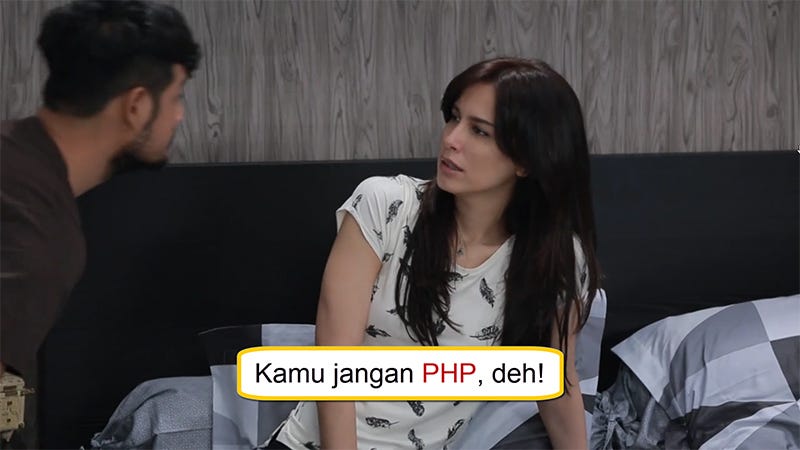
The first example we are about to watch is from Tetangga Masa Gitu, Season 3, Episode 224 - Calon Ayah (2022). Let’s watch the clip.
Conversation from the clip with English translations.
Adi: Angel.
Angel: He? (What?)
Adi: Kamu mo aku beliin anggur, ngga? (You want me to buy you grapes?)
Angel: Kamu jangan PHP, deh! Baru cari lowongan kerja aja udah mo beliin anggur. (Don’t give me false hope, okay? You’re still looking for a job, and now, all of a sudden, you want to buy me grapes?)
Adi: Hehehe. Engga, serius! Ngga, aku emang niat Angel, cari kerja. Makanya aku cari di koran, cari di mana-mana. Nah, untuk merealisasikan niat aku ini, boleh ngga kalau aku pinjem laptop kamu? Buat browsing-browsing cari kerja sama bikin lamaran. Boleh? (Hehehe. No, I’m serious! I really am looking for a job now. That’s why I searched for it in the newspaper and everywhere. And to make this happen, can I borrow your laptop? To search for a job on the internet and to make a job application. May I?)
In this clip, Adi wants to buy her wife grapes, but in the meantime, he is still looking for a job. That’s why her wife, Angel, says this to Adi:
Kamu jangan PHP, deh! (Don’t give me false hope, okay?)
Angel wonders how Adi can buy her grapes when he has no money, as Adi is jobless at the time of speaking.
Vocabulary From the Clip
[Kamu] is informal for [Anda] = you.
[Mo] is the colloquial way of saying [mau] = want.
[Beliin] is the colloquial way of saying [belikan]. If I change this sentence [kamu mo aku beliin anggur, ngga?] into a more formal sentence, it will become [Anda mau saya belikan anggur, tidak? (Do you want me to buy you grapes?]
[Deh] is a word that has no meaning. It falls under the category of phatic expression. It is just to emphasize.
[Aja] is short for [saja]. In conversational Indonesian, Indonesians tend to drop letters, as in this example.
[Engga] = [ngga] = [ga] = [tidak] = no.
[Cari] = search.
[Kerja] = job.
[Koran] = newspaper.
[Bikin] = [buat] = to make (something).
[Lamaran] = application, proposal.
The second example is from Mimpi Metropolitan (2018). Let's watch the clip.
Conversation from the clip with English translations.
Topan: Woi, bro! Ada makanan paling mantep! Mau ngga? (Hey, guys! I’ve got some really nice food here! Want some?)
Bambang: Oh. Boleh, mas. Mau. (Okay. I want one.)
Topan: Nah. (Here you are.)
Prima: Ati-ati, Mbang. Nanti isinya ngga sesuai ekspektasi. (You should be careful, Mbang. Usually, what’s inside is different than what you expected.)
Alan: Eh, betul itu! (Yeah, that’s true!)
Bambang: Waduh! Beneran, mas. (Damn! You’re right!)
Prima and Alan: Hahaha. (*both are laughing.)
Prima: Kan? Gue bilang juga apa, kan? Parah loe! Pehape loe, Pan! (See? What did I tell you? That’s not good, bro! You’re giving him false hope!)
Alan: Kau ini, Pan! Pan! (You morron!)
Topan: Masih mending gue bae ama loe-loe pada, nawarin. Mau ngga? Eh, kalo ngga mau, ya udah. (I’m still better than you guys; I offered you the food. You want this or not? If you refuse the offer, that’s okay with me.)
In this clip, Bambang, Prima, and Alan are eating, and then Topan comes in with a box containing food. He says that he’s got the nicest food ever, and then he offers them the food. However, because Alan and Prima already knew Topan very well, they knew that what Topan said was not true. But because Bambang is new and doesn’t know Topan well, he accepts the food.
Prima then warns Bambang and says this:
Ati-ati, Mbang. Nanti isinya ngga sesuai ekspektasi. (You should be careful, Mbang. Usually, what’s inside is different than what you expected.)
And what Prima said was true. Prima then says this to Topan:
Parah loe! Pehape loe, Pan!
By saying [pehape loe, Pan!], it means that Topan has given Bambang false hope.
Vocabulary From the Clip
[Mantep] = [mantap] = awesome.
[Mas] is an honorific title to address a male person just to be polite in this context. For more about this, you can read my article here: Mas In Indonesian.
[Waduh] is usually used when what you see is not something that you expected, or you can also use [waduh] when there is a problem.
[Gue] is informal for [saya] = I. You will see variations in the way Indonesians write this word. It can be written as [gue], [gua], or [gw], but all mean the same.
[Loe] is informal for [Anda]. You will see variations in the way Indonesians write this word. It can be written as [loe], [lo], [lu], [elu], or [elo], but all mean the same.
[Bae] = [baik] = good.
[Loe pada] = you guys. So, [loe pada] is the plural form of [loe]. Example: Lagi ngapain loe pada? (What are you guys doing?) It means that there is more than one person in front of the speaker speaking this.
If you found this article helpful and would like to support my work, you can buy me a coffee. Thank you for your support!
That’s gonna be it for now. Thank you for reading my article and bye now.