

Halo semuanya. Apa kabar? Ketemu lagi sama saya, Iman Prabawa a.k.a Pak Guru Iman. In this article, I want to talk to you about the meaning of the word [sih] in Indonesian. As always, we are also going to be watching examples from movies, comics, and others to better understand the meaning and to see how Indonesians use the word [sih] in their daily conversation.
Sih in Bahasa Indonesia
[Sih] is a filler word and is considered a phatic expression. It doesn’t have any meaning. Its function in the sentence is to emphasize and bring emotions to the sentence.
Ivan Lanin explains [sih], [dong], and [deh] in the video below. For the whole video, you can watch it here. Ivan Lanin is an expert in the Indonesian language.
Here’s what he says in the video with English translations.
Ivan Lanin: Terus kemudian ada yang istilahnya fatis. Ini keren-kerenan aja. Ini sebenarnya gampang. Semua orang pasti pake setiap hari. Dong, deh, sih. Itu namanya kategori fatis. Itu kosakata yang ngga ada artinya. Sebenarnya ngga ada artinya, secara gramatikal, eh, secara leksikal, secara kamus itu ngga ada artinya. Tapi itu kita gunakan untuk menyampaikan pesan tertentu. Coba rasakan. Apa bedanya [eh], [ih], [oh], [uh], [ah]? Beda lho. Kamu gitu, ah! Kamu gitu, ih! Kamu gitu, oh! Beda-beda, kan? Ada yang normal, terasa. Ada yang engga. Nah, fatis itu sangat bermanfaat untuk menyampaikan emosi. Sangat bermanfaat! Itu akan membuat juga tulisan kita, tuturan kita terasa lebih luwes. (Then, there’s what is called phatic expression. This is just a fancy term. This is literally easy. Everybody uses these words in their daily conversation. Dong, deh, sih. These fall into the category of phatic expression. Those are words without meaning. Actually, it has no meaning in terms of lexical or dictionaries. But they are used to deliver specific messages. Can you feel the difference between [eh], [ih], [oh], [uh], and [ah]? They have different feelings. Kamu gitu, ah! Kamu gitu, ih! Kamu gitu, oh! These sentences have different feelings, right? Some feel normal. Some are not. A phatic expression is beneficial for delivering emotions. It is very helpful. It will make our writings and our spoken words feel more human.)
So, it’s kind of hard to explain [sih] in Indonesian. Moreover, I will give you many examples of how Indonesians use it in their daily lives, using scenes from movies so you can grasp the idea of how Indonesians use the word [sih]. The hardest part of this is how to use [sih] correctly.
Many foreigners understand the meaning of [sih] but are still confused about how to use [sih] correctly. To know how to use [sih] correctly, you need to watch many scenes and videos and see how Indonesian people use it.
Example Sentences Using Sih
Here, I give you three example sentences to better understand how to use [sih] in a sentence.
Let’s look at the first example sentence below.
1. Lagi pada ngapain sih?
Which translates into English as:
1. What are you guys doing?
As I said earlier, [sih] doesn’t have any meaning in this sentence, and you can actually omit the word [sih] in this sentence. If you omit the word [sih], the sentence will become,
1. Lagi pada ngapain?
The difference between the sentence with [sih] and the sentence without [sih] is that the sentence with [sih] gives more emphasis. The speaker really wants to know what the guys are doing. He was curious about what was happening, so he asked for the sentence and added the word [sih] in his sentence.
Now, let’s look at the second example sentence below.
2. Kok loe gitu sih?
Which translates into English as:
2. Why are you like this?
Again, you can omit the word [sih] in this sentence. Thus, the sentence will become:
2. Kok loe gitu?
The difference between the two sentences is that the sentence with [sih] has more emotion than the one without the word [sih]. It’s like the speaker really wants to know the answer to his or her question.
Lastly, let’s look at the third example sentence below.
3. Ada apa sih?
Which translates into English as:
3. What’s going on?
Again, in this sentence, you can also omit the word [sih], but if you omit the word [sih] and just say it like below:
3. Ada apa?
Then, the sentence doesn’t have emotion in it. The speaker does not really want to know what is happening. They are asking, but if they use [sih] in the sentence, they really want to know what is happening.
It’s hard to explain, but you will understand this once you watch many movies and analyze how Indonesian people use this word.
Next, let’s watch short clips where the word [sih] is spoken, and I will try to explain them to you as best I can.
Examples of Sih In Use
In this section, we will watch examples from movies and whatnot where the word [sih] is used by Indonesians to better understand how to use it in a conversation.
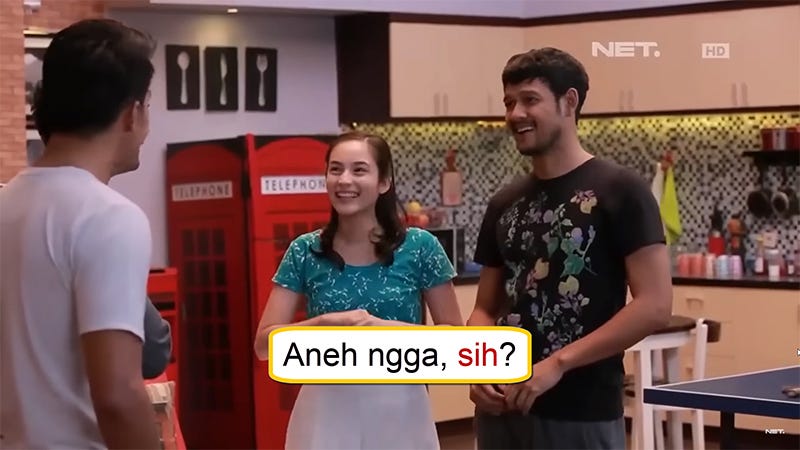
The first clip we are about to watch is from Tetangga Masa Gitu (2014-2017). Let’s watch the clip below.
Conversation from the clip with English translations.
Adi: Ah, eee.. Bastian, Bintang. (Oh, hey! Bastian, Bintang.)
Bintang: Mas Ruly. Haii! (Ruly. Hi!)
Ruly: Bintang, apa kabar? Astaga. (Bintang, how have you been? Oh my God.)
Bastian: Rudo! Ruly Ernando. Halo, mas. Apa kabar? (Rudo! Ruly Ernando. Hi. How have you been?)
Ruly: Baik. Sori lho ya ganggu malem-malem. Ngga ada maksud apa-apa. (I’ve been good. I’m sorry if I’m bothering you this late evening. I have no intention to bother.)
Bastian: Oh, ngga papa, mas. Kit.. Toh kita udah kebal diganggu pagi siang malem ama.. Hmm.. ini! (It’s okay. We are used to being disturbed at night by him!)
Ruly: Keliatan kok! (Yeah, I can see that.)
Bastian: He’eh. (Yup.)
Adi: Emang dia pernah ke sini? (Has he been here before?)
Bastian: Oh, iya, lah. (Yes, he has.)
Bintang: Iya, dong! Kan waktu itu pas mas Ruly beli rumah kita yang di Pondok Indah tanda tangan surat-suratnya di sini. (Yes, of course. When he bought our house in Pondok Indah, he signed all the documents here.)
Bastian: He’eh. (Yup.)
Adi: Aneh ngga, sih? (Isn’t it weird?)
Ruly: Engga. (Nope.)
Adi: Aneh, deh. Kayanya menurut saya aneh banget. Soalnya ya kok bisa kebetulan dia ini mantan pacarnya Angel dan kebetulan dia juga pernah ke sini, ke rumah kalian dan kebetulan juga dia pernah beli rumah kalian yang di Pondok Indah. (This is weird. I think this is really weird. The problem is, how come he happened to be Angel’s ex-boyfriend, and he also happened to be here, at your house, and he also happened to have bought your house in Pondok Indah?)
In the scene above, Ruly comes to Adi’s house. Ruly is Angel’s ex-boyfriend, and Adi is Angel’s husband. Bastian and Bintang are Adi’s neighbors. They are husband and wife. When Adi and Ruly are fighting, Bastian and Bintang come.
Adi didn’t know that Bastian and Bintang knew Rully; when Bintang explained, Adi found it weird. As you can see, Adi was asking for some kind of, like, agreement from the other person when he said, [Aneh ngga sih?], and then when the person he was talking to answered it with [Engga], Adi then explained why he thought that this was weird.
Here, Adi wants an agreement or some kind of reply from the person he talked to. So, if you omit the word [sih], the emotion is gone.
Vocabulary From the Clip
[Apa kabar?] is a phrase you use when you meet someone. [Apa kabar?] = How are you? How have you been?
[Astaga] is a word you use when you are surprised by something. Here, Ruly is surprised that he meets Bastian and Bintang.
[Baik] = fine, good.
[Ganggu] = bother, disturb.
[Ganggu malem-malem] is a phrase that is spoken by Ruly because at that time, he came to the house late in the evening, and he just wanted to be polite, saying [ganggu malem-malem].
[Malem-malem] = this evening.
[Malam] = [malem] = evening.
[Keliatan] = [kelihatan] = [terlihat] = can be seen.
[He’eh] means yes. For more about this, you can read my article: He’eh Meaning In Bahasa.
[Emang] is short for [memang] = of course. If [emang] is put in the front of a sentence, it is usually used to ask something, like in this example. [Emang dia pernah ke sini?] = [Memang dia pernah ke sini?] = [Apakah dia pernah ke sini?]
[Lah] and [dong] after the word [iya] have the same function, that is, to emphasize the word [iya].
[Deh] after the word [aneh] has no meaning. It just emphasizes the word [aneh]. By saying [deh] after the word [aneh], Adi wants to emphasize that it is really weird.
[Engga] = [ga] = [ngga] = no.
[Pacar] = girlfriend or boyfriend.
[Pondok Indah] is the name of an area in Jakarta.
[Beli] = buy.
[Rumah] = house.
The second clip we are about to watch is from a TV show called The East (2015-2019). Let's watch it below.
Conversation from the clip with English translations.
Baby: Ini butuh berapa lama lagi ya, Bonita? (How much longer is this, Bonita?)
Clarissa: Fotokopi aja lama banget sih, Bon? (Why are you taking so long just to make a copy?)
Bonita: Udah, udah, ini udah. Udah bisa pake. (It’s done. I’m done. You can use it now.)
In this scene, Baby and Clarissa are waiting to make a photocopy of something. At that moment, Bonita is still using the photocopying machine. Baby and Clarissa seem not patient enough to wait, and then they ask Bonita how long she will use the photocopying machine.
In the clip, Clarissa says this:
Fotokopi aja lama banget sih, Bon?
[Sih] in the sentence here, adding the emotion and showing that Clarissa is impatient to wait for Bonita to finish what she is doing with the photocopying machine.
Vocabulary From the Clip
[Ini] = this.
[Butuh] = need.
[Berapa lama lagi ya?] = How much longer is this?
[Berapa lama lagi ya?] is usually used when you are waiting for someone, and then you want to know how long you will have to wait.
[Udah] is a typical reduction for [sudah] = already.
The third clip we are about to watch is still from the same movie, The East (2015-2019). Let's watch the clip below.
Conversation from the clip with English translations.
Bima: Jadi gini, Gis. Buat Tonight Show nanti, aku itu mau ngadain Tonight Updates. (So, here’s the thing. For The Tonight Show, I want to do the Tonight Updates.)
Gista: Oke. (Okay.)
Bima: Nah! Aku itu butuh banget berita terbaru dari artis-artis di Jakarta ini. Nah, yang bisa didapetin sama Entertainment News tapi ngga bisa didapetin dari internet. Aku butuh itu. (So, I need the latest news from artists in Jakarta that I can get from Entertainment News, but people can’t get it from the internet. I need that kind of news!)
Gista: Gue mau bantu loe sih, ya tapi ngga bisa sekarang nih. Orang gue mau live. (I want to help you, but I can’t do it right now because I’m going live in just a moment.)
In this scene, Bima asks Gista to help him find something. Gista replies that she wants to help, but because she has something to do now, she can’t help Bima.
She says this:
Gue mau bantu loe sih.
The word [sih] emphasizes that Gista really wants to help Bima, but not now, because she has something to do.
Vocabulary From the Clip
[Jadi gini] is usually used when you want to start saying something. It’s kind of like [here’s the thing] in English.
[Buat] = [untuk] = for.
[Nanti] = later.
[Aku] is informal for [saya] = I. For a more detailed explanation, you can read my article here:
Aku In Indonesian

Halo, semuanya? Apa kabar? This time, we are going to talk about the meaning of [aku] in Indonesian. As always, we are also going to be watching examples from movies, YouTube videos, and whatnot, where Indonesians use this word.
[Ngadain] is the conversational way of saying [mengadakan] = to conduct something.
[Banget] = [sekali] = very. We usually use [banget] instead of [sekali] in daily conversation.
[Terbaru] = latest.
[Didapetin] is the conversational way of saying [didapatkan] = obtained.
[Gue] is informal for [saya] = I. For a more detailed explanation, you can read my article here:
Gue In Indonesian

Halo semuanya. Apa kabar? Ketemu lagi sama saya, Iman Prabawa. Today, we’re going to talk about what [gue] means in Indonesian. As always, I’ll show you some examples from movies, YouTube videos, comics, and other real-life situations where Indonesians use this word.
[Loe] is informal for [Anda] = you. For a more detailed explanation, you can read my article here:
Loe In Indonesian

Halo semuanya, apa kabar? Ketemu lagi sama saya, Iman Prabawa. In this article, I want to talk about the meaning of the word [loe] in bahasa Indonesia. Not only talk about the meaning of the word, but I will also show you some examples from movies and other real-life situations where Indonesians use this word.
[Orang] = people, but in this sentence, [orang gue mau live], it has a different meaning. [Orang], in this context, means [because actually]. [Orang gue mau live] can be changed into [karena sebenarnya saya mau live] = because I actually want to do the live session.
If you found this article helpful and would like to support my work, you can buy me a coffee. Thank you for your support!
So, that’s gonna be it for now. If you have any questions, feel free to leave them in the comments below. Thank you for reading my article, and I’ll see you soon.