

Halo semuanya, ketemu lagi sama saya, Iman Prabawa. In this article, I want to talk to you about the meaning of the word [teteh] in Indonesian. As always, we will watch scenes from movies where this word is spoken to better understand it.
Meaning of Teteh
[Teteh] comes from Sundanese, a language spoken by the Sundanese people, who are native to West Java, Indonesia. Although it is originally a Sundanese word, you might sometimes hear it used in Indonesian movies, especially in films set in West Java or featuring characters from the region.
[Teteh] is an honorific term used to address an older sister. But you don’t have to be talking to your actual older sister to use it! In West Java, you can also use [teteh] to address a woman who looks about your age or older as a polite way to address her, even if you don’t know her personally.
Now, here’s something you should be careful about: don’t confuse [teteh] with [tete]. In Indonesian, [tete] is a slang term for boobs. So make sure you pronounce the “h” at the end of [teteh]. Otherwise, you might accidentally say something completely different and get some pretty strange looks!
How to Pronounce Teteh
Here is how you pronounce [teteh] in Indonesian.
Make sure you pronounce the letter [h] when pronouncing the word [teteh].
Examples of Teteh In Use
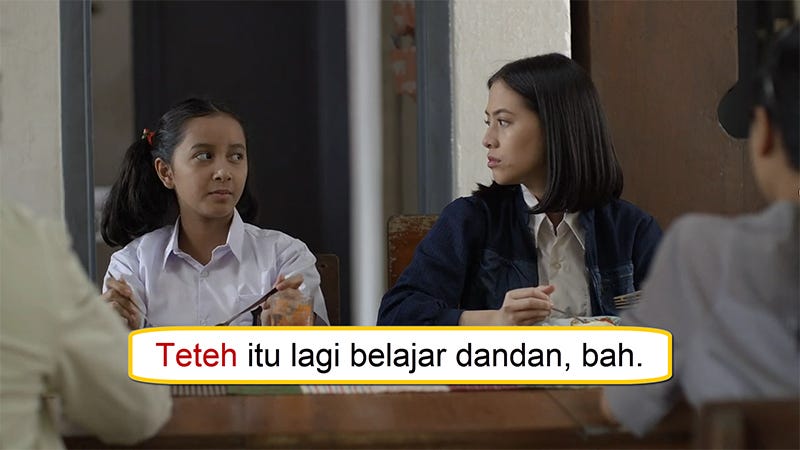
The first scene we are about to watch is from Keluarga Cemara, Season 1, Episode 1 (2022). Let’s watch the clip below.
Below is the transcript from the clip, along with the English translation:
Abah: Kamu ada yang beda yah hari ini. Apa yah? (You look different today. What is it?)
Ara: Teteh itu lagi belajar dandan, bah. Mau ketemu sam.. (Teteh’s been learning how to do her makeup, Bah. She wants to meet—)
Euis: Ara! (Ara!)
Emak: Ara, godain teteh terus. (Ara, stop teasing your sister.)
In this scene, Ara addresses her older sister Euis with the word [teteh], and their mother also calls Euis [teteh]. In the West Java region in Indonesia, it is common for parents to address their oldest daughter with that honorific term.
Vocabulary From the Clip
[Kamu] = you.
[Ada yang beda] in literal translations would translate to there is something different. When you notice something different or unusual from your friends or from something that you often see, you can say this phrase.
[Yah] in [apa yah?] is the same as [ya]. People in West Java usually add the letter [h] to it when speaking it. [Yah] in this context doesn’t have any meaning; it’s just emphasizing the word [apa] while he wonders what something different from Euis is.
[Belajar] = learn, study.
[Dandan] = grooming.
[Bah] is short for [abah]. [Abah] means daddy.
[Emak] = mommy.
[Mau ketemu sam.. ] <--- This is an unfinished sentence. If I finish this sentence, I can say something like this: “Mau ketemu sama seseorang.” In this sentence, there is no subject because it is clear what the subject is, and it is common in conversational Indonesian to omit the subject when it is clear. The subject is [teteh]. So, if I add the subject, the full sentence would be, “Teteh mau ketemu sama seseorang.” [Seseorang] = someone.
[Godain] is the conversational way of saying [menggodai] = teasing (someone). [Ara, godain teteh terus] <--- If I change this into a more formal sentence, it would become [Ara, menggodai teteh selalu.]
If you found this article helpful and would like to support my work, you can buy me a coffee. Thank you for your support!
That’s gonna be it for now. If you have any questions, just leave them in the comments below. I’ll be happy to answer them for you.
Thank you for reading my article, and I’ll see you soon.