

Halo semuanya, ketemu lagi sama saya, Iman Prabawa. In this article, I want to talk about the meaning of [itu], [tu], and [tuh] in Indonesian. And as always, we are going to be watching examples from movie scenes and whatnot where the word is spoken by Indonesians.

Itu, Tu, and Tuh In Bahasa Indonesia
[Itu] literally means [that]. [Tu] and [tuh] are informal for [itu]. The meanings of [itu], [tu], and [tuh] are the same.
Here are the meanings and usage of [itu], [tu], and [tuh] in Bahasa Indonesia.
1. To point to a thing or person that is far from the speaker.
Example sentences:
1. Rumah itu lokasinya berada di pinggir jalan raya. (The house is located along the main road.)
2. A: Jadi, kamu mau beli yang mana? (So, which one are you going to buy?)
B: Yang itu. (That one.)
3. Tu dia! Ayo kita ke sana. (There he is! Let’s go over there.)
4. A: Loe liat tas gue ngga? (Have you seen my bag?)
B: Tuh! Di sana. (There it is! Over there.)
5. A: Kata loe si A udah ngga jualan lagi. Itu ada tuh! (You said he wasn’t selling anything anymore. There he is!)
B: Oh, iya, ya. Kemarin-kemarin yang gue lihat udah ngga ada soalnya. Mungkin kemarin dia mudik doang kali ya? (Oh yeah, you’re right. I hadn’t seen him around for the past few days, so I thought he wasn’t selling anymore. Maybe he just went back to his hometown for a few days.)
2. To refer back to a whole cause and to something that has already been spoken or written about.
Example sentences:
1. A: Kasih tahu si Lisa biar dia buruan dong. Kalau ngga kita telat nih. (Can you tell Lisa to hurry up? Otherwise, we’re gonna be late.)
B: Itu sih dari tadi juga udah gue bilangin ke dia. (I’ve already told her that.) <--- [Itu] here to refer to [kasih tahu si Lisa biar dia buruan].
2. A: Makanan itu ternyata enak banget lho! Gue tadi nyobain. (That food was actually really delicious! I tried it earlier.)
B: Makanan itu yang mana? (Which food?)
A: Makanan yang kita lihat pas kita pergi ke toko buku kemarin. (The food we saw when we went to the bookstore yesterday.)
3. To emphasize something. It is usually used in conversational Indonesian, and actually, if you omit it, the meaning doesn’t change.
Example sentences:
1. Itu tuh yang sering dia lakuin yang ngebuat orang-orang kesel sama dia. (That’s exactly the kind of thing he does that really gets on people’s nerves!) <-- [Itu] in this sentence is to refer to a whole cause, and [tuh] is used just to emphasize the whole cause.
2. Ini tu makanan yang gue suka banget! (THIS is the food I really love!) <--- [Tu] in this sentence is just to emphasize. Actually, you can erase it, and the meaning does not change. Although the meaning does not change, the emotions are gone from that sentence.
4. To describe the subject or add more detail to the subject. In this case, it functions like a linking verb in the English language.
Example sentences:
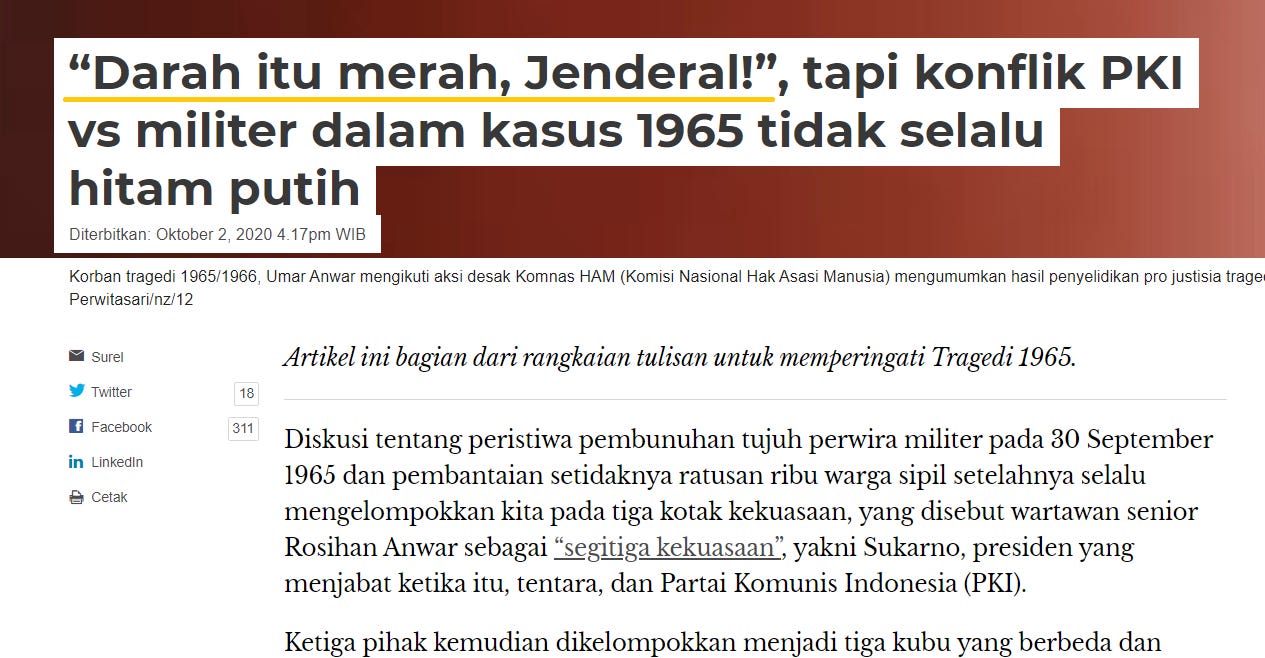
1. Darah itu merah, Jenderal! (Blood is red, General!)
2. Tempat ini tuh berantakan sekali deh! (This place is such a mess!)
3. Dia tu ibumu! Kamu tidak boleh seperti itu terhadap ibumu sendiri. (She’s your mother! You shouldn’t treat your own mother like that!) <-- [Tu] in this sentence functions as a linking verb, and [itu] refers to the actions that are already done before.
How to Pronounce Itu, Tu, and Tuh
Here is how you pronounce [itu] in Bahasa Indonesia.
And here is how you pronounce [tu].
And this is how you pronounce [tuh].
Next, let’s watch movie scenes where Indonesians say the word.
Examples of Itu in Use
The first example we are about to watch is from Di Bulan Suci Ini..., Season 1, Episode 1 (2023). Let’s watch the clip below.
Below is the transcript from the clip, along with the English translation:
Faisal: Stef! (Stef!)
Stefani: Apa? (What?)
Faisal: Burung. (A bird.)
Stefani: Mana? (Where?)
Faisal: Itu. (Over there.)
In this scene, Faisal points to a bird far away from him while riding his bicycle, and he uses [itu] while pointing to the bird.
The second example we are about to watch is from Najwa Shihab’s YouTube Channel. Let’s watch the clip below.
Below is the transcript from the clip, along with the English translation:
Najwa Shihab: Mas Anies, saya akan bertanya itu. Dan pertanyaannya sederhana saja. Soal kebebasan berpendapat, mas. (Mr. Anies, that’s what I want to ask you about. And it’s a simple question. It’s about freedom of speech.)
Anies Baswedan: Apa tuh? (What’s that?)
Najwa Shihab: Hmm, kalau diminta kasih skor, nilai 1 sampai 10. Seberapa atmosfir kebebasan berpendapat di negeri ini menurut Anda? (Hmm, if you had to give it a score from 1 to 10, how would you rate the climate for freedom of speech in this country?)
From the clip above, we see that there are [itu] and [tuh] being used by the speakers. [Itu] in [Mas Anies, saya akan bertanya itu] refers to the second usage of the word [itu] that I explained above, which is to refer to something that has already been spoken.
[Tuh] in [apa tuh?], you can change [tuh] into [itu], and it will become [apa itu?], and here it refers to the question that Najwa is going to ask Mr. Anies.
Vocabulary From the Clip
[Mas] is an honorific title used to address a male person older than you are. For more about this, you can read my article:
Mas In Indonesian

Halo semuanya. Ketemu lagi sama saya, Iman Prabawa. In this article, I want to talk to you about the word [mas] in bahasa Indonesia. You will hear this word a lot if you are in Indonesia, especially on Java Island.
[Bertanya] = to ask.
[Pertanyaan] = question.
[Sederhana] = simple.
[Soal] = about.
[Kebebasan berpendapat] = freedom of speech.
[Diminta] = being asked.
[Kasih] can have many meanings depending on the context, but in this context, [kasih] means to give.
The third example is from a TV Program called Tonight Show Net. Let’s watch the clip below.
For the conversation from the clip with English translations and vocabulary explanations, you can read my article titled Kulbet in Indonesian because this is from the same clip that is used there.
[Tu] in [kulbet tu apa sih?] is used to emphasize or refer to the third use that I have explained above. Here, actually, you can drop [tu], and it will become [kulbet apa sih?], but if you omit it, the emphasis is also gone.
[Itu] in [kulbet itu cool banget] is used to describe the subject or refer to the fourth use that I explained above.
The fourth example is a post from @komikbosque on Instagram. Let’s look at the picture below.

Below is the conversation from the comic, along with the English translations:
Cewe: Lho, itu kamu mau tidur pake jeans? (Wait, you’re going to sleep in your jeans?)
Cowo: Iya beb, kenapa? (Yeah, babe. Why?)
Cewe: Ga papa, beb.
[Itu] here refers to the third use that I explained above, which is to emphasize, and actually, you can drop the word [itu] there, and the meaning is not changed.
Vocabulary From the Picture
[Cewe] = girls.
[Cowo] = boys.
[Lho] is used when you are surprised. For more about this, you can read my article: Lho in Indonesian.
[Mau] = want.
[Pake] is informal for [pakai] = using.
[Ga papa] is informal for [tidak apa-apa] = it’s okay.
The fifth example is still from @komikbosque’s comics. Let’s look at the picture below.

Below is the conversation from the picture, along with the English translation:
Suatu hari.. (One day..)
Cewe 1: Udah putusin aja. Rehan itu psyco. (Just dump him already. Rehan is psycho.)
Cewe 2: Psyco? (Psycho?)
[Itu] here refers to the fourth meaning that I explained above, which is to describe the subject. [Rehan is psycho] has the same meaning as [Rehan = psycho].
Vocabulary From the Picture
[Udah] is a common reduction for [sudah] = already.
[Putusin] is the conversational way of saying [putuskan] = to dump someone.
[Aja] is a common reduction for [saja] = just.
If you found this article helpful and would like to support my work, you can buy me a coffee. Thank you for your support!
That wraps up today’s article. If you have any questions, leave them in the comments below, and I’ll be happy to answer them for you.
Thank you for reading my article, and I’ll see you soon.