

Halo semuanya, apa kabar? Ketemu lagi dengan saya, Iman Prabawa. This time, we are going to talk about the meaning of the phrase [bodo amat]. As always, we will also watch a scene from an Indonesian movie where this phrase is spoken.

Meaning of Bodo Amat
[Bodo] is informal for [bodoh], which means [stupid]. [Amat] means [very]. So, bodo amat in literal meaning means [very stupid].
But, there is another meaning of [bodo amat], which is very different than the literal meaning of [bodo amat].
When you say “bodo amat,” it means that, you don’t care what others think about you.
I found an Instagram post where this [bodo amat] is used. Let’s see the picture below.
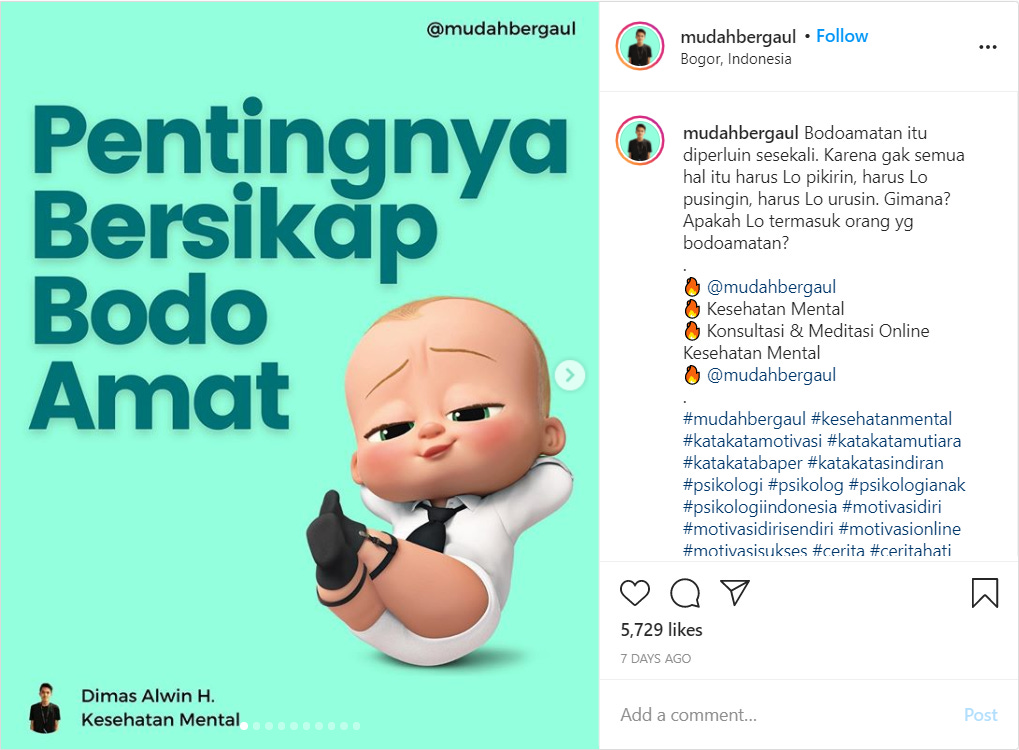
The headline says this:
Pentingnya bersikap bodo amat. (The importance of stopping caring what others think.)
There are also sentences using [bodo amat] and [bodo amatan] on the headline’s side. [Bodo amat] and [bodo amatan] mean the same thing. Let me translate those sentences.
Bodo amatan itu diperluin sesekali. Karena gak semua hal itu harus lo pikirin, harus lo pusingin, harus lo urusin. Gimana? Apakah lo termasuk orang yang bodo amatan? (Sometimes we need to not care about other people. Because not everything you need to think about, to care about, or to take care of. How about you? Are you one of those people who don’t give a fuck of things?)
Example Sentences Using Bodo Amat
Let’s look at three example sentences using [bodo amat] below.
Example sentence number 1:
Loe bodo amat sih jadi orang? Soal matematika kaya gini aja loe ngga bisa! (Oh, my God, you’re so stupid! You can’t even solve this simple math problem!)
Example sentence number 2:
Bodo amat! Emang gue pikirin! Terserah deh loe mau ngomong apaan. (Yeah, whatever! I don’t care! You can say whatever you want.)
Example sentence number 3:
Jangan jadi orang yang bodo amatan sama lingkungan sekitar loe dong. (Don't be a nonchalant person who doesn't care about your surroundings.)
In the example sentence number 1, [bodo amat] is used in its literal meaning, which means [very stupid].
How to Pronounce Bodo Amat
Here is how you pronounce [bodo amat] in bahasa Indonesia.
And this is how you pronounce [bodo amatan].
Next, we’re going to watch a clip from a movie where this phrase [bodo amat] is spoken.
Examples of Bodo Amat In Use
In this section, I will gather examples that I found from movies, YouTube videos, comics, and whatnot, where the phrase [bodo amat] is spoken
The first example is from a web series from Umay Shahab’s YouTube channel. Let’s watch the clip.
Conversation from the clip with English translations.
Rendra: Si Jiwo, mana sih ini semua? (Where is Jiwo, and all those guys?)
Vira: Eh, Panjul! Kenapa lu? (Hey, Panjul! What’s wrong?)
Rendra: Ah, lu abis darimana sih pada? (Where have you been, you guys?)
Alina: Eh, si knalpot racing muncul. (Here comes the miss chatterbox.)
Rendra: Ini ban belakang gue kempes. (I’ve got a flat tire.)
Vira: Ya elah! Eh, ini motor bagus. Kalah nih ama motor butut. Jalan normal terus. (Oh, please! Your bike is new and shiny, but it loses to this old bike. This bike doesn’t have any problems at all. )
Rendra: Bodo amat ah! (Yeah, whatever you say!)
Vira: Hihi.
Alina: Ih!
In this clip, Vira called him Panjul. This is common in Indonesia. Vira here was calling names to Rendra. She just picked random names that are usually not good to call her friend, Rendra.
Alina also called names to Vira. She called her [si knalpot racing], which literally means [motorcycle racing exhaust], and, in this context, the meaning of [si knalpot racing] is [miss chatterbox]. Motorcycle racing exhaust is really noisy, right? That’s why Alina called Vira that name because she talks all the time about trivial matters.
Vira was kind of mocking Rendra and saying that although her boyfriend’s motorbike was old compared to Rendra’s motorbike, her boyfriend’s motorbike didn’t have any problems at all. And then Rendra said this:
Bodo amat ah!
This context means Rendra didn’t give a damn about Vira’s words for him.
The second example is from an Indonesian FTV Serial, Cinta Dalam Dompet. Let's watch the clip below.
Conversation from the clip with English translations.
Reno: Dina, tunggu ya. Jelasin dulu ya. Ya? (Dina, wait a second. I will explain it to you.)
Dina: Udah cukup. Gue ngga mau denger apa-apa lagi. Mulai sekarang kita putus. (That’s enough. I don’t wanna hear anything. From now on, we break up.)
Reno: Dih, kok putus? Pacaran aja belum. Dina! Lihat! Gara-gara loe kan gebetan gue kabur. (What? Break up? We haven’t been in a relationship yet. Dina! See! Because of you, my crush is running away.)
Kinan: Bodo amat! Kok loe nyalahin gue? Yeee! Bye! (I don’t care! Why are you blaming me? Oh, please! Bye!)
In the clip, Reno’s crush saw him with another girl, and then she got jealous, and she said she wanted to break up with him, but they were not yet in a relationship. And then, when she was running away, Reno blamed Kinan for that.
Here, Kinan said this:
Bodo amat! (I don’t care!)
Kinan said this because she really didn’t care about what had just happened. Let’s learn vocabulary from the scene above.
Vocabulary From the Clip
[Jelasin dulu ya], this phrase actually is not complete. This sentence has no subject in it. The complete sentence is [aku jelasin dulu ya]. [Jelasin] is informal for [jelaskan], which means [to explain]. This is common in daily conversation in Indonesia.
[Udah] is short for [sudah]. It means [already]. [Udah cukup] means [that’s enough].
[Denger] is informal for [dengar], which means [to listen].
[Pacaran] is when there is a relationship between a man and a woman. In Indonesia, we call this [pacaran].
[Gebetan] is someone that you have a crush on.
[Kabur] means [running away].
[Nyalahin] is informal for [menyalahkan], which means [to blame].
The third example is from a TV Program called FTV: Bidadari From Angkot. Let's watch the clip below.
Conversation from the clip with English translations.
Rafael: Woi! Gimana sih loe bawa mobilnya?! Loe kalo bawa mobil, hati-hati dong! Ngga bisa rem sembarangan begitu. Kebiasaan banget ni supir angkot. (Hey! Watch your driving! You need to be careful when driving! You can’t just hit the brakes like that! This thing is common for public transportation drivers.)
Aisyah: Iya, iya, mas. Sorry. Gue minta maaf. (I’m so sorry, sir. I’ve messed up. Please, forgive me.)
Aldo: Cuy, cuy. Cewe, cuy! Cakep lagi! Jangan terlalu kenceng ah. (Bro, bro. It’s a woman, bro! And she’s pretty! Don’t be too hard on her.)
Rafael: Bodo amat! Emang ini udah kebiasaan supir angkot. Tahu ngga? Rem mendadak, rem mendadak, kan begini jadinya. (I don’t fucking care! You know what? This is the habit of public transportation drivers. Suddenly hit the brake, and this is the result.)
Aldo: Pelan-pelan. Kenapa mba ngerem mendadak? Jangan ngerem mendadak, dong. Jadi ditabrak deh tuh. (Calm down, man. Why did you suddenly hit the brakes? Please, don’t suddenly hit the brakes. As a result, your car got hit by us.)
Aisyah: Iya, iya, gue minta maaf. (I’m so sorry.)
In this scene, Aldo reminds his friend that the person whose car hit them is a woman, so he asks his friend not to be too hard on her. And then Rafael said:
Bodo amat!
In this context, it means that he doesn’t want to care about it. Now, let’s learn the vocabulary from the scene.
Vocabulary From the Clip
[Cuy] is a slang term. [Cuy] = bro.
[Kenceng] is informal for [kencang] = fast. [Jangan terlalu kenceng ah], if translated literally, means [don’t go too fast], but in this context, it means [don’t be too hard on her]. For example, 1. Bawa mobilnya jangan kencang-kencang dong. (Please don’t drive too fast.) So, context is important. Different contexts can have different meanings.
[Pelan-pelan] means [slowly], but in this context, it means [calm down]. Aldo was trying to calm his friend down. That’s why he said this phrase [pelan-pelan]. Example sentence for [pelan-pelan] that has a meaning [slowly]: 1. Bacainnya tolong pelan-pelan aja. (Please read it slowly.)
[Banget] = very.
[Cewe] is informal for [wanita]. It means a woman.
[Hati-hati] = be careful.
[Sembarangan] = carelessly.
[Angkot] is short for [ANGkutan KOTa] = public transportation.
[Cakep] = pretty.
[Emang] is informal for [memang] = indeed. You will hear it a lot in daily conversation.
[Gue] is informal for [saya] = I. For a more detailed explanation on this, you can read my article here:
Gue In Indonesian

Halo semuanya. Apa kabar? Ketemu lagi sama saya, Iman Prabawa. Today, we’re going to talk about what [gue] means in Indonesian. As always, I’ll show you some examples from movies, YouTube videos, comics, and other real-life situations where Indonesians use this word.
[Loe] is informal for [Anda] = you. For a more detailed explanation on this, you can read my article here:
Loe In Indonesian

Halo semuanya, apa kabar? Ketemu lagi sama saya, Iman Prabawa. In this article, I want to talk about the meaning of the word [loe] in bahasa Indonesia. Not only talk about the meaning of the word, but I will also show you some examples from movies and other real-life situations where Indonesians use this word.
The fourth example is from a talk show on The Tonight Show Net’s YouTube video. Let’s watch the clip below.
Conversation from the clip with English translations.
Dikta: Tapi kalo kucing tu kaya teman kosan, kan? Jadi, kalo kita tinggalin, dia bodo amat gitu kan? (Cats are like our roommate, right? If we left them, they don’t really care.)
Desta: Tapi kan suka berak sembarangan. (But, they like to pup anywhere they like.)
Dikta: Ngga, dong. Kucing itu binatang yang kalo mo pup, dia nyari pasir. (Nope. Cats are animals; when they want to pup, they will search for sand.)
Vincent: Oo. (I see.)
In this clip, Dikta explains the nature of cats, like, they really don’t care if we leave them. So, [bodo amat] here means [don’t care].
Vocabulary From the Clip
[Kalo] is the colloquial way of saying [kalau] = if.
[Tu] is short for [itu]. In conversational Indonesian, you will hear Indonesian people drop letters, syllables, and words when they speak. For more about this, you can read my article here: Itu, Tu, and Tuh In Indonesian.
[Teman] = friend.
[Kosan] or [kostan] is a rented room. Usually, you can rent for a minimum of one month.
[Tinggalin] is the colloquial way of saying [tinggalkan] = to leave (someone or something behind).
[Gitu kan?] is used when you want to emphasize what you just said or when you have doubts and ask for justification from others.
[Berak] is an informal word for [buang air besar] = defecate.
[Sembarangan] = at random
[Mo] is the colloquial way of saying [may] = want.
[Nyari] is the colloquial way of saying [mencari] = to search for.
If you found this article helpful and would like to support my work, you can buy me a coffee. Thank you for your support!
That’s gonna be it for today’s article. If you have any questions, feel free to leave them in the comments below. Thank you for reading my article, and I’ll see you soon.