

Halo semuanya, ketemu lagi sama saya, Iman Prabawa. In this article, I want to talk about the meaning of the phrase [sok tahu] in Indonesian. We’ll also look at examples, mostly from movies, where Indonesians use this phrase.
Meaning of Sok Tahu
The phrase [sok tahu] consists of two words: [sok] and [tahu]. The word [tahu] means [to know], while the word [sok] is used to describe someone who acts a certain way or pretends to be something they are not. When you put them together, you get a phrase with a different meaning.
[Sok tahu] describes someone who acts like they know something when they actually don’t. They pretend to be knowledgeable or experienced, even though they don’t really know what they are talking about.
In casual Indonesian, there is also a slang term for [sok tahu]: [sotoy]. It has exactly the same meaning, but [sotoy] is a more informal, slangy way of saying it.
Example Sentences Using Sok Tahu
1. Kalau ngga tahu jangan suka sok tahu deh, nanti malah berantakan lho! (If you don’t know what you’re doing, don’t pretend you do. You’re just going to mess things up!)
2. Dia emang suka kebiasaan, sok tahu kaya gitu! Tiba-tiba, ntar rusak aja komputer loe! (He’s always acting like he knows everything! He’s gonna end up breaking your computer!)
3. Orang yang sok tahu memang sering kali membuat kita sebal. (People who act like they know everything can be really annoying.)
As you can see from these examples, [sok tahu] is often used when someone acts like an expert but doesn’t actually know what they are talking about. It can also express annoyance with someone who keeps pretending to know everything.
How to Pronounce Sok Tahu
Here is how you pronounce [sok tahu] in Bahasa Indonesia.
Next, let’s watch some examples of Indonesians using the phrase [sok tahu] in everyday conversations.
Examples of Sok Tahu In Use
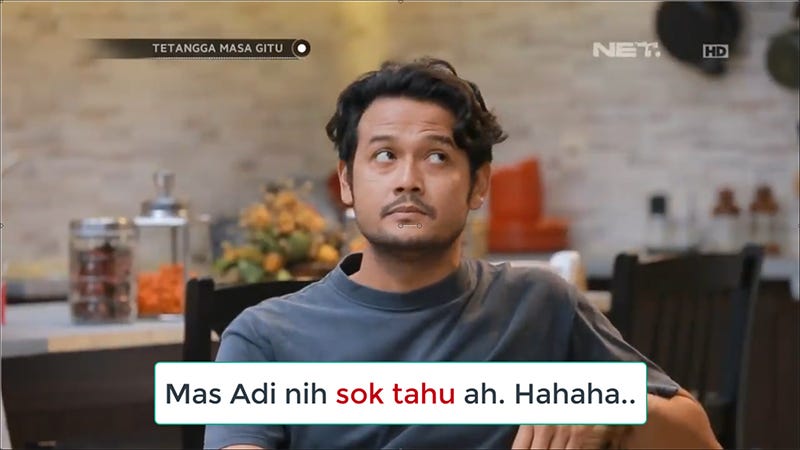
The first example we are about to watch is from a TV Serial, Tetangga Masa Gitu (2014). Let’s watch the clip below.
Below is the transcription from the clip, along with the English translation:
Bastian : Mas Adi nih sok tahu ah. Hahaha.. Mas Adi kan baru kenal Bintang sehari. Lagian kalau istri saya tuh udah bilang ide brilian, dia pasti setuju kok soal meja pingpong. Hehehe.. (Oh, come on, Mas Adi. Don’t be such a know-it-all! Hahaha. You’ve only known Bintang for a day. Besides, if my wife says my idea is brilliant, she’ll definitely be on board with the ping-pong table. Hehehe.)
Adi: Mungkin saya kenal kalian baru sehari, ya. Tapi saya sudah menikah sama istri saya sejak kalian masih SD. Dan pernikahan itu tidak semudah yang ada di kepala kamu, anak muda! (Maybe I’ve known you guys for a day, but I’ve been married to my wife since you two were still in elementary school. And marriage isn’t as easy as you think, young man!)
There are two men in this scene, Bastian and Adi. Adi was trying to explain something to Bastian because he thought that he knew more than Bastian. And then Bastian could not accept that and thought that Adi was being a Mr.Know-It-All.
Vocabulary From the Clip
[Baru] = new.
[Kenal] = know.
[Baru kenal (someone)] is when you just get to know someone for a short while.
[Sehari] = [satu hari] = one day.
[Istri] = wife.
[Setuju] = agree.
[Udah] is a common reduction of [sudah] = already.
[Meja] = table.
[Mungkin] = maybe.
[Menikah] = marry.
[SD] stands for Sekolah Dasar = elementary school.
[Pernikahan] = marriage.
[Kepala] = head.
[Anak muda] = young man.
The second example is from a TV series, Mimpi Metropolitan, Episode 1 (2019). Let’s watch the clip below.
Below is the trancript from the clip, along with the English translation:
Bambang: Mas Alan. Dari tadi kita jalan keliling-keliling, kok ngga sampe-sampe juga ke kosnya mas Alan? Jangan-jangan salah, mas. Kosan mas bukan di sini, tapi di sana. (Alan, we’ve been walking around in circles this whole time. How come we still haven’t reached your place? Are you sure we’re going the right way? Maybe your place isn’t here but over there.)
Alan: Kau ini macam mana pula? Yang ngekos itu aku bukan kau, jadi kau jangan sok tahu. Aku memang sengaja, ngajak kau putar-putar dulu, ngga langsung sampe ke kosan. Biar kau tahu daerah sekitar sini. Kau tengok tuh, sebelahku ini. Itu ada warung. Nanti kalau kau mau jajan, kau boleh ke sini. Atau kau mau beli pulsa? Tuh! Di sana ada konter hape. (What are you talking about? I’m the one who lives here, not you, so don’t act like you know everything. I did this on purposes. I wanted to show you around the neighborhood instead of taking you straight to my place, so you’d get to know the area. Look, see that shop on my left? You can go there whenever you want to grab a snack or buy something. Or maybe you need to top up your phone credit? Look! There’s a phone shop over there.)
In this scene, Bambang is new to Jakarta. He meets Alan, and the two become friends. Alan then invites Bambang to his boarding house. As they walk, Bambang starts wondering why they still haven’t reached Alan’s place. He suspects they might be lost.
Of course, Alan knows exactly how to get to his own boarding house. That’s why he responds by saying:
Yang ngekos itu aku, bukan kau, jadi kau jangan sok tahu.
Alan is basically telling Bambang not to act like a know-it-all by saying, “Jangan sok tahu.” After all, Alan is the one who lives there, so he knows the area better than Bambang does. Alan then explains why he hasn’t taken Bambang straight to his boarding house. Instead, he’s been showing Bambang around the neighborhood so he can get familiar with the area.
Vocabulary From the Clip
[Mas] is an honorific title to address older men or strangers you meet on the street. For more on this, you can read this article:
Mas In Indonesian

Halo semuanya. Ketemu lagi sama saya, Iman Prabawa. In this article, I want to talk to you about the word [mas] in bahasa Indonesia. You will hear this word a lot if you are in Indonesia, especially on Java Island.
[Dari tadi] = from earlier.
[Jalan] = walk.
[Keliling-keliling] = walking around.
[Sampe] is the colloquial way of saying [sampai] = until, reach the destination.
[Kos] or [kos-kosan] is a house where rooms in the house are rented to people. They usually rent the room for a minimum of a month.
[Jangan-jangan (something-something)] is usually used when you are making an assumption about something. You are just blindly guessing about something.
[Kau ini macam mana pula?] is usually said to a person if the person is doing something awful, and in this scene, Bambang doubts Alan and makes a guess that they are lost because they never reached the destination, and then Alan says this phrase, which in this context means like, “What the hell, man?” or, “Just shut up! I know where I’m headed.”
[Ngekos] is a person who rents a room in a boarding house.
[Warung] is a very small shop. It usually sells groceries.
[Jajan] is to buy something, usually something small like candy, drinks, and fast food.
[Pulsa] = phone credit.
[Konter hape] = mobile phone shop.
[Kau boleh ke sini] = [Anda bisa ke sini] = You can come here.
The third example is from a movie called Komedi Modern Gokil (2015). Let’s watch the clip below.
Below is the transcript from the clip, along with the English translation:
Dodit: Berarti bener di sini Ris alamatnya. (So, the address is right, Ris. This is the place.)
Maid: Oh, mau ngekos di sini, ya? (Oh, you guys are looking to rent a room here?)
Boris: Betul mba, betul, betul, betul. (That’s right, ma’am. That’s right, right, right!)
Maid: Follow me. (Follow me.)
Boris: Aku follow you. (I’ll follow you.)
Dodit: Aku follow juga. (Me too.)
Boris: Mba, ngekos di sini juga, ya? (Do you rent a room here too, ma’am?)
Maid: Ih, bukan mas. Saya ini asisten rumah tangga. (No. I don’t. I’m the housekeeper here.)
Dodit: Oh. Pasti namanya Inem. (Oh. Your name must be Inem, then.)
Maid: Bukan! Sok tahu! (No! Don’t be such a know-it-all!)
Dodit: Kok sexy? (Then why are you so sexy?)
Maid: Huh. (Huh!)
In this scene, Dodit tries to guess the maid’s name and says:
Pasti namanya Inem. (Your name must be Inem, right?)
His guess is completely wrong, which is why the maid responds:
Sok tahu! (Don’t be such a know-it-all!)
As you can see, [sok tahu] describes someone who acts as if they know something when, in fact, they don’t know what they are talking about.
Vocabulary From the Clip
[Berarti] literally means [mempunyai arti] or [have meanings], but in this context, its function is like [so] in English.
[Bener] is the colloquial way of saying [benar] = true, right.
[Mba] is an honorific title to address older women or strangers on the street. For more on this, you can read this article:
Mbak In Indonesian

Halo semuanya. Apa kabar? Ketemu lagi sama saya, Iman Prabawa. In this article, I want to talk to you about the meaning of the word [mbak] in bahasa Indonesia.
[Bukan] is used when you deny something.
[Asisten rumah tangga] = [pembantu rumah tangga] = maid.
The fourth example is from a movie, Dating Queen, Episode 1 (2022). Let’s watch the clip below.
In the scene above, Dina says:
Adik sepupuku yang paling sok tahu. (My younger cousin, who thinks she knows everything.)
In this scene, Dina is talking about her younger cousin, who always acts like she knows everything. That’s why she describes her as [sok tahu].
If you found this article helpful and would like to support my work, you can buy me a coffee. Thank you for your support!
That’s a wrap. If you have any questions, just leave them in the comments below, and I’ll be happy to answer them for you.
Thank you for reading my article, and I’ll see you soon. Bye now!