

Halo semuanya, ketemu lagi sama saya, Iman Prabawa. In this article, I want to talk to you about the meaning of PR in Indonesian. As always, we are going to be watching examples from YouTube videos, movies, comics, and whatnot where Indonesians use the word.

Pr, Pe Er, or Pe-Er in Indonesian
PR stands for Pekerjaan Rumah, which literally means “housework” or “work to be done at home.” In Indonesian, however, PR is commonly used to mean homework, especially homework assigned by a teacher at school.
Sometimes you may also see it written as pe er, pe-er, or peer. They all refer to the same word, PR.
1. PR means homework.
The first and most common meaning of PR is homework, such as an assignment given by a teacher.
Example:
Kamu udah ngerjain PR belum? (Have you done your homework yet?)
Here, PR simply means homework.
2. PR means something that still needs to be done, learned, fixed, or improved.
PR can also be used figuratively to describe something that you still need to work on, learn, fix, or improve.
The idea is similar to having homework: there is something that has been left for you to work on.
Example 1:
Hal ini masih menjadi PR buat saya untuk bisa menjadi orang yang lebih baik. (This is something that I still need to work on to become a better person.)
In this sentence, PR doesn’t mean actual homework. It means something that the speaker still needs to work on or improve.
Example 2:
PR UI masih banyak. (There are still a lot of things that need to be fixed at UI.)
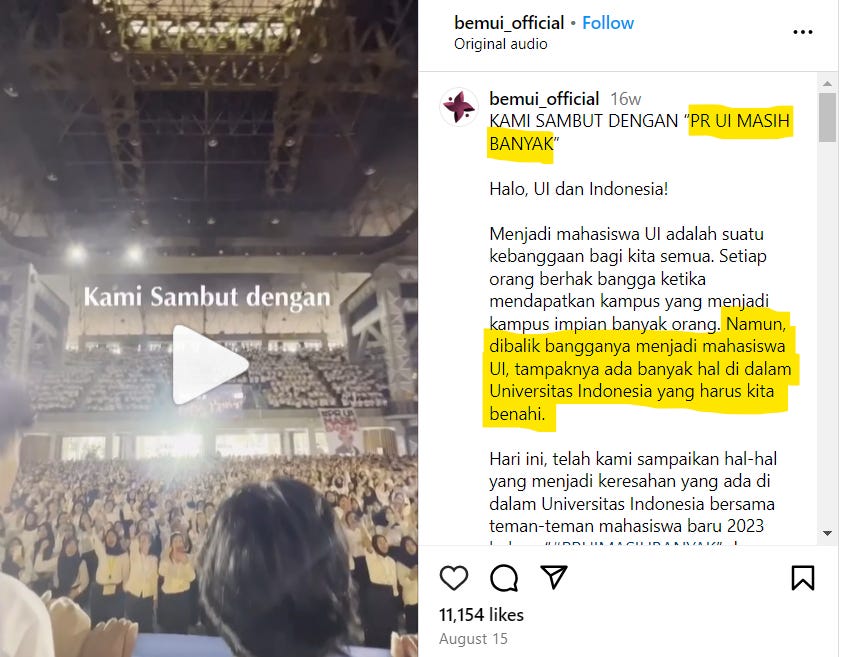
Let’s look at the picture above. In the sentence shown in the picture, we can see:
Namun, di balik bangganya menjadi mahasiswa UI, tampaknya ada banyak hal di dalam Universitas Indonesia yang harus kita benahi. (However, despite the pride of being a UI student, there still seem to be many things within the University of Indonesia that we need to fix.)
This sentence explains that there are still many things at UI that need to be improved or fixed. UI stands for Universitas Indonesia (University of Indonesia).
Example 3:
Pe er banget sih ini buat saya juga. Anak-anak digedein bareng di satu rumah aja beda-beda banget hasilnya ya, dan itu tanda memang nggak boleh berhenti belajar jadi orang tua. (This is something that I still really need to learn, too. Even though the children are raised together in the same house, the results can be so different, and that’s a sign that we can never stop learning how to be better parents.)

Here, pe er banget means that something is a big challenge or something the speaker still has a lot to learn about.
3. PR means something troublesome or bothersome.
PR can also be used to describe something that is troublesome, inconvenient, or a hassle.
This meaning is especially common when talking about a problem that someone has to deal with.
Example 1:
PR banget motor matik terasa berat saat didorong. Mari kenali penyebabnya! (It’s such a hassle when your automatic motorcycle feels heavy when you try to push it. Let’s find out what causes it!)
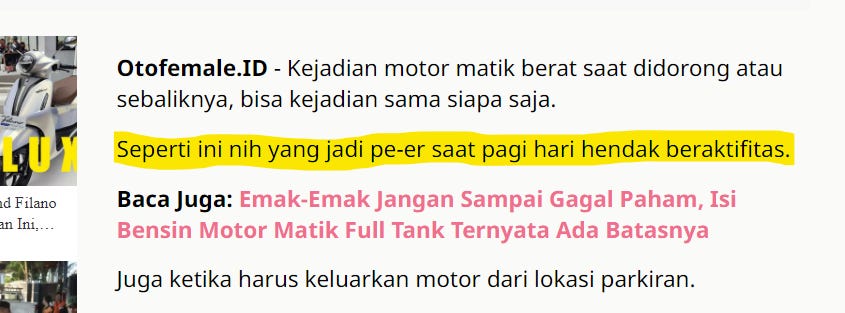
Here, PR banget means that the problem is quite a hassle or troublesome to deal with.
Example 2:
Kejadian motor matik berat saat didorong atau sebaliknya, bisa kejadian sama siapa saja. Seperti ini nih yang jadi pe-er saat pagi hari hendak beraktifitas. (Having an automatic motorcycle that feels heavy when you try to push it can happen to anyone. This is the kind of hassle you don’t want to deal with when you’re trying to get ready for the day in the morning.)
In this example, pe-er refers to a problem or inconvenience that someone has to deal with.
So, depending on the context, PR can mean homework, something you still need to work on, or a troublesome problem that needs to be dealt with.
How to Pronounce PR
Here is how you pronounce PR in Bahasa Indonesia.
Next, let’s look at examples where Indonesians use the word PR.
Examples of PR in Use
The first example we are about to watch is from Bobo Cantik’s YouTube Channel. Let’s watch the clip below.
Below is the transcript from the clip, along with the English translation:
Bobo Cantik: Dan mungkin sedikit masukan buat Alinson. Harus ada yang jaga stafnya di sini. Jadi, kalo misalnya kita mo lewat, ngga papasan sama orang, karena kalo papasan di spot ini agak PR banget ya. (And maybe I have a little suggestion for Alinson. There should be someone from their staff standing by here. That way, if we want to pass through, we won’t run into someone coming from the opposite direction, because if we meet another vehicle at this spot, it can be pretty tricky to get through.)
PR is this clip refers to the third meaning I explained above, which is a troublesome problem that needs to be dealt with.
Vocabulary From the Clip
[Dan] = and.
[Mungkin] = maybe.
[Sedikit] = a little.
[Masukan] = input.
[Buat] = [untuk] = for.
[Jaga] = stand by, guard.
[Kalo] is informal for [kalau] = if.
[Mo] is informal for [mau] = want.
[Lewat] = pass.
[Ngga] = [tidak] = no.
[Papasan] = meet someone or something by accident from the opposite direction. For example, you are driving a car, and then you meet other vehicles from the opposite direction. This is called [papasan].
[Banget] = very. For more on this, you can read this article:
Banget In Indonesian

Halo semuanya, ketemu lagi sama saya, Iman Prabawa. In this article, I want to talk to you about the meaning of the word [banget] in Indonesian. As always, we will also watch examples from movies where the word [banget] is spoken by Indonesians to better understand the meaning and how to use this word.
The second example is taken from Tekotok’s YouTube Channel. Let’s watch the clip below.
Below is the transcript from the clip, along with the English translation:
Pak Guru: Ayo, anak-anak. PR IPAnya dikumpulkan ke meja guru. Ayo, ayo, ayo. (All right, kids. Hand in your science homework on my desk. Come one, come on, come on.)
Bejo: Pak, nyerah, Pak, nyerah, Pak. (Sir, I give up! I give up, sir!)
Pak Guru: Napa lu? (What’s with you?)
Bejo: Nyerah, Pak. Saya serahkan diri, Pak. Saya ngga ngerjain PR. Damai, Pak, damai. Ini lambang perdamaian, Pak. (I surrender, sir. I’m turning myself in. I didn’t do my homework. Peace, sir, peace! This is a symbol of peace, sir.)
Pak Guru: Ya ampun, Bejo! Kamu lagi! Kamu lagi! Bentar. (Oh, my God, Bejo! You again?! You again! Hold on.)
PR in this clip refers to the first meaning that I explained above, which is homework.
Vocabulary From the Clip
[Ayo] in this context is a word that you use to tell someone to hurry.
[Anak-anak] = kids.
[IPA] stands for Ilmu Pengetahuan Alam = science.
[Pak Guru] = male teacher.
[Nyerah] is short for [menyerah] = surrender.
[Pak] is an honorific title you use to address a man. That person is usually already married. For more on this, you can read this article:
Pak In Indonesian

Halo semuanya. Apa kabar? Today, I want to talk to you about the meaning of the word [pak] in the Indonesian language. We are also going to watch a video where the word [pak] is spoken by Indonesians.
[Napa] is short for [kenapa]. [Kenapa] in this context is used to ask what is wrong with something. In this clip, it is written as [nape], and it has the same meaning. [Nape] is usually said by people from Jakarta.
[Lu] is informal for [Anda] = you. For more on this, you can read this article:
Loe In Indonesian

Halo semuanya, apa kabar? Ketemu lagi sama saya, Iman Prabawa. In this article, I want to talk about the meaning of the word [loe] in bahasa Indonesia. Not only talk about the meaning of the word, but I will also show you some examples from movies and other real-life situations where Indonesians use this word.
[Ngerjain] is the colloquial way of saying [mengerjakan] = to do something. [Saya ngga ngerjain PR] = [saya tidak mengerjakan PR] = I didn’t do my homework.
[Lambang] = symbol.
[Damai] = peace, silent.
[Perdamean] = [perdamaian] = peace.
[Ya ampun] are words that are used when you are angry or surprised.
[Kamu] = you.
[Lagi] = again.
[Bentar] is a common reduction of [sebentar]. In this context, this word is used to tell someone to wait for a little while.
The third example is taken from a story on Wattpad. Let’s look at the picture below.
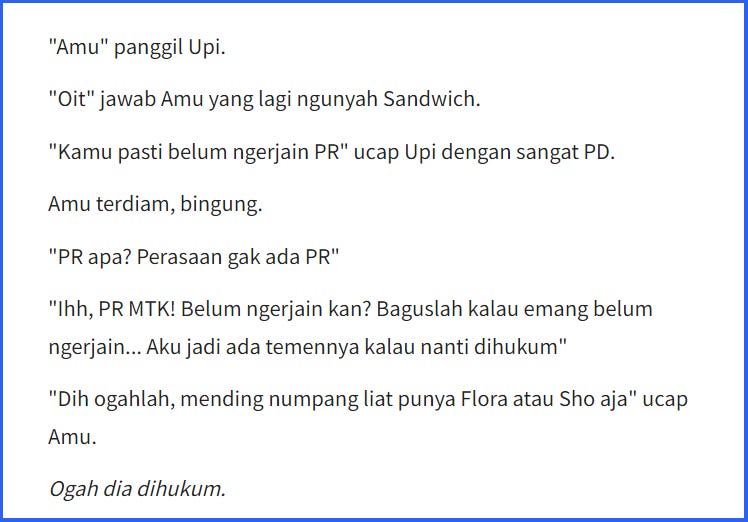
Below is the convo above, along with the English translation:
“Amu” panggil Upi. (”Amu,” Upi called.)
“Oit” jawab Amu yang lagi ngunyah Sandwich. (”Oit,” Amu replied, munching on a sandwich.)
“Kamu pasti belum ngerjain PR” ucap Upi dengan sangat PD. (”You definitely haven’t done your homework,” Upi said with complete confidence.)
Amu terdiam, bingung. (Amu fell silent, looking confused.)
“PR apa? Perasaan gak ada PR” (”What homework? I didn’t know we had any.”)
“lhh, PR MTK! Belum ngerjain kan? Baguslah kalau emang belum ngerjain... Aku jadi ada temennya kalau nanti dihukum” (”Oh, the math homework! You haven’t done it, have you? Well, that’s actually great. At least, I’ll have someone to keep me company when we get punished later.”)
“Dih ogahlah, mending numpang liat punya Flora atau Sho aja” ucap Amu. (”Yeah, right. No way. I’d rather copy Flora’s or Sho’s,” Amu said.)
Ogah dia dihukum. (She definitely didn’t want to get punished.)
PR in this conversation refers to the first meaning that I explained above, which is homework.
Vocabulary From the Picture
[Ngunyah] is a common reduction of [mengunyah] = munching.
[PD] stands for Percaya Diri = confident. For more on this, you can read my article: PD in Indonesian.
[Gak] = [tidak] = no.
[MTK] stands for MaTematiKa = math.
[Kan] is used when you are sure about something. For more on this, you can read my article: Kan in Indonesian.
[Emang] is a common reduction for [memang] = indeed.
[Dih] is used to express feelings of disgust.
[Ogah] is used when you don’t want to do something. For more on this, you can read my article: Ogah in Indonesian.
If you found this article helpful and would like to support my work, you can buy me a coffee. Thank you for your support!
That’s gonna be it for now. If you have any questions, please leave them in the comments below. I’ll be happy to answer them for you.
Thank you for reading my article, and I’ll see you soon. Bye now!