

Halo semuanya, ketemu lagi sama saya, Iman Prabawa. Today, I'm going to talk about the meaning of the words [sebel] and [sebal] in bahasa Indonesia. We are also going to be watching examples from movies, YouTube videos, and whatnot where the word [sebel] is used by Indonesians.
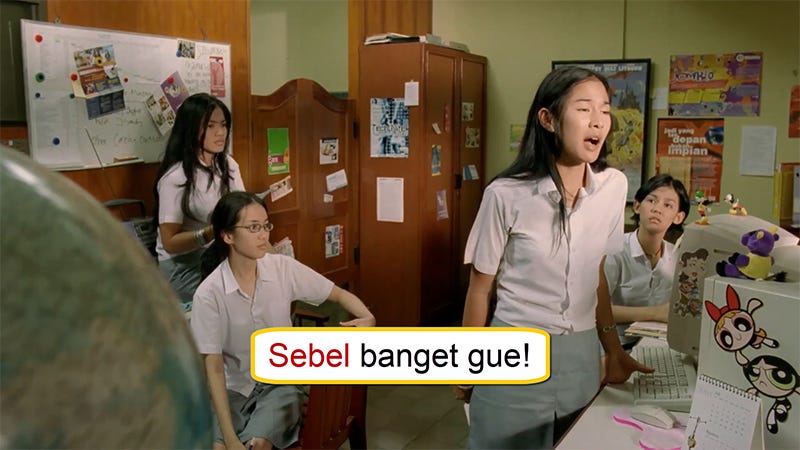
Sebel and Sebal in Indonesian
[Sebel] is informal for [sebal]. [Sebal] is a state where you feel annoyed, disappointed, or not happy with something or someone, and you also feel angry at the same time.
Example sentences using the word [sebel] or [sebal]:
Loe sebel-sebel sama dia, tapi sekarang kangen. Gimana sih? (You used to be so annoyed with him, but now you miss him. What’s up with that?)
Jangan terlalu sebel sama dia, ntar loe jadi suka lho! (Don’t hate him too much—you might end up falling for him!)
Pelayanan di sini bikin sebal! (The service here sucks!)
In daily conversation, you will hear it pronounced mostly as [sebel]. [Sebal] is usually used in a more formal setting or in your textbooks.
How to Pronounce Sebel and Sebal
Here is how you pronounce [sebal] in Bahasa Indonesia.
And here is how you pronounce [sebel] in Bahasa Indonesia.
Moving on, let’s watch examples where Indonesians use the words [sebel] and [sebal].
Examples of Sebel in Use
The first example we are about to watch is taken from a movie called Ada Apa Dengan Cinta 1 (2002). Let’s watch the clip below.
Below is the transcript from the clip, along with the English translation:
Maura: Ta, emangnya loe diapain sih? (Ta, what did he actually do to you?)
Karmen: Loe dipegang-pegang Ta ama dia? (Did he, like, touch you or something?)
Cinta: Gila, loe! Jangan ampe lah gue dipegang-pegang ama dia! (Are you crazy? No way I’d let him touch me!)
Alya: Ta, Ta! Tarik nafas dulu, Ta. Biar loe bisa ngomong yang bener. (Ta, Ta! Take a breath first. Calm down so you can tell us properly.)
Cinta: Sebel banget gue! Orangnya tu sok bintang, tau ngga loe? (Ugh, I’m so pissed off! That gur acts like he’s some kind of superstar, you know?)
Milly: Kita lagi ngomongin siapa sih? (Wait, who are we even talking about?)
In this scene, Cinta is upset with a boy named Rangga. That is why she says, “Sebel banget gue!” in that clip.
She wants to interview Rangga because he won the poetry competition held at their school, but Rangga refuses to be interviewed because he doesn’t feel like he sent any poetry to that competition. It was Pak Wardiman who sent Rangga’s poem to that contest because he thought Rangga’s poem was amazing. Pak Wardiman is an office boy in their school, and Rangga is close to him.
Let’s learn vocabulary from the short clip above.
Vocabulary From the Clip
[Emangnya] is short for [memangnya] and is used when you want to ask about something.
[Diapain] in this context has the same meaning as [diperlakukan seperti apa] = how are you being treated (by someone).
[Sih] has no meaning. Its function is just to emphasize. For more about this, you can read this article:
Sih In Indonesian

Halo semuanya. Apa kabar? Ketemu lagi sama saya, Iman Prabawa a.k.a Pak Guru Iman. In this article, I want to talk to you about the meaning of the word [sih] in Indonesian. As always, we are also going to be watching examples from movies, comics, and others to better understand the meaning and to see how Indonesians use the word [sih] in their daily con…
[Ama] is short for [sama] = with. In daily conversation, it is common for native speakers to drop letters when speaking.
[Dipegang-pegang] literally means to be touched. In this context, it means that you are being sexually harassed by someone.
[Ampe] is short for [sampe]. [Sampe] is informal for [sampai] = until.
[Gue] is informal for [saya] = I. For more about this, you can read this article:
Gue In Indonesian

Halo semuanya. Apa kabar? Ketemu lagi sama saya, Iman Prabawa. Today, we’re going to talk about what [gue] means in Indonesian. As always, I’ll show you some examples from movies, YouTube videos, comics, and other real-life situations where Indonesians use this word.
[Loe] is informal for [Anda] = you. For more about this, you can read this article:
Loe In Indonesian

Halo semuanya, apa kabar? Ketemu lagi sama saya, Iman Prabawa. In this article, I want to talk about the meaning of the word [loe] in bahasa Indonesia. Not only talk about the meaning of the word, but I will also show you some examples from movies and other real-life situations where Indonesians use this word.
[Tarik nafas] = [tarik napas], but sometimes you will hear Indonesians say it as [tarik nafas] instead of [tarik napas], just like in the short clip above. [Tarik napas] = take a breath.
[Tu] is short for [itu] = that. For more about this, you can read this article:
Itu, Tu, and Tuh in Indonesian

Halo semuanya, ketemu lagi sama saya, Iman Prabawa. In this article, I want to talk about the meaning of [itu], [tu], and [tuh] in Indonesian. And as always, we are going to be watching examples from movie scenes and whatnot where the word is spoken by Indonesians.
[Bintang] literally means star, but in this context, it means superstar.
[Ngomongin] is the colloquial way of saying [membicarakan] = talking about something.
[Gila] literally means crazy. For more about this, you can read my article: Gila in Indonesian.
If you found this article helpful and would like to support my work, you can buy me a coffee. Thank you for your support!
That wraps up today’s article. If you have any questions, just leave them in the comments below, and I’ll be happy to answer them.
Thank you for reading my article, and I’ll see you soon. Bye for now!